










Expert Assessment: Militarization Concerns Raised Over US Parade
In a notable commentary on the evolving landscape of American society, David L. Phillips, an esteemed adjunct professor of Security Studies at Georgetown University, has drawn attention to a significant event as a potential indicator of a deeper trend. Professor Phillips specifically pointed to the recent military parade held in Washington D.C. as a prominent signpost suggesting an increasing militarisation of US society.
The observation from a scholar with a focus on security studies carries particular weight, offering a perspective rooted in academic analysis of geopolitical trends and their domestic reflections. The concept of societal militarisation is complex, often referring to the process by which military values, structures, and priorities become increasingly embedded in civilian institutions, culture, and public life. It is not merely about the strength of the armed forces, but about the pervasive influence and normalization of military symbols, rhetoric, and viewpoints within the civilian sphere.
The Significance of the Washington D.C. Military Parade
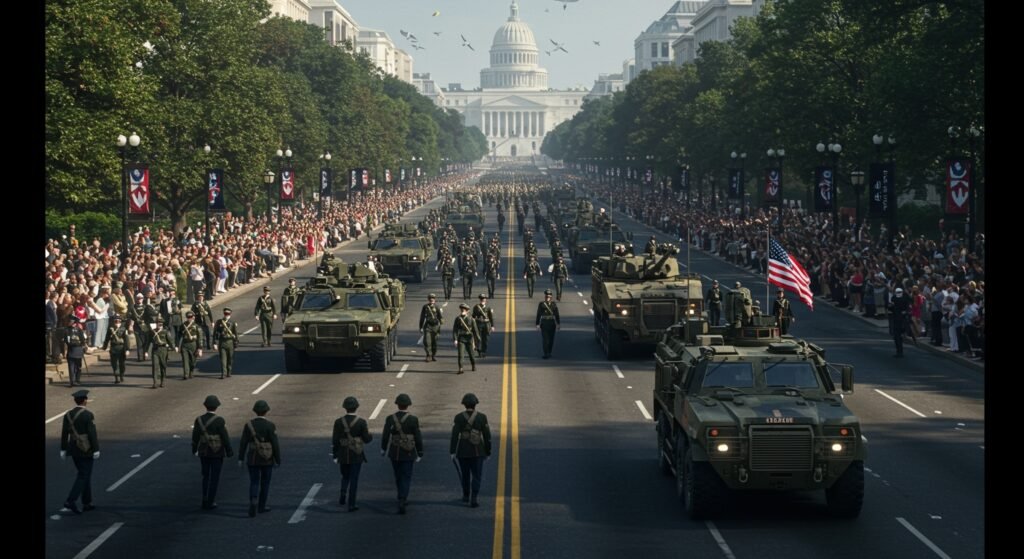
The military parade in Washington D.C., the nation’s capital, served as the specific event highlighted by Professor Phillips. Such parades, while common in some nations as displays of national strength and military prowess, have historically been less frequent or prominent features of public life in the United States compared to other forms of national celebration. The decision to hold a large-scale military display involving troops, vehicles, and equipment in the heart of Washington D.C. is, in this expert’s view, more than just a ceremonial event.
According to the perspective shared by Professor Phillips, the parade acts as a tangible manifestation of military presence and visibility being brought into the civilian public domain in a highly conspicuous manner. It is the public display of instruments of war and personnel associated with combat and defense, presented for civilian consumption and national spectacle. This visibility, he suggests, contributes to the normalization and potentially the valorisation of military power and identity within the broader civilian population.
Underlying Trends and Indicators
The military parade, in this analysis, is not presented as the sole cause of societal militarisation but rather as a particularly visible indication of an ongoing process. While Professor Phillips specifically cited the Washington D.C. event, the broader concept of increasing militarisation can encompass a range of phenomena. These might include, but are not limited to, the growing prominence of military figures in civilian leadership roles, the increasing alignment of civilian industries with defense priorities, the portrayal of military themes in popular culture, and the expansion of military-style training and equipment into civilian law enforcement.
The core argument articulated by the adjunct professor from Georgetown University’s Security Studies program is that the decision to showcase military might in a public, ceremonial fashion within the nation’s capital reflects a societal shift. It suggests a potential blurring of the lines between the civilian and military spheres, where the overt display of military power becomes a more accepted or even celebrated part of the national identity and public consciousness.
Academic Perspective from Georgetown University
David L. Phillips’s position as an adjunct professor of Security Studies at Georgetown University lends academic credibility to his observation. Security Studies is a field that examines the complexities of conflict, peace, and the various factors that contribute to national and international security. Experts in this field often analyze how military power intersects with political, social, and cultural dynamics. From this vantage point, a public display like a military parade can be interpreted not just as a logistical event, but as a symbolic act with potential implications for civil-military relations and societal values.
Professor Phillips’s focus on this particular event underscores the idea that even seemingly isolated incidents can serve as barometers for larger societal or political currents. The parade in Washington D.C., therefore, is presented not as an anomaly, but as a revealing symptom within the framework of increasing societal militarisation in the United States.
Conclusion: Interpreting the Signs
The statement by David L. Phillips, adjunct professor of Security Studies at Georgetown University, serves as a pointed observation on the state of American society. By highlighting the military parade in Washington D.C., he offers a specific, public event as evidence supporting his assertion of an increasing militarisation trend. This perspective encourages a critical examination of how military presence and symbols are integrated into civilian life and what that integration signifies for the future direction of the nation’s societal values and civil-military balance. His analysis suggests that such public displays warrant careful consideration as indicators of broader shifts within the fabric of US society.
The details provided, specifically referencing David L. Phillips, his role at Georgetown University within Security Studies, and the military parade in Washington D.C. as the central piece of evidence for the increasing militarisation of US society, form the foundation of this expert assessment.
More Stories
Lowriding’s Rise: SF Celebrates Cruising Culture
U.S. Repatriates 64 Cultural Relics and Fossils to China
Betting on Viral Fame: Novig’s Strategic Use of Sydney Sweeney