











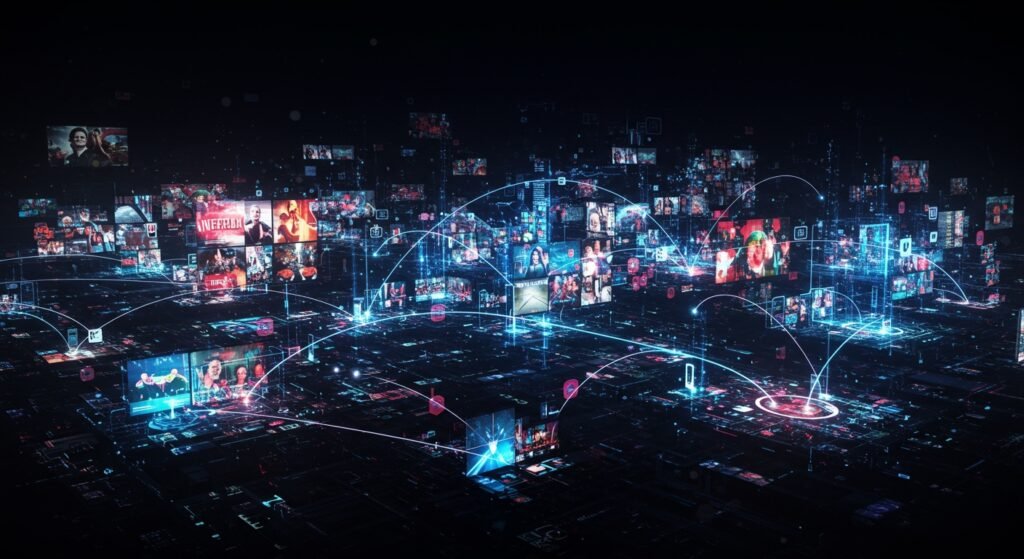
Technology is fundamentally transforming the global entertainment industry at an unprecedented pace, altering how content is consumed, interacted with, and created. This digital revolution is not only generating new opportunities for creators but is also significantly reshaping audience expectations. Traditional media organizations are actively adapting to this rapidly evolving digital landscape to remain relevant and reach audiences in new ways.
The Rise of Streaming Platforms
One of the most significant drivers of this transformation is the proliferation and dominance of streaming platforms. Services such as Netflix, Disney+, and Amazon Prime have not merely changed what people watch but how they watch it. By offering vast libraries of content on demand, these platforms have fundamentally shifted viewing habits away from traditional broadcast schedules towards a more personalized, anytime-anywhere model. This shift has also popularized the phenomenon known as binge-watching, where viewers consume multiple episodes or even entire seasons of a show in a single sitting.
Beyond distribution, these platforms have become major content producers themselves, investing heavily in original programming across diverse genres. This dual role as distributor and producer has given them immense influence over cultural trends and consumption patterns worldwide.
Enhancing the Viewing Experience
The expansion of streaming capabilities is heavily reliant on advancements in underlying infrastructure. Improved internet infrastructure, including faster broadband speeds and more ubiquitous Wi-Fi access, enables seamless streaming of high-definition content. Simultaneously, the evolution of smart TV technology has integrated streaming services directly into living rooms, making access more convenient than ever.
These technological advancements enhance the viewing experience with features like high-resolution streaming, notably 4K resolution, which offers unparalleled picture clarity. Furthermore, capabilities such as offline viewing allow subscribers to download content for consumption without an internet connection, while multi-device synchronization ensures a consistent viewing experience across smartphones, tablets, computers, and smart TVs.
The Gaming Industry’s Explosive Growth
The gaming industry has also experienced remarkable growth and transformation fueled by technology. Once primarily a solitary or local multiplayer activity, gaming has been profoundly reshaped by online platforms that connect players globally. Mobile gaming has become a massive segment, accessible on devices carried by billions worldwide, democratizing participation.
Cloud gaming services represent another frontier, promising the ability to play high-end games on less powerful hardware by streaming the game processing from remote servers. This technological shift lowers the barrier to entry for complex games. Moreover, esports, or competitive video gaming, has emerged as a major industry, complete with professional players, teams, leagues, large-scale tournaments, and substantial prize pools, transforming gaming into a significant platform for community and social interaction on a global scale.
Interactive Entertainment and New Realities
Technology is also driving the growth of interactive entertainment, blurring the lines between viewer and participant. Technologies like motion capture and real-time rendering, initially prominent in film and gaming, are increasingly being used to create dynamic, responsive content. This allows for experiences where viewers can potentially influence storylines or outcomes, offering a deeper level of engagement than passive consumption.
Beyond direct narrative influence, technology facilitates interactive elements such as virtual fan experiences, which might include attending virtual concerts or events, and second-screen interactions, where viewers use a separate device (like a smartphone or tablet) to access supplementary content, participate in polls, or interact with other viewers while watching a main screen.
Social Media as Entertainment Hubs
Social media platforms, once primarily for social networking, have evolved into powerful entertainment hubs. Platforms like TikTok exemplify this shift, enabling new forms of content creation, particularly through short-form video and live-streaming. These formats allow individuals to become creators and broadcasters with relatively low barriers to entry, effectively democratizing content creation.
Social media has also fostered the rise of influencer marketing, where individuals with significant followings create and promote content. Crucially, these platforms leverage sophisticated algorithms to analyze user behavior and preferences, providing highly personalized content recommendations that keep users engaged and expose them to a constant stream of tailored entertainment.
Conclusion
The intersection of technology and entertainment continues to drive profound changes across the media landscape. From the revolutionary impact of streaming services and the explosion of the gaming industry to the rise of interactive experiences and the transformation of social media into entertainment platforms, technology is not merely a tool but a central force shaping how we access, experience, and participate in culture and leisure in the modern era. As technology advances further, the future of entertainment promises even more innovative and immersive possibilities.
More Stories
Global TV and Video Revenue to Shatter $1 Trillion by 2030
Taylor Swift Faces Trademark Suit Over ‘Life of a Showgirl’
Drake Shocks Junos 2026; Tate McRae No-Show Sparks Buzz