











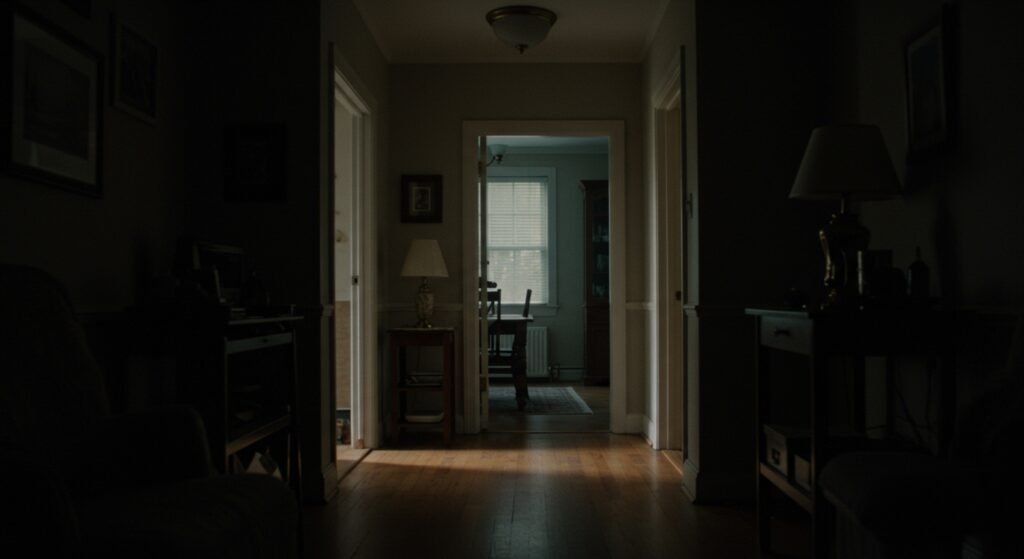
In a notable departure from conventional filmmaking, Academy Award-winning director Steven Soderbergh presents “Presence,” a rare cinematic work told entirely from the first-person perspective of a spirit. Written by David Koepp, the film sees Soderbergh himself take on the multifaceted roles of director, cinematographer, and editor, physically operating the camera to embody the spectral point-of-view and interact directly with the cast.
A Novel Narrative Approach
The core conceit of “Presence” lies in its commitment to this singular perspective. The audience is positioned as the unseen observer, experiencing events solely through the ‘eyes’ of the spirit. This innovative technique is not merely a stylistic choice but serves as the film’s fundamental narrative engine. Soderbergh’s decision to handle the camera himself underscores this immersion, making his physical movement and interaction with the actors an integral part of the storytelling.
Unfolding Drama Through an Unseen Witness
The narrative follows this spirit as it observes the Payne family – Rebecca, her husband Chris, and their teenage son Tyler – shortly after they relocate to a new house. The arrival of the family into this space provides the spirit with its subjects, whose lives and dynamics it begins to witness and perhaps, subtly, influence. The film stars Lucy Liu as Rebecca, Julia Fox as Cece, Chris Sullivan as Chris, and Eddy Madday as Tyler Payne.
Beyond Genre Boundaries: A Drama of Human Nature
While the premise involves a spirit and a new house, the film is notably categorized as being less of a traditional horror movie or ghost story. Instead, reviews highlight “Presence” as a profound drama centered on themes of personal morality, responsibility, self-inquiry, and personal evolution. The spirit’s perspective serves as a lens through which the audience examines the human condition and the characters’ ethical choices and transformations.
Cinematography as Character
The camerawork is crucial to the film’s success. Operating from the spirit’s perspective, the camera itself becomes a character, actively revealing plot information and details as the spirit ‘moves’ and ‘observes’ within the space. This intimate and subjective viewpoint creates a unique relationship between the audience, the spirit, and the unfolding events, suggesting that the film may offer deeper layers of understanding and insight upon repeat viewings due to the nuances captured by this embodied camera.
Key Details and Thematic Depth
“Presence” has a runtime of 85 minutes and is rated R, indicating mature themes and content suitable for adult audiences. The tight runtime complements the focused narrative, maintaining intensity and intimacy throughout. The film’s exploration of complex human issues through the detached, yet ever-present, viewpoint of a spirit offers a fresh perspective on familiar dramatic territory.
By employing such a distinctive technical and narrative structure, Soderbergh and Koepp craft a film that challenges audience expectations and invites contemplation on themes that resonate beyond the supernatural. It stands out as a thought-provoking piece that prioritizes character study and moral examination over conventional genre scares, solidifying its place as a significant entry in contemporary independent cinema.
More Stories
Mike Flanagan’s ‘Carrie’ Stuns Fantastic Fest
J Mascis: How Black Sabbath Turned Him Into a Rock Outlier
Sound Strokes: A Sonic Bridge Between China and Scotland