











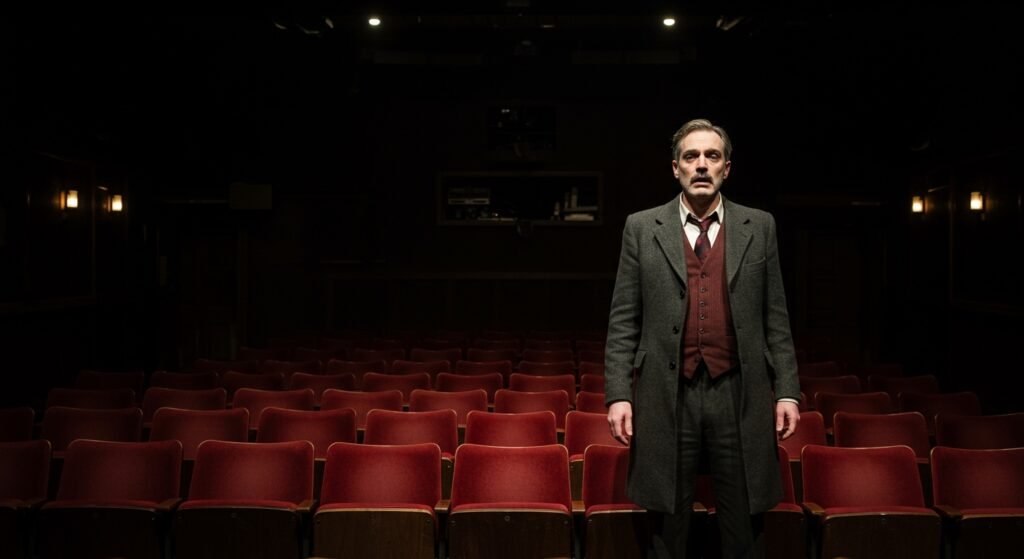
In the demanding landscape of short filmmaking, where every second counts and creative choices must be deliberate, the production of Curtain Call stands out. This short film, a comedy directed by Harrison Winter Altmann and co-written with Imogen Fennessey, has garnered attention for its distinctive approach: a single, uninterrupted take that follows the narrative without relying on conventional edits.
Based on a review published by Indie Shorts Mag, Curtain Call centers on Grant, a character portrayed as a narcissistic, once-famous actor. Grant now finds himself performing in community theatre, a setting that sharply contrasts with his perceived past glory. The core conflict of the film arises when Grant faces a significant ego blow stemming from low attendance at his performance. This premise sets the stage for a character-driven comedy exploring themes of faded fame, entitlement, and the humbling realities of a changing world.
The Single-Take Challenge
The decision to execute Curtain Call as a single take is perhaps its most defining technical characteristic. This method presents considerable challenges for filmmakers, requiring meticulous planning, precise choreography of actors and camera movement, and flawless execution. Any error typically necessitates restarting the entire shoot from the beginning.
Rather than employing traditional edits or “cuts” to guide the viewer’s eye or transition between moments, Altmann’s direction, informed by the script from Fennessey and Altmann, leverages strategic camerawork and blocking. The review specifically notes how the camera’s movement and the actors’ positioning within the frame are used to direct focus, reveal information, and maintain the narrative flow seamlessly. This technique transforms a potential constraint into a creative asset, forcing a continuous engagement with the unfolding events and characters on screen.
Character Dynamics and Unfolding Drama
The narrative primarily orbits around Grant’s reaction to the sparse audience, but the single-take format allows for surrounding interactions to be observed in real-time. The review specifically highlights a scene with a couple arguing and making out. This moment serves not just as background activity but as an example of the film’s observational quality and its use of space within the theatre setting.
Crucially, the scene is punctuated by the camera’s focus shifting to the character Bella. This shift is noted as a key point in the review, indicating how the continuous shot can still direct attention to specific characters and their reactions, potentially contrasting Bella’s perspective or presence with the main action involving Grant or the arguing couple. It demonstrates the deliberate control over focus and narrative emphasis possible even within the confines of a single take, using movement and framing to achieve what cuts typically would.
Creative Vision and Execution
The success of a technically ambitious project like Curtain Call rests heavily on the collaboration between its key creatives. Director Harrison Winter Altmann was tasked with orchestrating the complex single-take performance, ensuring timing, movement, and technical precision aligned perfectly. Co-writer Imogen Fennessey, alongside Altmann, crafted a script that could sustain interest and allow for character development and comedic beats to land naturally within the continuous flow.
The review suggests that this creative partnership resulted in a film that not only successfully navigates its technical challenge but also delivers on its narrative and comedic intentions. The phrase from the original source, “That Knows Why It’s There,” implies a clarity of purpose and successful execution of the film’s core concept – a satirical look at theatrical ego through a technically audacious lens.
Critical Observations
According to the review, Curtain Call‘s strengths lie in its effective use of the single-take format, particularly the deployment of strategic camerawork and blocking as intelligent alternatives to traditional editing. The film’s ability to maintain momentum and focus while allowing for peripheral actions, such as the highlighted scene involving the couple and the shift to Bella, is presented as evidence of its well-planned direction and execution.
The portrayal of Grant’s narcissistic vulnerability in the face of low attendance is central to the comedy, and the continuous shot allows the audience to experience his discomfort and the surrounding environment without interruption. This contributes to the film’s immersive quality and heightens the impact of Grant’s predicament.
In conclusion, Curtain Call, under the direction of Harrison Winter Altmann and with a script co-written by Imogen Fennessey, is noted as a short comedy that skillfully employs a single-take structure. By prioritizing strategic camerawork and blocking, the film effectively tells its story of an actor’s wounded ego, leveraging technical discipline to enhance its satirical narrative and earning positive critical attention for its precise and purposeful filmmaking.
More Stories
Bill Skarsgård Confirmed as Lead Star in Kojima’s PHYSINT
Andrew Scott to Bring ‘Sea Wall’ to the Big Screen in Directorial Team-Up with Tina Satter
Oasis Brothers Unite: The ‘Don’t Look Back In Anger’ London Premiere