











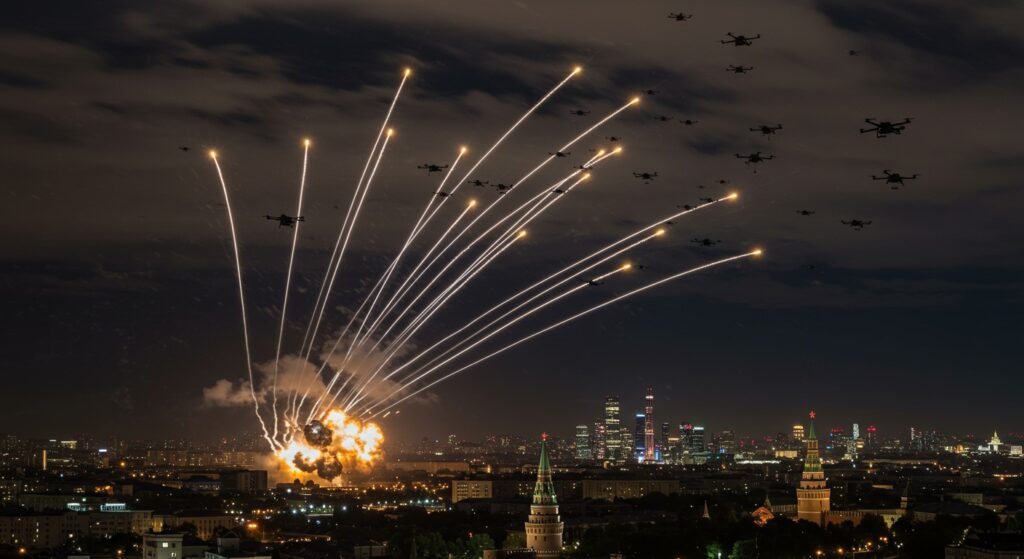
Moscow’s defenses were tested early Monday, May 5, 2025, as Russian air defense units successfully intercepted and destroyed a significant swarm of nineteen Ukrainian drones explicitly targeting the capital. This incident marked the second consecutive night of such aerial assaults aimed at Moscow, prompting authorities to implement immediate measures, including the temporary closure of the capital’s airports, according to reports from Moscow Mayor Sergey Sobyanin. The coordinated attempt to breach the city’s airspace unfolded as the unmanned aerial vehicles (UAVs) approached Moscow from various directions, a tactic often employed to potentially overwhelm defensive systems and exploit potential vulnerabilities.
Deterring the Aerial Threat
The operation by Russian air defense forces commenced as the inbound drones were detected on their approach vector towards Moscow. The nineteen drones were engaged and neutralized before reaching their intended targets within the city or its immediate vicinity. This defensive action highlights the ongoing efforts to safeguard key urban centers and critical infrastructure from aerial incursions, particularly within the context of the protracted conflict. The destruction of the drones, reported to be nineteen in total, underscores the persistent nature of the threats directed at Russian territory and the reactive measures taken to counter them.
Mayor Sergey Sobyanin was among the first to confirm the details of the attack and its immediate consequences. His statement provided official confirmation of the number of drones involved and the successful defensive outcome by air defense units. The report specifying that the drones approached from various directions suggests a potentially complex or multi-pronged attack strategy, requiring a distributed and responsive air defense posture to effectively counter the threat across multiple axes simultaneously.
Impact on Capital Operations: Airports Closed
One of the most immediate and tangible consequences of the drone attack was the temporary closure of the capital’s airports. This measure, a standard protocol implemented during periods of confirmed aerial threat to civilian airspace, was reported by Mayor Sergey Sobyanin. Airport operations were suspended to ensure the safety of passenger aircraft and prevent potential incidents during the air defense engagement. Such closures inevitably lead to disruptions in air travel, affecting both domestic and international flights originating from or destined for Moscow.
The decision to halt airport operations underscores the seriousness with which authorities view these drone incursions, prioritizing public safety above operational continuity during active defense scenarios. While the duration of the closures was not detailed in the summary, such measures typically remain in effect until the threat is fully assessed and neutralized, and the airspace is deemed safe for normal flight operations. The impact on travellers and logistical movements highlights the broader disruptive potential of even unsuccessful drone attacks on major urban centers.
Context: A Second Consecutive Night
The fact that this incident marked the second consecutive night of Ukrainian drone attacks targeting Moscow introduces a significant layer of context. Repeated attempts targeting the capital could indicate an evolving strategy or an intensified campaign aimed at bringing the realities of the conflict closer to Russia’s political and economic heartland. While the nineteen drones were reportedly destroyed, the persistence of such attacks, night after night, poses ongoing challenges for defensive systems and raises questions about the trajectory of drone warfare in the conflict.
Consecutive attacks also suggest a potential increase in the frequency or scale of such operations, potentially aimed at probing the capabilities and response times of Moscow’s layered air defense network. The targeting of a major global capital, particularly over successive nights, carries significant symbolic weight and serves to highlight the reach and persistence of the aerial threat emanating from the conflict zone.
Broader Implications
The successful interception of the nineteen Ukrainian drones by Russian air defense forces on Monday, May 5, while preventing direct hits on Moscow, nonetheless underscored the continued vulnerability of distant targets to modern drone technology. The report from Mayor Sergey Sobyanin detailing the attack and the subsequent airport closures serves as a reminder of how aerial incursions can disrupt daily life and operations in even heavily defended urban environments. The pattern of attacks, particularly this being the second consecutive night, points towards a potential escalation or change in tactics regarding the use of long-range drones targeting Russian territory, specifically its most prominent city. As the conflict continues, the skies above major cities like Moscow remain a potential front in the ongoing hostilities, necessitating constant vigilance and robust defensive measures against aerial threats approaching from various directions. The details, as summarized from news reports for Tuesday, May 6, 2025, emphasize the sustained nature of this aspect of the conflict and the critical role of air defense in mitigating potential impacts.
More Stories
Costco Goes Nationwide on Uber Eats: A New Era for Bulk Delivery
Elena Rybakina Wins US Open, Ascends to World No. 1
Rubio Seals Security Pacts; Vance Drives Policy Agenda