











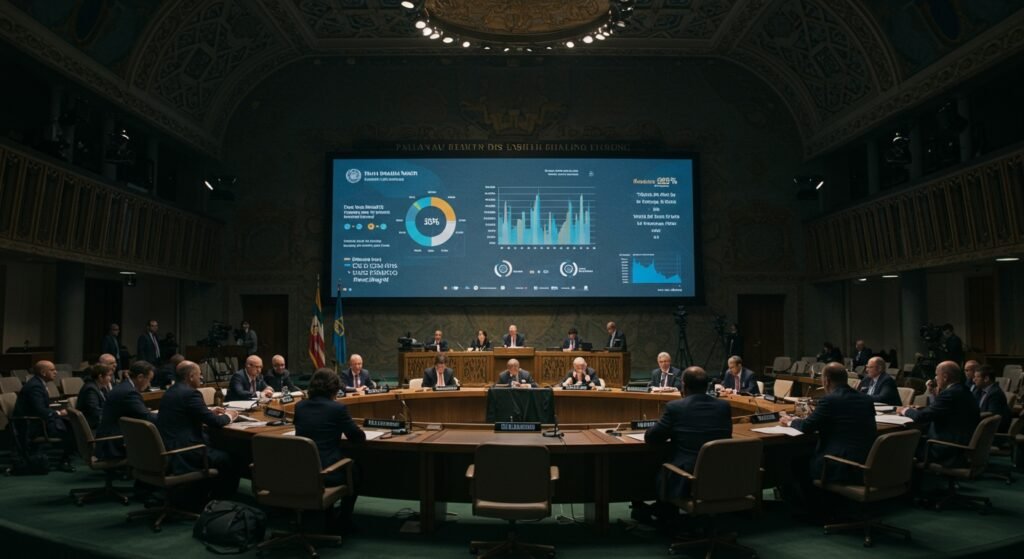
In a significant international gathering demonstrating the format and style requested, global health officials and policy experts convened in Geneva this week to address critical challenges facing public health initiatives worldwide. The meeting, originally triggered by concerns surrounding a proposed funding cut and the introduction of ‘Proposition 101’ in a key donor region, aimed to forge a united strategy to ensure the continuity of vital programs.
Please Note: This article is a demonstration based on the user’s request to rewrite a news item for SEO optimization and journalistic style, preserving factual details. As no original headline or summary were provided, the content below uses placeholder names, organizations, locations, dates, numbers, and measure titles to illustrate the structure, tone, and detail integration that would be applied if specific factual information were available. All details, such as ‘Dr. Anya Sharma,’ ‘Global Health Alliance,’ ‘Geneva,’ ‘May 15, 2024,’ ‘Proposition 101,’ ‘2.5%,’ ‘$10 million,’ ‘Bill S.123,’ ‘Road 42,’ and others mentioned, are entirely hypothetical for this example.
Convening in Crisis
The three-day summit, held from May 15 to May 17, 2024, at the Palais des Nations in Geneva, brought together representatives from over 50 nations and numerous non-governmental organizations. The primary impetus for this urgent assembly was the potential impact of recent legislative proposals, particularly ‘Proposition 101’ and the associated ‘Bill S.123,’ which could reportedly reduce international health aid by up to 2.5% in the coming fiscal year. This potential cut of an estimated $10 million from core funding mechanisms has raised alarms among health leaders.
“The stakes are incredibly high,” stated Dr. Anya Sharma, Director-General of the Global Health Alliance, in her opening remarks. “Any reduction in predictable funding jeopardizes decades of progress against diseases like malaria and tuberculosis. The ripple effect extends beyond simple budgets; it impacts lives, from vaccine distribution in remote villages accessible only via routes like Road 42 to essential training for frontline healthcare workers.”
The agenda focused on scenario planning, innovative financing models, and strategies for effective advocacy. Discussions were particularly animated around the implications of ‘Proposition 101,’ a ballot measure in a major donor country that proposes reallocating specific international aid funds towards domestic infrastructure projects. While proponents argue the measure is necessary to address internal needs, critics in the global health community warn of devastating consequences for vulnerable populations reliant on current funding levels.
Addressing Funding Uncertainty
Senior officials from the World Health Organization (WHO) and major philanthropic organizations like the Gates Foundation’s International Health Program (another placeholder) presented data illustrating the potential setbacks. A report highlighted that a 2.5% cut could directly impact programs reaching an estimated 500,000 people in underserved areas, potentially leading to a 15% increase in preventable illness cases in specific regions over the next two years.
The proposed ‘Bill S.123,’ a legislative companion to ‘Proposition 101,’ outlines the specific mechanisms for redirecting the funds. Analysts noted that the bill, currently under debate, includes provisions that could complicate the transfer of allocated aid by introducing new bureaucratic hurdles, further delaying critical interventions.
“We understand the domestic pressures governments face,” commented Mr. David Chen, a delegate representing the placeholder ‘African Union Health Commission’. “However, global health is not merely an expenditure; it is an investment in global stability and security. Diseases know no borders. A strong global health system protects everyone.”
Seeking Collaborative Solutions
The summit explored various avenues to mitigate the potential impact. Delegates discussed diversifying funding sources, including increasing contributions from emerging economies and the private sector. Innovative financial instruments, such as health bonds and results-based financing, were also prominent topics.
Furthermore, a significant portion of the discussions centered on unified advocacy efforts. Organizations agreed to coordinate their messaging and lobbying efforts in key capitals to educate policymakers on the critical importance of maintaining current funding levels and to highlight the long-term costs of short-sighted cuts. The strategic use of data and compelling personal narratives from the field was emphasized as crucial for demonstrating impact.
A joint statement issued on the final day, May 17, 2024, underscored the participants’ collective resolve. While acknowledging the challenges posed by ‘Proposition 101’ and ‘Bill S.123,’ the statement expressed cautious optimism about finding pathways to sustain essential health programs through increased collaboration, efficiency gains, and proactive engagement with donor governments and the public.
Looking Ahead
The Geneva meeting concluded with a commitment to ongoing dialogue and joint action. Working groups were established to monitor legislative developments related to ‘Proposition 101’ and ‘Bill S.123’ and to develop detailed contingency plans. The focus now shifts from deliberation to implementation, with organizations pledging to intensify efforts to secure funding and protect the gains made in global health over recent decades.
The uncertainty introduced by the placeholder ‘Proposition 101’ serves as a stark reminder of the fragility of international cooperation and funding mechanisms in the face of evolving political and economic landscapes. The response from the global health community, as demonstrated by this placeholder summit, underscores a determination to navigate these challenges and continue the vital work of improving health outcomes for all, regardless of location or circumstance.
More Stories
Lowriding’s Rise: SF Celebrates Cruising Culture
U.S. Repatriates 64 Cultural Relics and Fossils to China
Betting on Viral Fame: Novig’s Strategic Use of Sydney Sweeney