






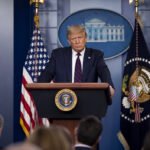

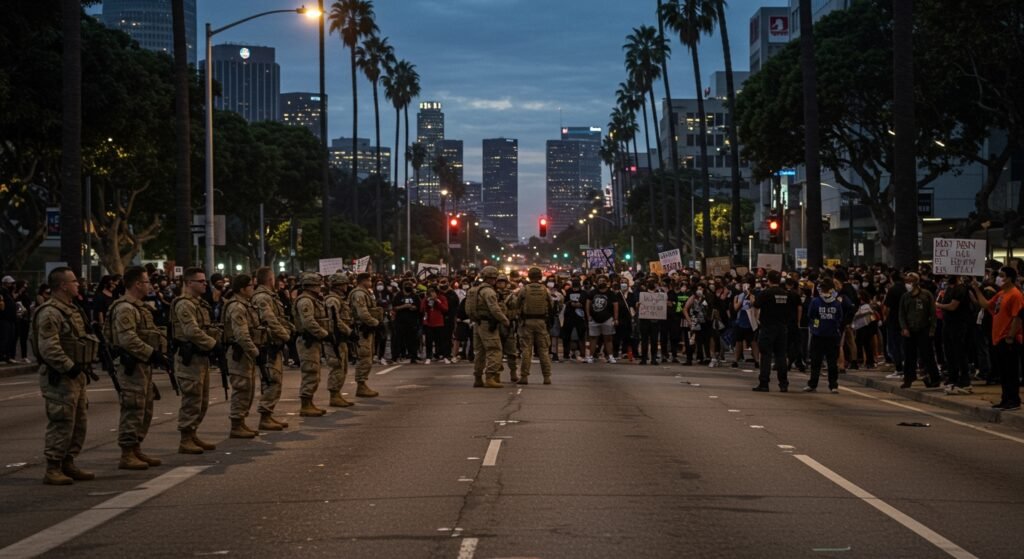
Los Angeles, California – U.S. President Donald Trump has ordered the deployment of approximately 2,000 National Guard troops to the city of Los Angeles, California, a move the administration frames as a response to burgeoning protests. These demonstrations have reportedly been fueled by the federal government’s stringent measures on illegal immigration and recent actions undertaken by Immigration and Customs Enforcement (ICE) within southern California.
The decision has drawn sharp criticism from California’s Democratic Governor, Gavin Newsom, who castigated the federal action. Governor Newsom asserted that the federal government is actively “sewing chaos” across the state, portraying the deployment as little more than an “excuse to escalate” an already tense situation. The move reignites ongoing tensions between the Trump administration and the state of California, which has frequently pushed back against federal immigration policies.
Context of the Deployment
The deployment comes against a backdrop of heightened tensions surrounding immigration enforcement. The Trump administration has prioritized increased border security and interior enforcement, leading to widespread protests, particularly in states like California with large immigrant populations. Actions by ICE agents in southern California, while often targeting individuals with criminal records, have also reportedly led to the detention and deportation of others, sparking outcry from civil rights advocates and immigrant communities.
These enforcement activities, coupled with broader administration policies such as the separation of families at the border and increased deportations, have ignited public demonstrations. Los Angeles, a major metropolitan center in southern California, has been a focal point for some of these protests, bringing the issue to the forefront of national discourse.
Governor Newsom’s Strong Rebuke
Governor Gavin Newsom, a prominent figure within the Democratic Party and a vocal critic of President Trump’s policies, did not mince words in his assessment of the National Guard deployment. His characterization of the federal government as “sewing chaos” suggests a deliberate effort to destabilize the situation rather than resolve it.
Newsom’s assertion that the deployment is merely an “excuse to escalate” implies that the federal government is using the protests as a pretext to introduce a significant military presence, potentially leading to further confrontation or a heavy-handed response that could exacerbate public unrest. This perspective highlights a fundamental disagreement over how domestic civil unrest should be managed.
The Role of National Guard vs. Local Law Enforcement
A central point of contention raised by critics of the deployment is the appropriateness of utilizing military forces – in this case, the National Guard under federal orders – for situations involving civilian protests. Traditional protocol often dictates that local law enforcement agencies, such as city police departments and county sheriff’s offices, are the primary authorities responsible for maintaining order during demonstrations.
Critics argue that deploying the National Guard, particularly under federal command and potentially armed for combat situations, escalates the perception of conflict and can be seen as an overreach of federal power into matters typically handled at the state or local level. They contend that local police are better equipped, trained, and integrated with the community to handle such events with less potential for adversarial outcomes compared to military personnel.
The use of the National Guard in domestic situations is permitted, but it is often reserved for large-scale emergencies, disasters, or instances where state and local resources are overwhelmed. Its deployment in response to protests stemming from specific federal policies, as is the case here, adds another layer of political complexity and fuels the debate over federalism and the balance of power.
Political Implications and Federal-State Dynamics
The deployment underscores the significant political chasm between the Trump administration and the state of California, particularly under Governor Newsom’s leadership. California has positioned itself as a “sanctuary state,” implementing policies designed to limit cooperation with federal immigration enforcement efforts, a stance that has frequently drawn ire from the White House.
This latest move is seen by many as another manifestation of this ongoing conflict, with the federal government asserting its authority in a state that has actively resisted many of its key initiatives, particularly on immigration. The deployment of federalized National Guard troops to a major California city without clear coordination or support from the state’s governor further illustrates the strained relationship.
The situation in Los Angeles reflects a broader national debate about immigration policy, federal power, and the rights of protesters. It places local officials, law enforcement, and residents in a precarious position, caught between federal mandates and state leadership’s objections.
Reporting on the response indicates varied reactions, with some residents expressing concern over the military presence and others supporting measures to restore order. Global News’s Candice Cole reported on the immediate unfolding of the situation and the initial reactions from various stakeholders.
As the situation develops, the focus remains on how the presence of the National Guard will impact the protests and whether it will de-escalate tensions or, as Governor Newsom fears, serve as an “excuse to escalate” the confrontation between demonstrators and authorities. The deployment marks a significant moment in the ongoing national dialogue about immigration and the appropriate use of federal power in response to domestic dissent. The coming days will likely reveal the practical consequences of this controversial decision on the ground in Los Angeles.
More Stories
Trump Issues Iran Ultimatum as Diplomacy Fails
Three Dead After Seattle Food Festival Shooting
Trump Warns of Iran Escalation Amid Regional Airstrikes