











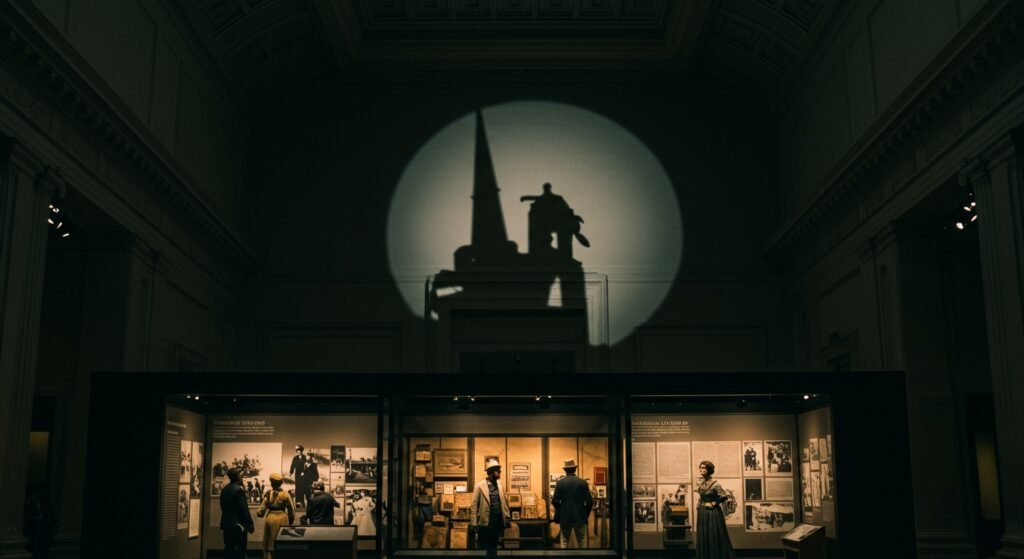
Washington, D.C. – In a move sparking significant debate over institutional independence and the portrayal of national history, President Donald Trump has issued an executive order titled “Restoring Truth and Sanity to American History.” The directive specifically targets the Smithsonian Institution, aiming to fundamentally reshape the nation’s vast network of museums according to the President’s vision.
The order calls for the removal of what it terms “improper ideology” from exhibitions and collections. While not explicitly defining the term, the text clearly targets museum content related to race and gender, suggesting that portrayals should ignore racism and sexism, and deny the existence of trans people.
Order’s Focus on Specific Exhibitions
The executive order singles out particular exhibitions for criticism. The American Art Museum’s exhibition “The Shape of Power: Stories of Race and American Sculpture” is highlighted, specifically for its statement that “societies including the United States have used race to establish and maintain systems of power, privilege, and disenfranchisement.” Critics of the order argue this interpretation reflects a fundamental disagreement with academic and historical consensus on the role of race in American society.
The National Museum of African American History and Culture (NMAAHC) also draws specific attention in the order. The museum had previously come under scrutiny from Mr. Trump concerning its “Talking About Race” portal. The portal included graphics that listed concepts like “hard work,” “individualism,” and “the nuclear family” as aspects of “White culture.” These graphics were drawn from the book “White Awareness: Handbook for Anti-Racism Training by Judy H. Katz.”
Following conservative complaints in 2020, the NMAAHC removed this specific graphic from its online resources, illustrating the sensitivity surrounding such discussions and the potential impact of external pressure on institutional content.
Mechanisms for Influence and Historical Context
Beyond directing content changes, the executive order outlines mechanisms to implement the President’s vision for the Smithsonian. A key aspect involves reshaping the institution’s governance. Vice President J.D. Vance has reportedly been tasked with overseeing changes to the composition of the Smithsonian’s board of regents, the governing body responsible for the institution’s oversight and strategic direction.
Experts suggest that the threat of losing federal funding represents a powerful tool that could be leveraged to compel the Smithsonian to adhere to the order’s directives. The Smithsonian Institution is a federally funded complex, though it also relies significantly on private donations.
This approach echoes past actions taken by Mr. Trump regarding cultural institutions. During his previous term, he installed new board members at the Kennedy Center in Washington, D.C. Following these appointments, Mr. Trump was subsequently named board chair, a position from which he publicly stated they would work to make the center “not woke.” Critics view this as a precedent for using board appointments to steer institutional programming and philosophy in line with political objectives.
Reactions and Concerns for Independence
The executive order has drawn sharp criticism from historians, academics, and cultural observers. Raymond Arsenault, a distinguished professor of Southern history at the University of South Florida, was quoted describing the order as “totalitarian” and reminiscent of a “fascist state.” Such strong language underscores the perceived severity of the administration’s attempt to assert control over the narrative presented by national museums.
Critics argue that beyond the immediate content disagreements, the order represents a fundamental challenge to the long-standing tradition of academic freedom and institutional independence that governs the Smithsonian’s operations. The institution has historically enjoyed broad bipartisan support and remains highly popular with the public, attracting 16.8 million visitors in 2024 alone. Its mission is broadly understood as the increase and diffusion of knowledge, operating largely independently of direct political control over its exhibitions and research.
Concerns extend beyond potential funding cuts, centering on the potential for political interference to compromise the integrity and credibility of the nation’s premier museums and research centers. Observers fear that explicitly political directives could undermine the Smithsonian’s ability to present complex, sometimes challenging, historical narratives based on scholarly research.
As the executive order’s implications are assessed, the future of the Smithsonian’s autonomy and the presentation of American history and culture within its halls face an period of heightened uncertainty and political pressure.
More Stories
Taiwan Makes Historic Debut at World Children’s Festival in D.C.
Choctaw Heritage Ignites at World Series of Stickball
Concrete Renaissance: Inside Fort Worth’s Cultural District Building Boom