











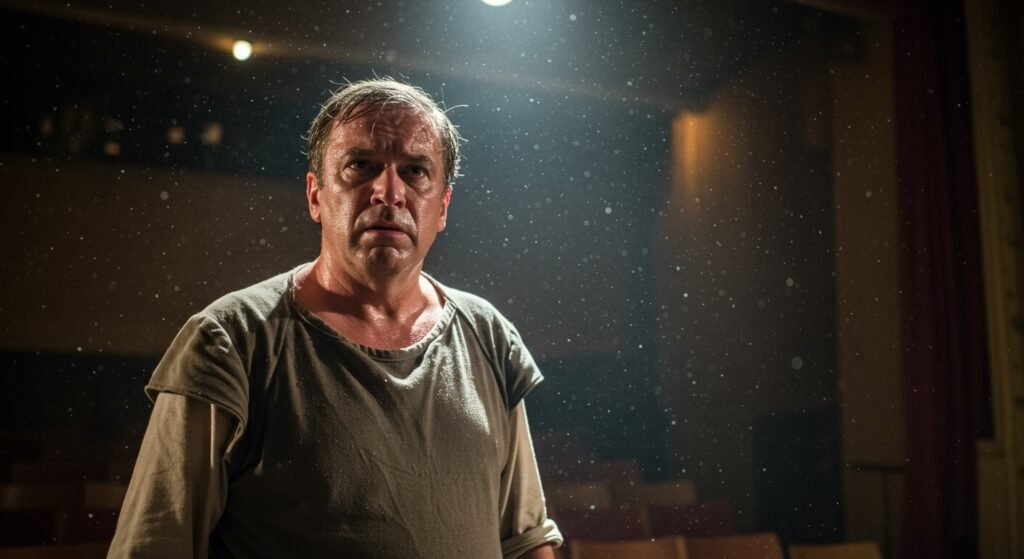
In the confines of community theatre, where aspirations often clash with stark realities, a new production titled ‘Curtain Call’ offers a penetrating examination of ego, delusion, and the harsh spotlight on fading fame. Co-written by Harrison Winter Altmann, who also directs, and Imogen Fennessey, this distinctive work is a single-take comedy, a format chosen to heighten the audience’s immersion in the unraveling psychological state of its protagonist.
The film centres on Grant, a once-famous actor now performing in a local community theatre production. Grant embodies a potent mix of entitlement and insecurity, viewing the dedicated crew around him as fundamentally beneath his perceived status. Despite the undeniable evidence of his current standing – the play attracts an audience of less than ten individuals – Grant expects the same level of adulation and deference he might have received during the height of his earlier career.
The Single Take: A Window into the Psyche
The decision to shoot ‘Curtain Call’ in a single, uninterrupted take is not merely a technical flourish; it serves as a crucial narrative device. This format relentlessly focuses on Grant, denying him the conventional edits that might offer respite or control over his portrayal. Instead, the camera becomes a constant observer, mirroring the intense pressure Grant feels and simultaneously highlighting his growing detachment from the immediate reality of his circumstances. The continuous flow of time and action underscores the escalating tension and the inescapable nature of his internal turmoil.
Through this sustained gaze, the film effectively illustrates Grant’s intense psychological state. His interactions, increasingly strained and revealing, unfold in real-time, allowing the audience to witness the fragile facade of his ego begin to crack under the weight of his own expectations and the indifference of his environment. The single take emphasizes the claustrophobic nature of his self-imposed reality and the difficulty he has in connecting with the genuine efforts of those around him.
Balancing Empathy and Schadenfreude
One of the film’s notable achievements lies in its delicate narrative balance. As Grant’s behaviour becomes increasingly insufferable, driven by his inflated sense of self-importance and his palpable disappointment, the audience might naturally anticipate or even desire his eventual downfall. The script, however, navigates this potential pitfall with nuance.
While acknowledging the comedic potential in Grant’s predicament and the satisfaction some viewers might derive from seeing his arrogance challenged, ‘Curtain Call’ also makes a point of acknowledging his underlying humanity. The film does not simply present Grant as a one-dimensional villain or a caricature of faded glory. Instead, it hints at the vulnerabilities and perhaps the past experiences that have shaped his current state, inviting a more complex emotional response from the viewer. This duality prevents the film from becoming purely an exercise in mockery, instead offering moments of uncomfortable recognition or even pathos amidst the comedy.
Craft and Performance
The technical execution of a single-take film requires meticulous planning and flawless coordination. ‘Curtain Call’ demonstrates strategic camerawork and blocking that are essential to its success. The camera movements are carefully choreographed to follow the action, reveal character dynamics, and maintain visual interest without disrupting the continuous shot. Blocking, the precise staging of actors’ movements, is equally critical, ensuring that the narrative flows naturally within the constraints of the format and that key interactions are captured effectively.
The success of the production also rests heavily on the strength of its cast performances. Navigating the demands of a single take, which requires sustained focus and energy without the safety net of multiple takes or editing, is a significant challenge for actors. The review notes strong performances across the ensemble, suggesting that the cast rose to this technical and artistic task.
Particular highlight is given to the character of Bella. While the summary doesn’t detail Bella’s role, her specific mention suggests a performance that stands out within the ensemble, potentially serving as a foil to Grant, an observer, or a character who helps illuminate different facets of his personality or the surrounding world of the community theatre.
Conclusion
‘Curtain Call’ distinguishes itself not only through its ambitious single-take structure but also through its insightful portrayal of a common human frailty: the struggle to reconcile past self-image with present reality. By grounding this exploration in the specific, often humorous, world of community theatre, Harrison Winter Altmann and Imogen Fennessey have crafted a comedy that uses its formal constraints to enhance its thematic depth, offering audiences a concentrated, unwavering look at an ego on the brink, while subtly reminding us of the shared vulnerabilities that lie beneath even the most inflated exteriors. It is a production that, as the original review notes, clearly understands and effectively utilizes the reasons behind its chosen artistic approach.
More Stories
Bill Skarsgård Confirmed as Lead Star in Kojima’s PHYSINT
Andrew Scott to Bring ‘Sea Wall’ to the Big Screen in Directorial Team-Up with Tina Satter
Oasis Brothers Unite: The ‘Don’t Look Back In Anger’ London Premiere