











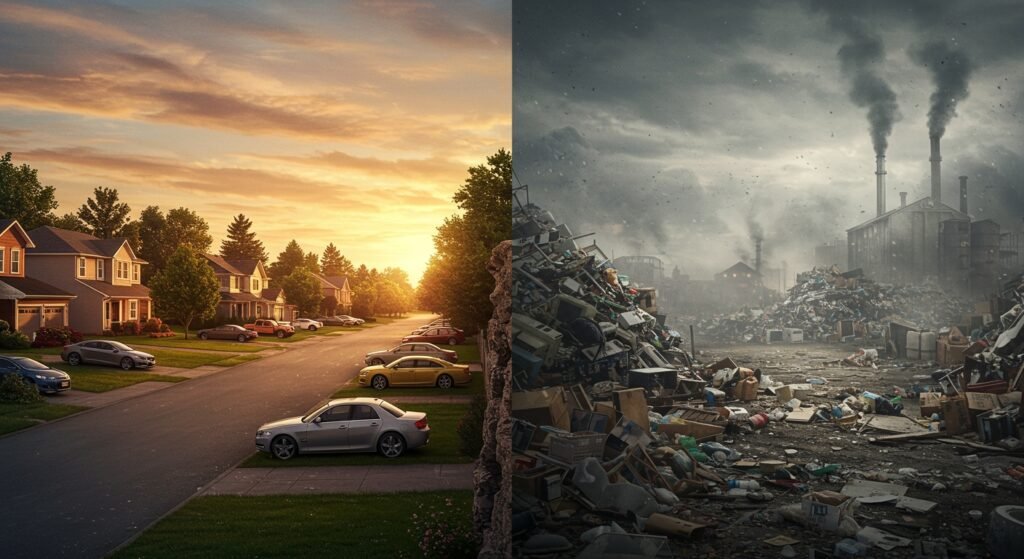
The American narrative has long intertwined individualism, freedom, and success with not just liberty but also the tangible ability to accumulate wealth and consume. This deep-rooted cultural perspective has shaped a specific understanding of prosperity, one famously encapsulated by former US President Donald Trump’s assertion that Americans are the world’s ultimate consumers.
The Consumption Imperative
Within this framework, the “American Dream” has become increasingly synonymous with material ownership and the capacity for high levels of consumption. This is not merely a passive outcome but is often viewed as both a fundamental right and, implicitly, a civic duty contributing to economic dynamism. However, critics argue that this consumption-driven model is showing signs of strain, leading to significant societal challenges.
Inequality and Destabilization
Central to this critique is the observation that the relentless pursuit of capital accumulation, often facilitated through mechanisms described as “rent-seeking” – activities that generate wealth without creating new value – has led to a growing concentration of wealth and power. This escalating inequality is not just an economic issue; it creates social friction and destabilizes communities, potentially undermining the very prosperity it purports to represent.
A Historical Perspective
The notion of consumption as a powerful statement, even a geopolitical one, has historical roots. A vivid example is the 1959 Kitchen Debate between then-Vice President Richard Nixon and Soviet Premier Nikita Khrushchev in Moscow. The exchange famously centered on the consumer goods available in an American home, implicitly positioning material abundance as a key metric of ideological superiority. Furthermore, the techniques of consumer advertising, explored critically in works like Vance Packard’s 1957 book “The Hidden Persuaders,” have long worked to shape desires and reinforce the connection between personal fulfillment and purchasing power.
Challenging Moderation
Despite the cultural entrenchment, questions are mounting about the nature and sustainability of the consumption being promoted. Trends such as rising car ownership, speculative housing markets, and persistent inequality highlight a system where moderation is increasingly challenging to achieve for many, while simultaneously fueling environmental and social costs. The unbridled pursuit of material acquisition appears increasingly at odds with broader goals of societal well-being and ecological balance.
The Call for a Global Reset
Against this backdrop, there is a growing sense globally that a fundamental rethinking, often termed a “reset,” is necessary for economic and social models. Yet, experts caution that any such reset will be ultimately superficial unless it confronts the underlying cultural assumption that prosperity is inherently defined by consumption. This requires a deeper examination of societal values and economic structures.
Towards a New Definition of Success
The prevailing American model, prioritizing endless material throughput, is increasingly seen by many as ecologically obsolete and socially corrosive. It raises a fundamental question for the 21st century: Can thriving economies exist and societies flourish without relying on continuous, escalating material consumption? As nations grapple with sustainability and equitable growth, some observers note that countries like China are reportedly exploring alternative economic trajectories that may diverge from the traditional Western consumption-heavy path, signaling a potential global shift in the understanding of progress and prosperity.
More Stories
Lowriding’s Rise: SF Celebrates Cruising Culture
U.S. Repatriates 64 Cultural Relics and Fossils to China
Betting on Viral Fame: Novig’s Strategic Use of Sydney Sweeney