








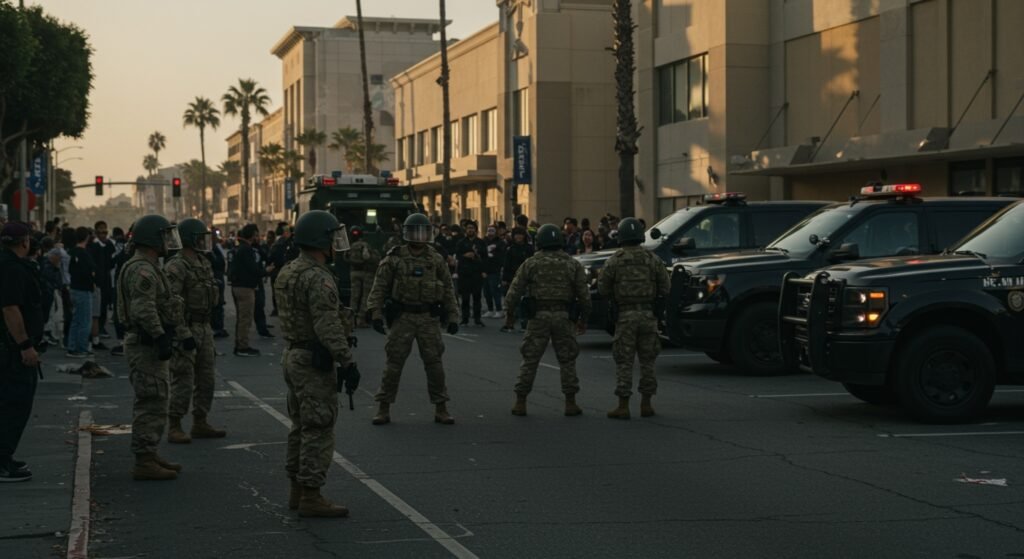
Washington D.C. – U.S. President Donald Trump has ordered the deployment of approximately 2,000 California National Guard troops to Los Angeles, California, a directive issued over the explicit objections of Governor Gavin Newsom. The significant federal intervention into a state matter follows a second consecutive day of intense clashes between hundreds of protesters and federal immigration authorities clad in riot gear.
The confrontations on June 8, 2025, unfolded near a Home Depot store in Paramount, a city located south of Los Angeles and known for its heavily Latino population. Federal agents involved in the clashes were reportedly staged at a nearby Department of Homeland Security (DHS) office, adding a layer of tension to the demonstrations and raising questions about the nature and focus of the protests.
Executive Action and State Opposition
The President’s decision to deploy the National Guard directly to the streets of Los Angeles marks a notable assertion of federal authority into state-level management of public order. Governors typically hold primary command over their state’s National Guard forces when they are not called into federal service under Title 10 of the U.S. Code. President Trump’s order appears to invoke federal powers to bypass the state command structure or compel the Governor’s action, prompting immediate resistance from Governor Newsom’s office.
Sources familiar with the Governor’s stance indicated strong opposition to the federal deployment, viewing it as an unnecessary and potentially escalatory measure. Governor Newsom’s administration has reportedly advocated for alternative approaches to managing the protests, which have drawn attention due to their focus and the involvement of federal immigration personnel.
Escalation in Paramount
The area near the Home Depot in Paramount became a flashpoint over the weekend, culminating in the second day of significant unrest on June 8th. Hundreds of individuals gathered to protest, their demonstrations leading to direct confrontations with federal immigration authorities. The presence of agents in riot gear underscores the volatile nature of the situation and the preparedness of federal forces for potential conflict.
Paramount, a city characterized by its substantial Latino community, adds a specific socio-political context to the protests. While the exact grievances of the hundreds of protesters have not been fully detailed in initial reports, the location and the involvement of federal immigration authorities suggest potential links to immigration policy, enforcement actions, or broader issues affecting the community.
The fact that federal agents were staged at a Department of Homeland Security office nearby further emphasizes the federal nexus to the situation, distinguishing these events from typical local law enforcement responses to civil unrest.
Implications for State-Federal Relations
The direct override of a state governor’s authority concerning the deployment of his state’s National Guard troops raises significant constitutional and political questions. It highlights the ongoing tension between state autonomy and federal power, particularly during periods of domestic unrest or perceived crisis.
Experts in constitutional law and intergovernmental relations note that while the President has authority to call up the National Guard for federal service or to quell insurrections under specific conditions, bypassing a governor’s wishes for deployment within the state’s borders for domestic law enforcement purposes is legally complex and often politically fraught. The President’s action sets a precedent that could impact how states manage future civil disturbances and interact with federal authorities.
The deployment of 2,000 troops is a substantial commitment of resources, potentially impacting the state’s ability to utilize those forces for other purposes or creating logistical and command challenges. It also carries the risk of further polarizing public opinion, with supporters viewing it as necessary to restore order and critics decrying it as an overreach and provocation.
Uncertain Path Forward
The arrival of the California National Guard troops, under federal orders and despite state objections, creates an uncertain dynamic on the ground in Los Angeles and specifically in Paramount. Their presence, alongside federal immigration authorities and local law enforcement (if present), could either de-escalate or further intensify the situation.
The events of June 8, 2025, underscore the complex layers of authority and jurisdiction involved when federal interests intersect with state-level events, particularly in highly populated and politically charged environments like Los Angeles. The coming days will likely reveal the immediate impact of the federal troop deployment on the protests and the broader implications for state-federal relations under the current administration.
More Stories
Merz Defiant: Chancellor Stays Course After Historic CDU Losses
Costco Goes Nationwide on Uber Eats: A New Era for Bulk Delivery
Elena Rybakina Wins US Open, Ascends to World No. 1