










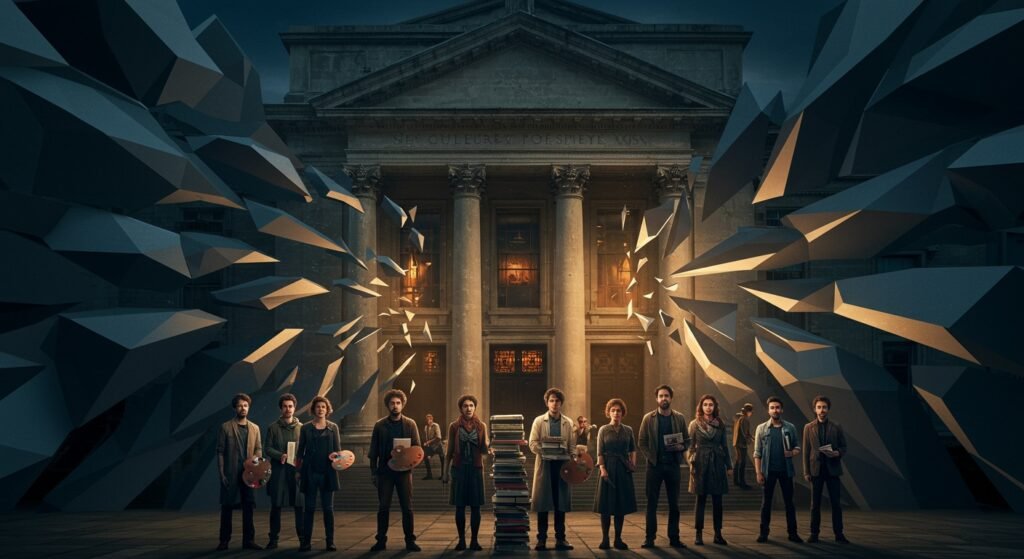
Washington D.C. and New York – A profound schism is deepening across the United States, pitting cultural and academic institutions, alongside artists, against a concerted effort by the Trump administration to exert influence and significantly curtail funding. This confrontation is being widely described as a “new culture war,” far exceeding previous skirmishes in intensity and scope.
Observers and participants say this is not merely a debate over public funding levels but a fundamental fight for the very definition of “America’s cultural soul.” The administration’s actions are viewed as a strategic dismantling or reshaping of significant swathes of the country’s cultural infrastructure, intended to align it with specific political objectives.
“It’s much more extreme” than past ideological clashes, according to those on the front lines of this burgeoning conflict. The impact has been described as both “swift and shocking,” prompting urgent calls within the arts, museum, and academic communities for “co-ordinated resistance.”
The Policy Onslaught and its Fallout
The core of the current tension stems from the Trump administration’s proactive measures to slash budgets and influence the programming and direction of federally funded cultural and educational entities. While specific cuts have been proposed or implemented across various agencies and grant-making bodies, the broader effect is perceived as an attempt to leverage funding power to enforce ideological compliance.
The consequences for the sector are tangible and severe. Erin Harkey, chief executive of Americans for the Arts, has highlighted the significant loss of jobs and revenue directly attributable to these policy shifts. The economic instability introduced by threatened cuts and ideological pressures creates an environment of uncertainty, making the long-term impact on the health and vitality of American arts and culture difficult to predict.
Beyond the economic fallout, the perceived ideological push is causing institutions to grapple with questions of independence and mission. The reshaping of infrastructure is seen by critics as an attempt to turn cultural bodies into instruments of White House policy rather than autonomous centers of creative and intellectual exploration.
Defending Academic Freedom
The academic world has also found itself squarely in the crosshairs. Universities, traditional bastions of independent thought and research, face threats to funding tied to various administrative pressures and policy demands. This has prompted strong defenses from university leadership determined to protect academic independence.
Prominent voices have emerged from leading institutions. University presidents, including Chris Eisgruber of Princeton and Alan Garber of Harvard, have publicly defended the principles of academic freedom and institutional autonomy against the backdrop of threatened funding cuts. Their stance underscores the deep concern within higher education that financial leverage is being used to compromise the integrity of academic pursuits.
Mobilization and Calls for Resistance
In response to what is widely seen as an existential threat, cultural workers, artists, academics, and institutional leaders are beginning to organize. The calls for “co-ordinated resistance” reflect a recognition that a fragmented response may be insufficient against a unified political agenda.
A concrete step in this direction is the proposal for a town hall meeting in New York. This gathering is envisioned as a crucial forum for representatives from the arts, museum, and academic community to convene, share information, and collaboratively plan effective responses. The urgency is underscored by the desire to strategize and potentially act before Congress’s summer recess, a period when key legislative decisions might be solidified.
Ideology and the Road Ahead
For many within the affected communities, the current policies are not isolated incidents but the culmination of long-standing efforts by the “extreme right wing.” These actions are frequently linked to broader initiatives such as “Project 2025,” which outlines plans for a comprehensive restructuring of the federal government and its relationship with various sectors, including culture and education.
The perceived goal behind these efforts is the suppression of dissenting voices and the promotion of a specific, government-sanctioned narrative. This framing elevates the conflict beyond mere budgetary concerns to a fundamental struggle over freedom of expression and intellectual inquiry.
Artists are being encouraged to actively resist, acknowledging that while individual creators may possess resilience, the institutions that support and amplify their work are significantly more vulnerable. The potential for these institutions to be severely damaged or fundamentally altered by policy changes is a driving force behind the calls for collective action.
The current “new culture war” presents a formidable challenge to the independence and vibrancy of American cultural and academic life. As institutions and individuals mobilize, the coming months, particularly before Congress’s summer recess, will be critical in determining the trajectory of this escalating conflict and the future of America’s cultural landscape.
More Stories
Lowriding’s Rise: SF Celebrates Cruising Culture
U.S. Repatriates 64 Cultural Relics and Fossils to China
Betting on Viral Fame: Novig’s Strategic Use of Sydney Sweeney