











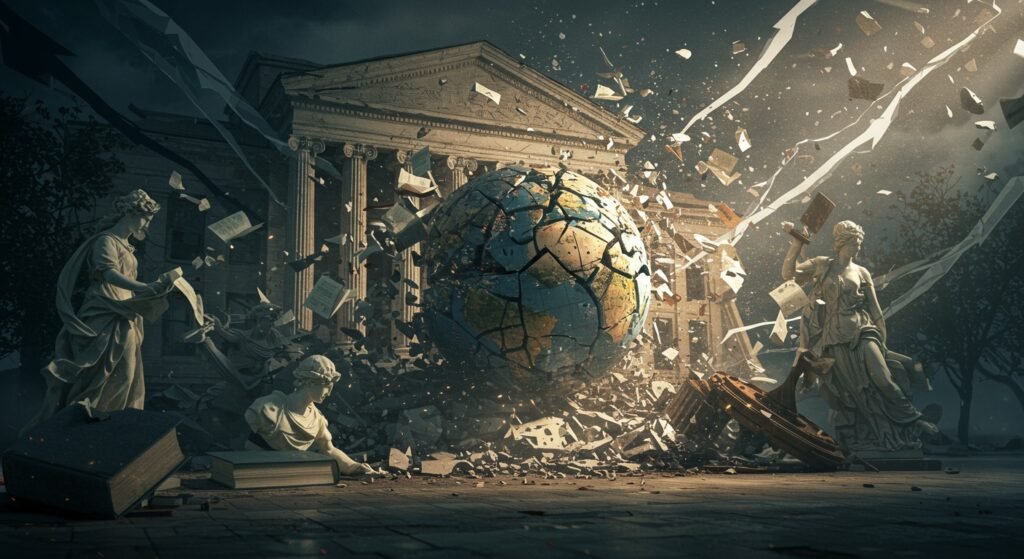
A prominent economic analyst has drawn a stark comparison between a potential future administration under former President Donald Trump and the disruptive period of China’s Cultural Revolution. In an analysis published on April 2, 2025, Stephen Roach posits that a “Trump 2.0” era could ignite an “America’s Cultural Revolution,” signaling a profound departure from established national norms.
Understanding the Core Analysis
Roach’s assessment, detailed in his recent article, suggests this potential upheaval is less about an absolute, violent revolution and more about a systematic overturning of pre-existing American standards and institutions. He argues that a second Trump presidency would likely initiate fundamental breaks from historical norms across several critical areas, including trade, the rule of law, America’s global role, and cultural institutions.
Shifts in Trade Policy
One significant area Roach identifies is trade policy. He highlights a decisive shift toward protectionism and a marked rise in tariffs, levels not seen since the 1930s. This potential move away from decades of multilateral trade agreements and global integration represents a substantial break from the post-World War II economic order that the United States largely championed.
Concerns Regarding the Rule of Law
The analysis also raises alarms regarding the rule of law. Roach points to what he describes as a “MAGA-based assault” on the separation of powers, a cornerstone of American governance. Concerns are amplified by actions and statements that appear to challenge the traditional boundaries of executive authority, including instances where former President Trump has hinted at the possibility of running for a third presidential term, which would require an unprecedented constitutional challenge.
Transformation of America’s Global Role
America’s position on the global stage is another key focus of Roach’s article. He notes a strong anti-globalist stance that could significantly undermine long-standing alliances and international agreements. Examples include potential weakening of cornerstone partnerships like NATO and the USMCA trade pact. Simultaneously, Roach highlights an apparent inclination towards embracing adversarial nations, citing warmer relations with Russia. Furthermore, he points to speculative discussions regarding potential territorial expansion into areas like Greenland and Canada as actions that could severely erode U.S. moral authority and challenge the concept of “American exceptionalism” – the belief in the unique trajectory and role of the United States in the world.
Attacks on National Culture and Institutions
Perhaps most strikingly, Roach identifies a cultural component to this potential shift, drawing a parallel to Mao Zedong’s assault on “bourgeois Chinese culture” during China’s Cultural Revolution. He argues that a “Trump 2.0” era could involve targeted attacks on institutions that embody America’s national culture and intellectual life. These include universities, scientific research bodies, a free and independent media, and the arts. Roach cites specific actions that could symbolize this cultural shift, such as the installation of figures like Donald Trump into leadership roles at prestigious cultural bodies, mentioning his position as Kennedy Center Chairman as an example of this phenomenon.
Potential Global Repercussions
The analysis concludes by emphasizing the significant global disruptive effects that America’s potential “Cultural Revolution” could unleash. Increased trade tensions, potentially escalating into global trade wars, are a major concern. Additionally, the splintering of crucial alliances, particularly the long-standing U.S.-Europe partnership, could reshape the international political and economic landscape, leading to heightened instability worldwide.
Roach’s analysis, published on April 2, 2025, serves as a cautionary assessment, suggesting that the potential policies and political climate of a future Trump administration could fundamentally alter the character of American governance, its international standing, and its cultural fabric, with far-reaching implications both domestically and abroad.
More Stories
The Women of Flower Drum Song Returns to Democracy Center
Freedom Plane Tour Brings History to Atlanta
PEN America’s 2026 Festival: Literature’s Defiant Return