











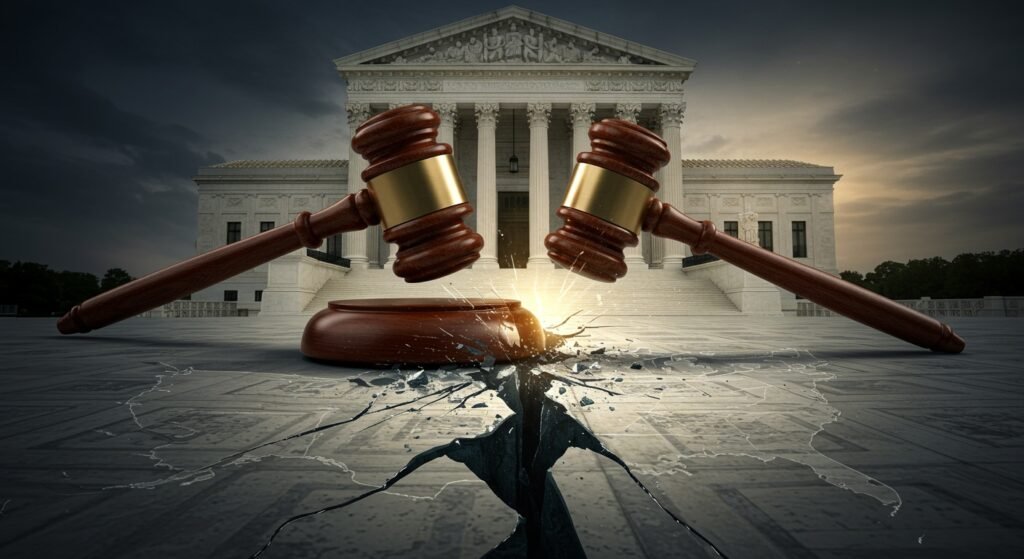
WASHINGTON D.C. – The United States Supreme Court convened on May 16 to hear oral arguments in a pivotal case that pits the power of the presidency against the authority of federal courts to issue injunctions that block executive actions nationwide. The high-stakes legal battle is set to redefine the delicate balance between the executive and judicial branches and could have profound implications for how federal policy is implemented and challenged across the country.
Supreme Court Hears Challenge to Judicial Authority
At the core of the dispute lies the practice of federal judges issuing “nationwide injunctions,” orders that halt the implementation of a government policy or action not just within the judge’s district or state, but across the entire United States. The Trump administration has argued strenuously against this practice, contending that it allows a single federal judge in a single state to effectively veto policy decisions for the entire nation, circumventing established legal processes and the democratic mandate of the executive branch. This legal challenge asserts that such broad judicial overreach is an unconstitutional expansion of judicial power.
Focus on Birthright Citizenship Order
The specific case before the court on May 16 directly involves lower courts blocking an executive order issued by President Trump. This order aimed to strip birthright citizenship for children born in the US to undocumented immigrants. The administration’s legal challenge to the nationwide injunction blocking this particular order serves as the vehicle for the broader argument against the scope of judicial authority in issuing such sweeping mandates that extend beyond the immediate parties or locations involved in a lawsuit.
The Administration’s Argument
Representing the executive branch, the Trump administration presented its argument that a single federal judge in a single state lacks the constitutional authority to issue an injunction that blocks an executive order or federal regulation for the entire country. They contended that while a judge might have the power to halt the enforcement of a policy as it applies to the specific plaintiffs before the court, extending that order nationwide represents an overreach that prevents the executive branch from implementing policy based on its interpretation of the law. This perspective views nationwide injunctions as an extraordinary remedy that has become too commonplace, particularly in challenges to federal policy.
Potential Impact and Stakes
The outcome of this landmark Supreme Court case carries significant potential ramifications that extend far beyond the specific executive order on birthright citizenship. Legal analysts and government officials warn that the court’s ruling could impact a wide array of federal policies and issues. These include matters related to immigration, where many nationwide injunctions have been issued, as well as potentially affecting the implementation of policies concerning federal funding and diversity initiatives in schools. A ruling limiting nationwide injunctions could empower the executive branch while potentially complicating legal challenges to federal actions, requiring plaintiffs to pursue numerous, geographically limited lawsuits.
Broader Context: Trump Administration and Injunctions
The legal challenge heard on May 16 is set against the backdrop of frequent clashes between the Trump administration and the judiciary. During his second term, President Trump faced nearly 40 nationwide injunctions that blocked his executive orders and policy initiatives. Many of these injunctions, particularly those related to immigration enforcement, travel restrictions, and border security measures, were deeply frustrating to the administration and fueled its argument that federal courts, often led by judges in states perceived as hostile to the administration’s policies, were unduly impeding executive authority through these broad orders.
Justices’ Perspectives
During the oral arguments on May 16, the nine justices of the Supreme Court actively questioned counsel for both sides, exploring the complex constitutional issues at play. The court’s conservative majority appeared notably open to the administration’s arguments concerning judicial overreach and the potential for a single judge to wield outsized influence over national policy. Conversely, some of the court’s liberal justices questioned the potential implications if judges are unable to block executive orders they deem illegal or unconstitutional on a nationwide basis. They raised concerns that limiting injunctions could lead to inconsistent application of the law across different states or prevent immediate, necessary halts to potentially harmful policies.
State Officials Weigh In
Adding another layer to the debate, Democratic state officials have voiced concerns about the potential consequences should the Trump administration prevail in its challenge. These officials argued that a victory for the administration could result in a fragmented or “patchwork of citizenship,” where eligibility for birthright citizenship, and potentially other federal rights or benefits, could vary significantly from state to state or even district to district depending on the status of specific legal challenges. They contended that this would create confusion, inequality, and undermine the principle of national uniformity in the application of federal law.
Other Key News from May 16
In addition to the significant proceedings at the Supreme Court, other notable news developments captured headlines on May 16. President Trump returned to Washington after concluding a four-day trip to the Middle East, the details of which were not immediately disclosed but marked a significant period of international engagement. Meanwhile, thousands of New Jersey commuters experienced significant travel disruptions due to a strike, impacting daily transportation routes and schedules. In legal news, attention turned to the efforts by lawyers for Sean “Diddy” Combs who were reportedly attempting to undermine the testimony of Cassie Ventura during cross-examination in a related legal matter, highlighting ongoing legal proceedings involving the prominent music figure.
More Stories
Merz Defiant: Chancellor Stays Course After Historic CDU Losses
Costco Goes Nationwide on Uber Eats: A New Era for Bulk Delivery
Elena Rybakina Wins US Open, Ascends to World No. 1