











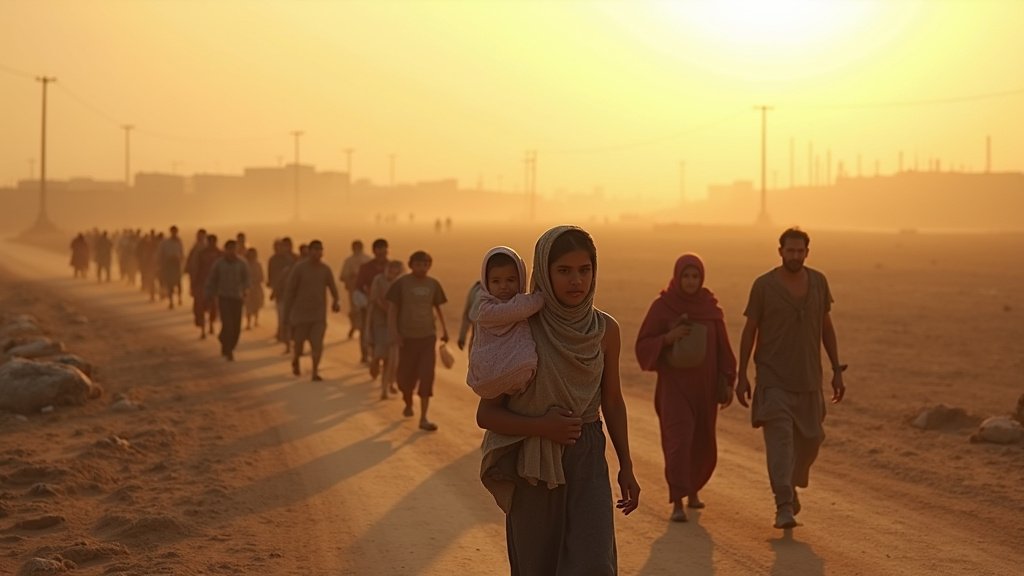
The Israeli military has announced preparations to forcibly displace hundreds of thousands of Palestinians to the southern Gaza Strip, a directive preceding an anticipated major offensive aimed at seizing control of northern Gaza City. This development has sparked immediate and grave concerns among international aid organizations and human rights groups, who warn of an already dire humanitarian crisis pushed to a new breaking point.
Israeli Directive and Justification
On Saturday, the Israeli military confirmed its plans to relocate civilians from active combat zones to the southern region of the enclave, asserting the move is intended to “ensure their safety.” The Coordination of Government Activities in the Territories (COGAT), Israel’s military agency responsible for civilian affairs in Palestinian territories, stated that the supply of tents and other shelter equipment would resume on Sunday, transported through the Kerem Shalom crossing by the United Nations and various international aid organizations following Israeli inspection. Prime Minister Benjamin Netanyahu has described these areas as “safe zones” and reiterated that Gaza City remains a critical stronghold for Hamas, which Israel aims to dismantle. Defense Minister Israel Katz confirmed that discussions are in their final stages to formalize the offensive plan. This news comes days after Israel announced its intention to launch a new offensive in the densely populated northern Gaza City area.
A Deepening Humanitarian Catastrophe
The announcement exacerbates an already catastrophic humanitarian situation in Gaza, where the majority of the population has been displaced multiple times since the conflict began in October 2023. According to figures from Gaza’s Health Ministry, more than 61,000 Palestinians have been killed and over 155,000 injured in the ongoing offensive. The United Nations and Palestinian officials vehemently dispute the notion of any truly safe zones within the besieged strip, noting that areas previously designated for humanitarian purposes in the south, such as Al-Muwasi, have also been subjected to Israeli airstrikes, with a recent strike on Saturday reportedly killing a baby and her parents in a tent. Over 90% of Gaza’s 2.1 million residents have already been internally displaced, facing acute shortages of food, water, medical care, and essential supplies. The UN Human Rights Office reported at least 1,760 Palestinians killed while seeking aid since late May, and the Health Ministry reports 251 hunger-related deaths, including 110 children, highlighting the severe famine conditions.
International Law and Mounting Condemnation
International bodies and human rights organizations have swiftly condemned the forced displacement, asserting it could constitute a serious breach of international law, including war crimes and crimes against humanity. Human Rights Watch has accused Israeli authorities of such violations due to the patterns of displacement. The International Commission of Jurists (ICJ) warns that forced displacement, particularly when no genuine choice exists for the population to remain, can amount to a crime against humanity. The issue is central to the genocide case against Israel at the International Court of Justice, and arrest warrants have been issued by the International Criminal Court for senior Israeli officials concerning alleged war crimes and crimes against humanity in Gaza. Concerns are particularly acute for vulnerable populations, including people with disabilities, who face immense challenges in adhering to rapid and unpredictable displacement orders and accessing vital assistance.
The Broader Conflict Context
This latest directive unfolds against the backdrop of the October 7, 2023, attacks by Hamas on southern Israel, which resulted in the deaths of approximately 1,200 Israelis and foreign nationals and the abduction of 251 hostages. Israel states its military operations are aimed at dismantling Hamas and ensuring its security. However, the comprehensive impact of these operations, including widespread destruction of infrastructure and the forced movement of civilians into increasingly confined spaces, continues to draw international alarm. Hamas has denounced the new relocation plan as a “new wave of genocide and displacement” and a blatant disregard for international and humanitarian laws. The ongoing conflict has also spurred protests within Israel, with families of the remaining ~50 hostages, of whom only 20 are believed to be alive, calling for an agreement to end the war and secure their release.
Challenges and Uncertain Future
The practical implementation of this mass displacement presents immense challenges. Southern Gaza is already severely overcrowded, with essential services having largely collapsed. Over 86% of the Gaza Strip is now under Israeli-militarized zones or displacement orders, leaving the remaining population squeezed into a fragmented and highly constrained area. The UN and humanitarian partners face significant obstacles in delivering aid safely and effectively due to military operations, inspection delays, and a severe lack of resources. The international community, through organizations like the UN Office for the Coordination of Humanitarian Affairs (OCHA), continues to call for an immediate and permanent ceasefire, unconditional release of all hostages, and unimpeded humanitarian access to prevent further catastrophic loss of life. The future for displaced Palestinians remains deeply uncertain, with many fearing that these new orders could lead to permanent dispossession.
More Stories
Costco Goes Nationwide on Uber Eats: A New Era for Bulk Delivery
Elena Rybakina Wins US Open, Ascends to World No. 1
Rubio Seals Security Pacts; Vance Drives Policy Agenda