











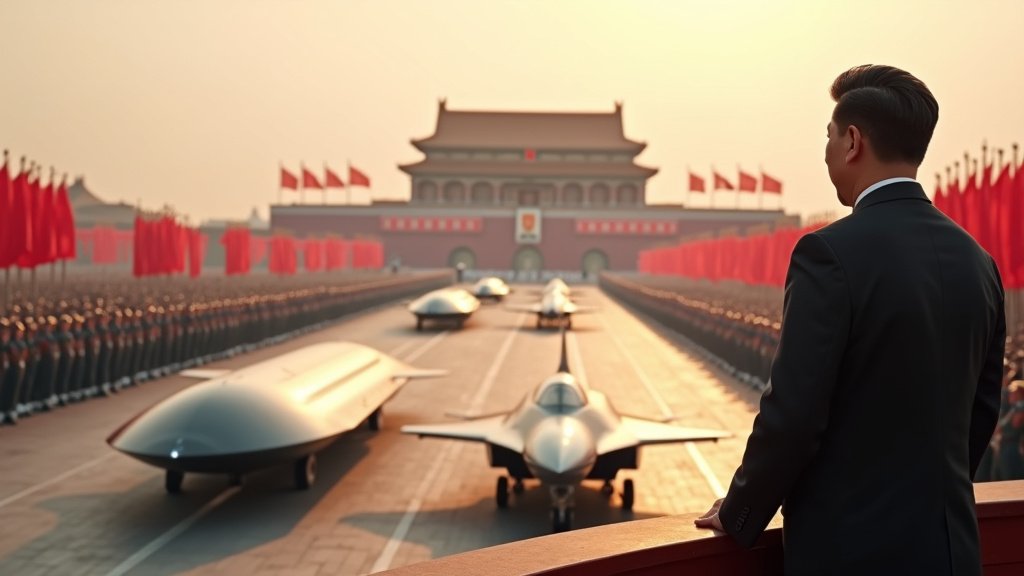
Beijing is poised to host a monumental military parade on September 3, 2025, a date designated as Victory Day, marking the 80th anniversary of China’s triumph in the War of Resistance Against Japanese Aggression and the broader World Anti-Fascist War. This significant event, centered around Tiananmen Square and traversing Chang’an Avenue, is set to be a powerful display of national remembrance and modern military might.
The central government has announced the completion of preparations for this gala event, which is expected to draw tens of thousands of participants and numerous international dignitaries.
Unprecedented Scale and Strategic Showcase
President Xi Jinping, who also serves as the General Secretary of the Communist Party of China (CPC) Central Committee and Chairman of the Central Military Commission, will review the troop formations and deliver an address. The roughly 70-minute parade will feature 45 contingents of troops and is anticipated to unveil an array of advanced, domestically produced weaponry, many of which will be making their public debut. Military officials, including Major General Wu Zeke, deputy director of the military parade, have indicated that the display will highlight China’s evolving defense capabilities.
Among the new-type fourth-generation armaments expected are advanced tanks, carrier-based aircraft, and cutting-edge fighter jets and bombers. Observers are particularly keen to see the showcase of strategic weapons, including land-, sea-, and air-based systems, as well as hypersonic precision-strike systems capable of traveling at five times the speed of sound. Furthermore, the parade will feature unmanned platforms, combat drones, counter-drone systems, directed-energy weapons, cyberspace warfare tools, and electronic jamming equipment, underscoring China’s advancements in emerging warfare domains.
The formations themselves are designed to demonstrate the People’s Liberation Army’s (PLA) system-based combat capability, organized in a manner reflecting their functions in real combat situations. This grand display is intended to fully demonstrate the Chinese military’s robust ability to adapt to technological advancements and evolving warfare patterns, asserting its readiness to prevail in future conflicts.
Historical Significance and International Presence
This year’s commemoration marks 80 years since the formal surrender of Japanese forces in 1945, following the devastating Second Sino-Japanese War (1937-1945), which inflicted immense casualties on the Chinese people and was a crucial component of the global anti-fascist struggle. China designated September 3 as its Victory Day, a day after Japan’s formal surrender on September 2, 1945.
This will be the second such large-scale parade since 2015, when China commemorated the 70th anniversary. Russian President Vladimir Putin is confirmed to be among the foreign leaders attending, a notable sign of geopolitical alignment. Other invited guests include leaders from Belarus, Indonesia, and Malaysia, with tentative invitations extended to Azerbaijan, Armenia, India, Iran, Laos, Myanmar, and Pakistan. However, many Western leaders largely abstained from the 2015 event, wary of endorsing Beijing’s overt demonstration of military power. Adding to the international dynamics, Taiwan’s Mainland Affairs Council has prohibited current government officials and certain former ones from attending, emphasizing its distinct perspective on the historical period.
Geopolitical Implications and Modernization Drive
This high-profile event is more than a historical remembrance; it serves as a significant projection of China’s burgeoning military strength and its ongoing modernization drive. Western nations and regional neighbors are closely monitoring the parade for insights into the People’s Liberation Army’s power projection capabilities, particularly given China’s rapid advancements in hypersonic missile technology and counter-drone systems. The strategic messaging of this news is clear: China aims to underscore its decisive role in the past victory while showcasing its capacity to safeguard its sovereignty, security, and development interests in the present and future.
The increase in China’s defense spending by 7.2 percent in March 2025 further highlights Beijing’s commitment to military modernization amidst deepening strategic competition, particularly with the United States.
Preparations for this grand spectacle have been ongoing for months, with large-scale rehearsals held in Beijing’s suburbs since early August, involving extensive participation from troops and enhanced security measures across the capital. This commemorative event is set to dominate the global headline as China reaffirms its historical narrative and demonstrates its formidable modern military capabilities on the international stage.
More Stories
Costco Goes Nationwide on Uber Eats: A New Era for Bulk Delivery
Elena Rybakina Wins US Open, Ascends to World No. 1
Rubio Seals Security Pacts; Vance Drives Policy Agenda