











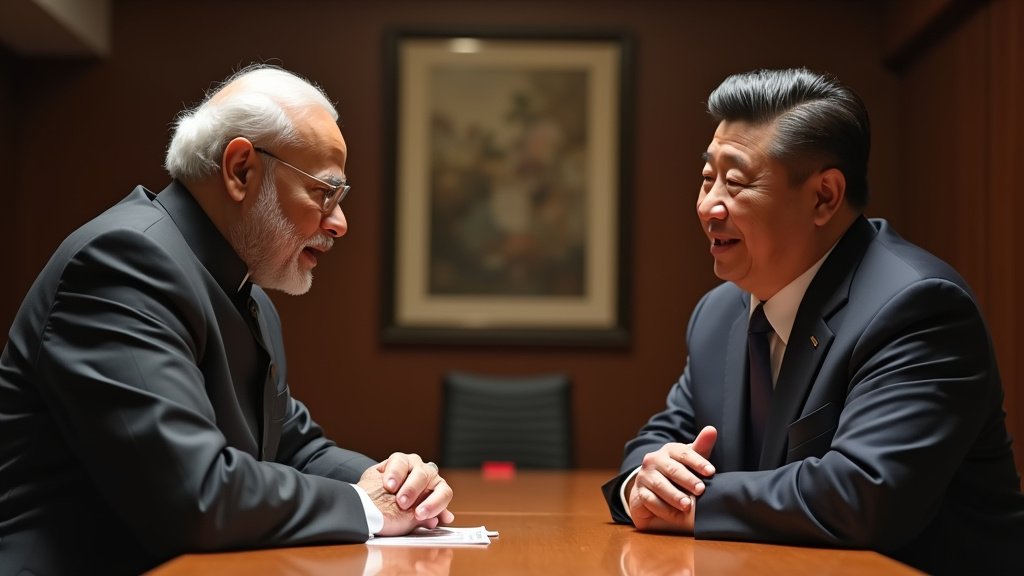
Tianjin, China – August 31, 2025 – Indian Prime Minister Narendra Modi and Chinese President Xi Jinping reaffirmed their commitment to a “fair, reasonable, and mutually acceptable” resolution of their long-standing boundary issue during a high-level meeting on the sidelines of the Shanghai Cooperation Organisation (SCO) Summit in Tianjin. The bilateral talks, held amidst global economic uncertainties and recent tariff-related trade tensions, also saw both leaders express a shared desire to stabilize global trade and foster a relationship characterized by cooperation rather than rivalry.
This significant meeting marked Prime Minister Modi’s first visit to China in seven years and provided a platform to build upon the “positive momentum and steady progress” noted in bilateral relations since their last engagement in Kazan, Russia, in October 2024. The discussions underscored a mutual agreement that the two Asian giants are “development partners, not rivals,” and that their differences should be managed constructively to prevent them from escalating into disputes.
Focus on Boundary Stability and Disengagement
Central to the discussions was the enduring Sino-Indian border dispute, a territorial disagreement with roots stretching back to colonial-era demarcations, notably the McMahon Line of 1914, which China has never formally accepted. Historical clashes, including the deadly 2020 Galwan Valley incident, have punctuated the relationship, leading to significant military disengagements and heightened tensions along the Line of Actual Control (LAC).
In this context, both leaders welcomed the “successful disengagement last year and the maintenance of peace and tranquility along the border areas since then.” Prime Minister Modi underlined the critical importance of sustained peace and stability in the border regions as a prerequisite for the continued development of overall bilateral relations, likening it to an “insurance policy for ties.” They acknowledged the important decisions taken by Special Representatives in their recent talks and agreed to further support their efforts towards a comprehensive resolution.
Economic Cooperation and Global Trade
The SCO Summit provided a crucial backdrop for discussions on economic matters, particularly in light of recent global trade disruptions and protectionist measures. Prime Minister Modi and President Xi recognized the vital role their respective economies play in stabilizing world trade. They underlined the necessity of approaching bilateral trade and investment from a “political and strategic direction” with the aim of expanding ties and reducing the significant trade deficit that India runs with China. While India’s trade deficit with China widened to $99.21 billion in fiscal year 2024-25, both leaders expressed a commitment to addressing these imbalances.
Strategic Autonomy and a ‘Third Country Lens’
Prime Minister Modi articulated India’s foreign policy stance by stating that both India and China pursue “strategic autonomy,” and that their bilateral relationship “should not be seen through a third country lens.” This sentiment, voiced amid US tariffs impacting Indian goods, highlighted India’s independent approach to foreign relations, seeking to balance multiple global partnerships based on national interests.
Enhancing People-to-People Ties and Future Engagement
The leaders also agreed on the importance of strengthening people-to-people exchanges. This includes facilitating direct flights between the two nations and enhancing visa processes, building upon the recent resumption of the Kailash Manasarovar Yatra and tourist visas. In a move signaling future cooperation, Prime Minister Modi extended an invitation to President Xi to attend the BRICS Summit that India will host in 2026.
Broader Geopolitical Context
The SCO summit itself serves as a significant platform for Eurasian nations to discuss regional security, economic cooperation, and global governance. Its expanded membership, including India, Pakistan, Iran, and Belarus, reflects its growing influence. The meeting between Modi and Xi occurs at a time when many nations are navigating complex geopolitical shifts, including shifts in global trade dynamics and alliances. The engagement between the two Asian giants, despite underlying strategic competition, suggests a pragmatic approach to managing differences and seeking common ground for regional and global stability. This news marks a crucial development in the ongoing efforts to foster a more predictable and cooperative relationship between India and China.
More Stories
Costco Goes Nationwide on Uber Eats: A New Era for Bulk Delivery
Elena Rybakina Wins US Open, Ascends to World No. 1
Rubio Seals Security Pacts; Vance Drives Policy Agenda