










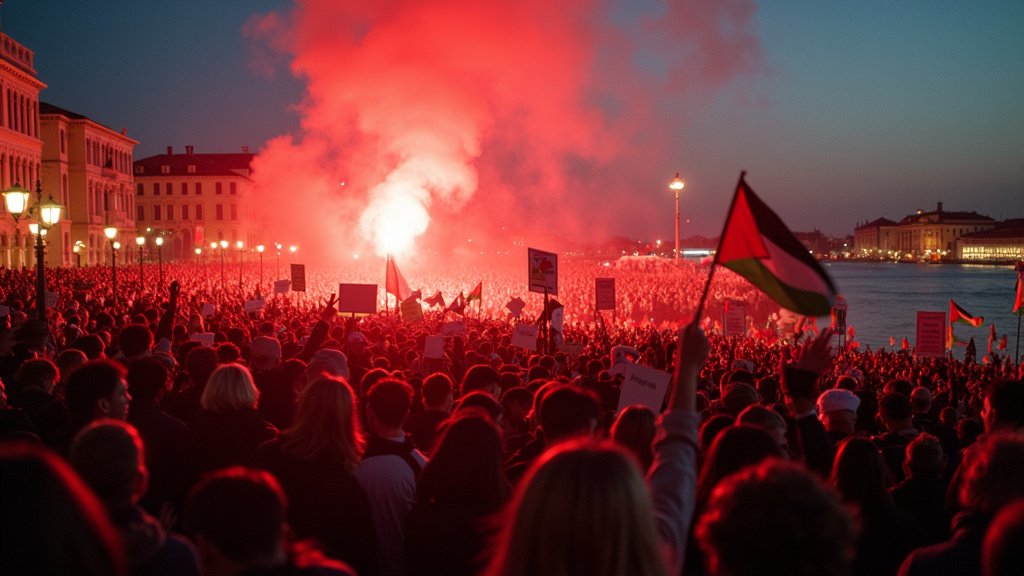
The 82nd Venice International Film Festival, a prestigious global cinema event, became the backdrop for a significant political statement on Saturday, August 30, 2025. Thousands of pro-Palestine demonstrators converged on the Lido, staging one of the largest protests ever seen at a major film festival. The march aimed to steer the focus away from cinematic glamour and toward the humanitarian crisis in Gaza, urging an end to the ongoing conflict and decrying international complicity. This event generated substantial film festival news, highlighting the intersection of art and activism.
A Groundswell of Solidarity: The March on Lido
The demonstration, organized by the Venice4Palestine collective, drew an estimated thousands of participants, with some reports suggesting numbers as high as 5,000. Attendees, comprising local Venetians and festival delegates alike, carried Palestinian flags, banners proclaiming “Stop the Genocide,” and chanted slogans such as “Free, Free Palestine.” The protest was characterized by its visual impact, employing music, flares, and symbolic paper boats to amplify its message. Organizers described the event as potentially the largest protest at a film event, emphasizing their goal to prevent the festival from remaining “an event isolated from reality.”
Festival Amidst Activism: “Frankenstein” Premiere and Official Stance
The march took place on the same day as the highly anticipated world premiere of Guillermo del Toro’s ambitious new movie, “Frankenstein,” starring Jacob Elordi and Mia Goth. While thousands marched, festival organizers, including Director Alberto Barbera, maintained a focus on cinema. Barbera acknowledged the international calls for the festival to take a stronger stance, expressing “huge sadness and suffering” regarding the Gaza conflict. However, he confirmed that the festival would not disinvite artists, stating, “We have never hesitated to clearly declare our huge sadness and suffering vis-à-vis what is happening in Gaza and Palestine.” He also noted that the Biennale had made a strong statement against the war earlier in the festival, featuring a priest who had been denied entry to Israel and was supportive of Palestine. The festival itself featured films that directly addressed the conflict, such as Kaouther Ben Hania’s “The Voice of Hind Rajab,” a film about a young Palestinian girl killed during the war, which premiered amidst the heightened political climate and had Brad Pitt among its executive producers.
Venice4Palestine: The Voice of Denouncement
The organizing group, Venice4Palestine, a coalition of Italian and international film professionals and activists, released a statement articulating their core demands and motivations. They accused Israel of committing genocide in Gaza and condemned Western governments for their alleged complicity through arms sales and diplomatic support, seeking to “break the silence on the systematic violence by the Israeli army.” Their message detailed the dire situation in Gaza, including accusations of widespread destruction of civilian infrastructure, hospitals, and schools, and the deprivation of essential resources. They also decried alleged “murderous attacks on film directors and crews in the West Bank.” This demonstration was not an isolated incident, following smaller protests on the festival’s opening day and mirroring similar activist efforts at other major film festivals. The collective had also penned an open letter signed by over 2,000 film professionals, urging the festival to explicitly denounce the “genocide” and calling for the disinvitation of prominent figures like Israeli actress Gal Gadot and actor Gerard Butler due to their past support for Israel. The scale of support for the letter, including from directors like Guillermo del Toro and Todd Field, underscored the widespread sentiment within the industry.
Cinema’s Role in Global Dialogue
The Venice Film Festival, a crucial launchpad for potential Oscar winners and a hub for new movie releases, also featured films that directly addressed the conflict. Protesters and signatories of the open letter stressed the responsibility of the film industry to leverage its global platform. “The entertainment industry has the advantage of being followed a lot, and so they should take a position on Gaza,” stated one participant. “This is not a political situation. This is a human situation.” The festival, which runs from August 27 to September 6, 2025, thus became a focal point not only for cinematic excellence but also for urgent global discourse, reflecting the increasing politicization of cultural events.
Broader Impact and Festival Narrative
The massive protest underscored a broader movement within the arts and film community to speak out against humanitarian crises. By bringing thousands to the streets, Venice4Palestine successfully placed the Gaza conflict at the center of public conversation surrounding the film festival. While festival director Barbera stated the protesters did not wish to enter the festival grounds and declined an offer to send a delegation to the red carpet, the sheer scale of the demonstration ensured its impact resonated far beyond the Lido’s immediate vicinity. The event generated considerable discussion about the role of cultural institutions in times of geopolitical conflict, making the news surrounding the film festival as much about activism as it was about the latest cinematic offerings. This highlighted how global affairs continue to shape the narrative of even the most celebrated cultural gatherings, influencing perceptions of new movie releases and the industry’s social responsibility.
More Stories
Bill Skarsgård Confirmed as Lead Star in Kojima’s PHYSINT
Andrew Scott to Bring ‘Sea Wall’ to the Big Screen in Directorial Team-Up with Tina Satter
Oasis Brothers Unite: The ‘Don’t Look Back In Anger’ London Premiere