











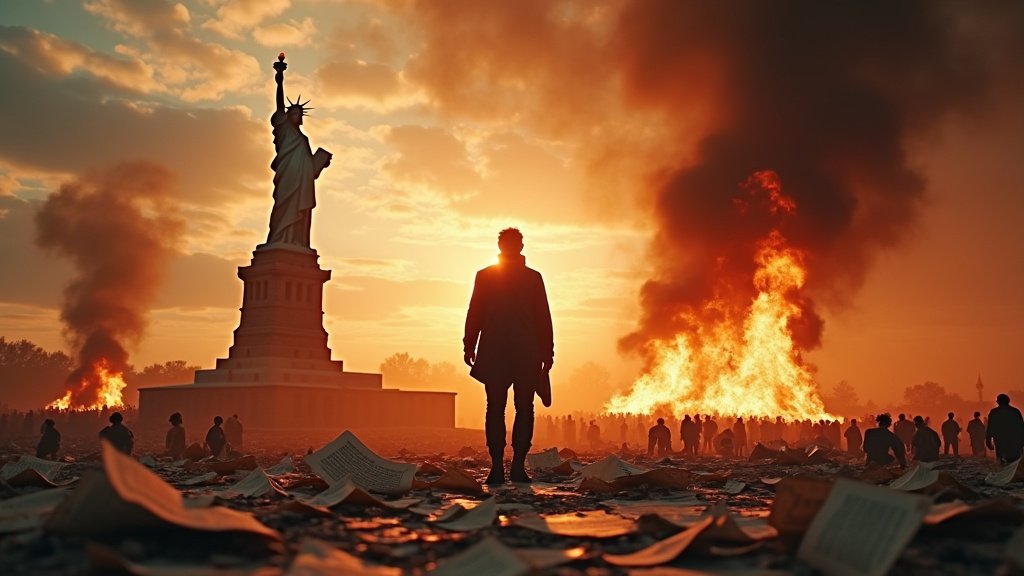
Recent acts of political violence, from the assassination of conservative activist Charlie Kirk to the January 6th Capitol attack, have prompted many to declare, “This isn’t who we are as Americans.” However, historical analysis suggests this sentiment overlooks a deeply ingrained aspect of the American experience: political violence has been a recurring and potent force throughout the nation’s 250-year history, shaping its culture and institutions.
The Roots of Violence: From Revolution to Repression
The foundation of the United States itself was forged in conflict, with the Revolutionary War demonstrating how political disagreements could escalate into widespread violence. Beyond open warfare, methods like tarring and feathering were used to punish political adversaries and enforce belonging, marking a persistent tendency to define insiders and outsiders through physical coercion. This was not an aberration but a tactic employed to enforce allegiances and decide who held power. Even after independence, the political landscape often remained grounded in a logic of violence towards adversaries, with instances of summary executions of suspected loyalists by patriot militias underscoring the normalization of such actions.
The early 20th century, particularly the years 1917-1921, witnessed what some historians describe as the bloodiest period of political violence in the United States since the Civil War. Fueled by America’s entry into World War I, this era saw widespread repression, including mass imprisonment for dissent, vigilante actions against leftists, and significant violence against Black Americans. This period exemplifies how national crises can ignite simmering conflicts, demonstrating that political violence has been interwoven with America’s social fabric, impacting labor relations, racial identities, and nativist sentiments.
Shifting Patterns and Evolving Threats
Over subsequent decades, the nature and targets of political violence evolved. The late 1960s and 1970s saw intense ideological groups on the far left committing acts of violence, often against property. By the late 1970s, political violence began to shift rightward with the rise of white supremacist, anti-abortion, and militia movements. While the number of incidents might have fluctuated, the targets increasingly shifted from property to people, including minorities, abortion providers, and federal agents.
In contemporary american news, a significant shift has been observed: the “ungrouping” of political violence. Instead of relying solely on organized groups, individuals are increasingly self-radicalizing through online engagement, leading to acts of violence that are harder to predict and attribute to specific organizations. This trend, coupled with extreme political polarization, has created a climate where violence can be catalyzed by social events or deliberately ignited for partisan gain. Threats against election administrators, plots to kidnap public officials, and the January 6th Capitol attack are stark examples of this escalating pattern.
The Role of Culture and Firearms
The unique gun culture in the United States, deeply rooted in its history and protected by the Second Amendment, plays a critical role in this narrative. Firearms have long been symbols of personal freedom, self-defense, and the individual’s right to resist authority. This deep connection between firearms and American identity means that debates over gun control are often intertwined with fundamental political and cultural values. As firearm access has increased, particularly since 2020, and with a growing segment of the population expressing willingness to use force for political objectives, the risk of violence is amplified.
Normalization and the Erosion of Democracy
Perhaps the most concerning trend is the normalization and increasing acceptance of political violence. Surveys indicate a disturbing rise in the proportion of Americans who would tolerate or even condone political violence, particularly against political opponents. This shift is exacerbated by rhetoric that demonizes opposing viewpoints, framing political rivals not as adversaries with different ideas, but as existential enemies. When the civil sphere, which ideally acts as a buffer, erodes, politics begins to feel like war, making compromise difficult and dialogue seem pointless. This environment directly threatens democratic stability, impacting everything from election processes to the safety of elected officials and poll workers.
While political violence has arguably been a constant companion to American democracy, its current intensity and the growing acceptance of its use present a profound challenge. Acknowledging this long and often violent history is not an act of resignation, but a crucial step towards understanding the present crisis and finding pathways to mitigate its destructive force, ensuring that the american culture moves away from the precipice of perpetual conflict.
More Stories
Lowriding’s Rise: SF Celebrates Cruising Culture
U.S. Repatriates 64 Cultural Relics and Fossils to China
Betting on Viral Fame: Novig’s Strategic Use of Sydney Sweeney