











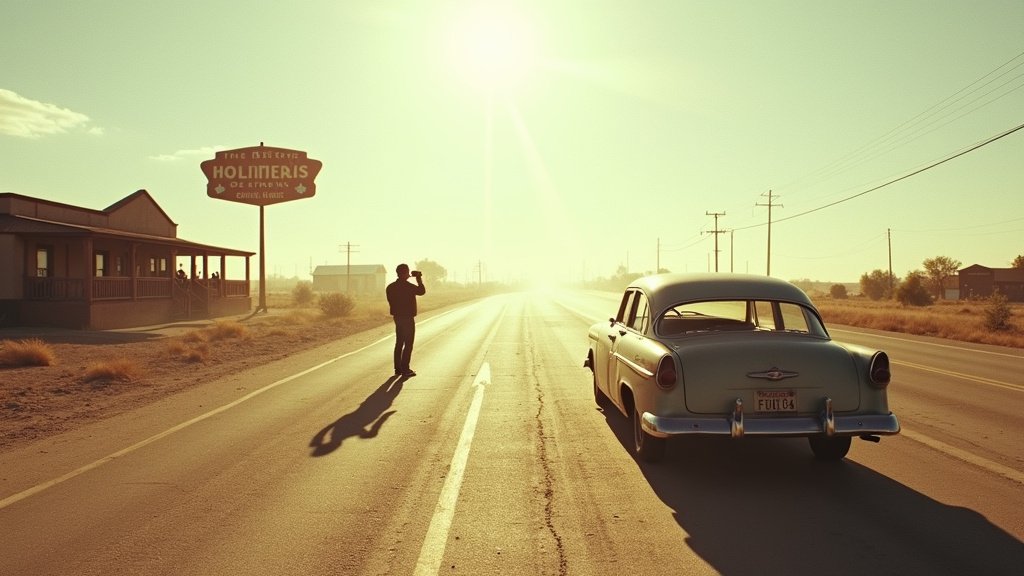
Robert Frank, a Swiss-American photographer and filmmaker, stands as one of the most influential figures in 20th-century photography. His unflinching gaze captured the complexities and contradictions of American life, leaving an indelible mark on the art form and continuing to resonate with audiences today. Frank’s seminal work, “The Americans,” is widely regarded as a revolutionary masterpiece that redefined the possibilities of documentary photography, offering a raw and nuanced portrait of a nation grappling with its identity.
The Outsider’s Perspective
Born in Zurich, Switzerland, in 1924, Frank immigrated to the United States in 1947, bringing with him the perspective of an outsider looking in. While initially working as a fashion photographer for Harper’s Bazaar, he found the constraints of commercial work limiting and yearned for a more profound artistic expression. This desire led him to embark on a cross-country journey across America, armed with his 35mm camera, to document the essence of its people and culture. His status as a Swiss-Jewish immigrant, coupled with his association with the Beat Generation, provided him with a unique vantage point to observe and critique the prevailing social norms and the often-unacknowledged realities beneath the surface of post-war American optimism.
“The Americans”: A Mirror to Society
Frank’s most celebrated work, “The Americans,” published in France in 1958 and the United States in 1959, was a radical departure from the optimistic and idealized portrayals of American life prevalent at the time. Comprising 83 black-and-white photographs, the collection delved into the “uneasy underbelly” of the nation, capturing scenes of racial inequality, consumerism, loneliness, and the stark divisions within society. Frank’s images offered a complex and often unsettling vision, presenting a nation caught between its burgeoning prosperity and underlying social tensions. The book’s unconventional approach, characterized by its empathetic yet critical eye, challenged the established norms of documentary photography and initiated a seismic shift in the medium’s perception.
A Style Defined by Rawness and Emotion
Robert Frank’s photographic style was revolutionary, characterized by its rawness, spontaneity, and emotional intensity. Eschewing the polished and perfectly composed images favored by many contemporaries, Frank embraced a more personal and intuitive approach. His photographs often featured grain, blur, unusual focus, and crooked horizons, a style that came to be known as the “snapshot aesthetic”. This unconventional technique, however, was not a result of technical deficiency but a deliberate choice to convey authenticity and capture the fleeting, unposed moments of everyday existence. Frank prioritized conveying the mood and atmosphere of a scene, inviting viewers to interpret the human emotions and subtle symbolism embedded within his frames.
An Enduring Legacy
Frank’s daring vision and unconventional approach profoundly influenced generations of photographers, including luminaries like Garry Winogrand, Diane Arbus, and Joel Meyerowitz. His work challenged photographers to look beyond surface appearances and to explore the deeper social, political, and cultural narratives within their subjects. The legacy of Robert Frank extends beyond photography; his work remains a vital commentary on the American experience, offering timeless lessons on observation, honesty, and the power of a singular artistic vision. His ability to capture the soul of a nation, with all its imperfections and beauty, solidifies his place as one of the most important visual storytellers of the 20th century.
More Stories
Lowriding’s Rise: SF Celebrates Cruising Culture
U.S. Repatriates 64 Cultural Relics and Fossils to China
Betting on Viral Fame: Novig’s Strategic Use of Sydney Sweeney