











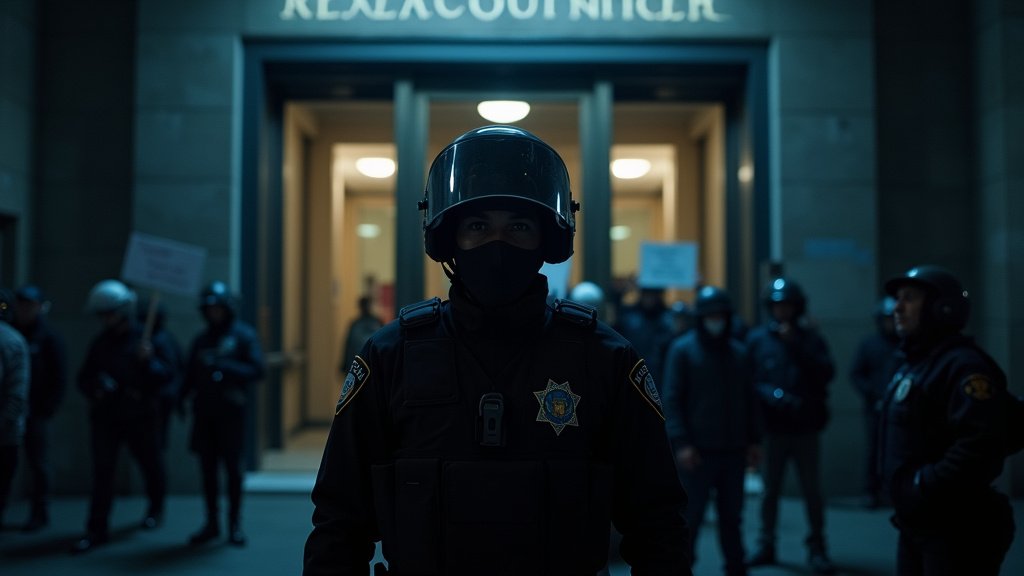
President Donald Trump has ordered the deployment of federal troops to Portland, Oregon, authorizing the use of “Full Force, if necessary,” to protect U.S. Immigration and Customs Enforcement (ICE) facilities, which he described as being “under siege from attack by Antifa, and other domestic terrorists.” The announcement, made via social media, escalates a controversial use of federal forces in American cities and has been met with immediate and strong condemnation from state and local officials who deem the deployment unnecessary and an abuse of power.
Portland Under Fire: A City Reacts
Trump’s decision casts Portland as a “war-ravaged” city in need of federal intervention, a characterization sharply disputed by Oregon’s Governor Tina Kotek and Portland Mayor Ted Wheeler. Governor Kotek stated unequivocally that the city and state “can manage our own local public safety needs” and that “there is no insurrection. There is no threat to national security.” Mayor Wheeler echoed this sentiment, asserting, “The number of necessary troops is zero, in Portland and any other American city.” He further criticized the deployment as an “absolute abuse of federal law enforcement officials” and a tactic to “bolster his sagging polling data.” Both leaders reported they were not consulted prior to the President’s announcement.
The Oregon congressional delegation, with one exception, also penned a letter to Trump, Secretary of Homeland Security Kristi Noem, and Secretary of Defense Pete Hegseth, rejecting the deployment. They characterized it as “unilateral action” that “represents an abuse of executive authority, seeks to incite violence, and undermines the constitutional balance of power between the federal government and states.”
Background of Federal Presence and Civil Liberties Concerns
This latest deployment revisits a tense chapter in Portland’s recent history. In the summer of 2020, following nationwide protests against racial injustice after the murder of George Floyd, the Trump administration sent hundreds of federal agents to Portland. These agents, drawn from agencies like Customs and Border Protection (CBP), the U.S. Marshals Service, and Homeland Security, were tasked with protecting federal property, including the U.S. Courthouse. However, their presence quickly became a focal point of conflict and controversy.
Reports and lawsuits filed by organizations such as the American Civil Liberties Union (ACLU) detailed aggressive tactics by federal agents, including the use of unmarked vehicles, indiscriminate tear gas deployment, and the apprehension of protesters far from federal property—actions the ACLU decried as “kidnapping” and violations of civil liberties. The federal government’s actions led to accusations of overreach and a “personal army” being used for political purposes.
Justifications and Counterarguments
President Trump’s administration has consistently framed the protests in Portland as lawless and anarchic. The recent announcement specifically cited the designation of Antifa as a domestic terror organization and alleged ongoing attacks on ICE facilities as justification for deploying troops. The Department of Homeland Security stated that “rioters in Portland, Oregon have repeatedly attacked and laid siege” to their facilities.
Conversely, local news outlets and officials have painted a picture of a city that, while experiencing ongoing protests, is not “war-ravaged.” Data indicates that violent crime and homicide rates in Portland have been declining in the years leading up to this announcement, with homicides reportedly down significantly in the first half of 2025.
The Road Ahead
While the Pentagon has stated it “stand[s] ready to mobilize U.S. military personnel in support of DHS operations in Portland at the President’s direction,” details regarding the specific troop numbers and timeline for deployment remain unclear. The authorization to use “Full Force” has also raised concerns about the potential for escalation and the legal boundaries of military involvement in domestic law enforcement.
This escalation in federal involvement in Portland represents a significant moment in the ongoing national conversation about civil unrest, federal authority, and the rights of american citizens to protest. The news is being closely watched as it unfolds, reflecting a complex interplay of political rhetoric, local governance, and constitutional rights that continue to shape the american news cycle.
More Stories
Lowriding’s Rise: SF Celebrates Cruising Culture
U.S. Repatriates 64 Cultural Relics and Fossils to China
Betting on Viral Fame: Novig’s Strategic Use of Sydney Sweeney