











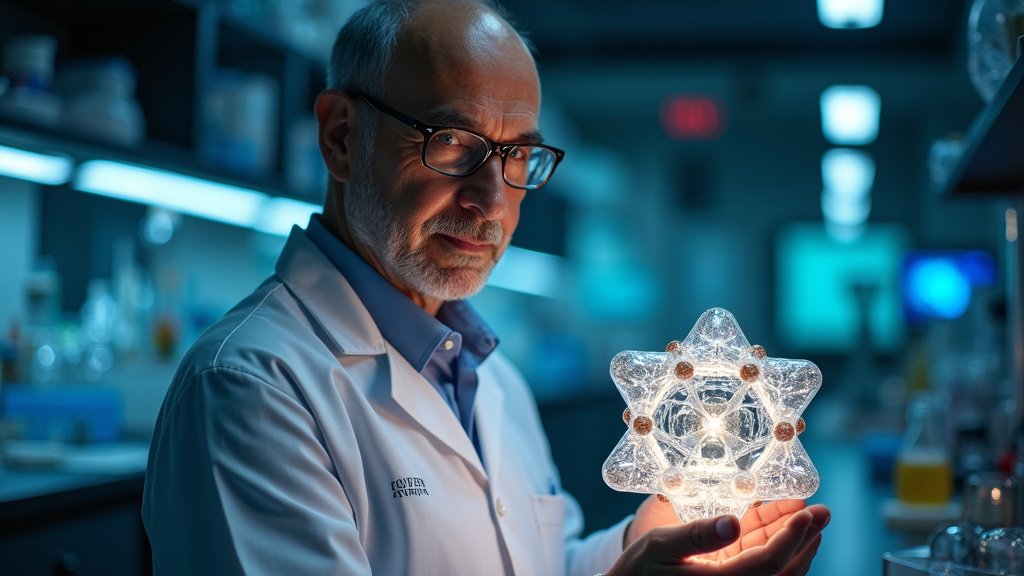
Stockholm, Sweden – October 8, 2025 – The Royal Swedish Academy of Sciences today announced the recipients of the 2025 Nobel Prize in Chemistry, honoring Omar M. Yaghi, a distinguished chemist at the University of California, Berkeley, alongside Richard Robson of the University of Melbourne and Susumu Kitagawa of Kyoto University. The prestigious award recognizes their foundational work in developing metal-organic frameworks (MOFs), a revolutionary class of materials that have unlocked novel molecular architectures with vast internal spaces.
A New Era in Molecular Architecture
The Nobel Committee cited the laureates for “creating new rules” in chemistry by designing a novel form of molecular architecture. These structures, known as MOFs, are formed by linking metal ions with organic molecules, creating highly porous crystalline materials. These intricate frameworks possess large cavities that allow gases and other chemicals to flow in and out, enabling unprecedented control over molecular interactions. The development of MOFs has revolutionized material design, offering chemists the ability to create custom materials with precise properties for a wide array of applications.
The Science Behind the Breakthrough
Omar Yaghi, often hailed as the founder of reticular chemistry, pioneered the concept of stitching molecular building blocks together with strong bonds to form predictable, extended structures. His seminal work, particularly the development of MOF-5 in 1999, demonstrated ultra-high porosity, a characteristic far exceeding previous porous solids. This innovation laid the groundwork for synthesizing tens of thousands of MOF variations, each with unique properties tailored for specific functions.
Richard Robson is credited with creating the first spacious MOF crystal in 1989, laying early groundwork for the field. Susumu Kitagawa significantly advanced the understanding of MOFs between 1992 and 2003, demonstrating gas flow through these frameworks and highlighting their flexibility and modifiability. Together, their contributions have transformed the field from rudimentary coordination polymers into robust, versatile materials.
Revolutionary Applications for Global Challenges
The implications of MOFs extend far beyond the laboratory, offering innovative solutions to some of the world’s most pressing environmental and industrial challenges. These materials are proving invaluable in:
* Climate Change Mitigation: MOFs can selectively capture carbon dioxide (CO2) from industrial emissions and even directly from the air, offering a powerful tool in the fight against global warming.
* Water Harvesting: Certain MOFs can absorb moisture from the atmosphere, even in arid desert conditions, and release it as clean, drinkable water, addressing global water scarcity.
* Gas Storage and Separation: Their porous nature allows for efficient storage of gases like hydrogen and methane, crucial for clean energy technologies, and the separation of various gases for industrial processes.
* Catalysis and Remediation: MOFs can act as catalysts for chemical reactions and are being developed to filter toxic pollutants from water and break down harmful chemicals.
A Legacy of Innovation at UC Berkeley
Omar Yaghi, a Jordanian-American chemist, is the James and Neeltje Tretter Professor of Chemistry at the University of California, Berkeley. His Nobel Prize win marks him as the fifth UC Berkeley faculty member to receive the award in the past five years and the 28th overall. Yaghi’s work has not only established reticular chemistry as a field but has also led to the spin-off of companies aimed at commercializing MOF technology for practical applications, such as water harvesting devices.
The announcement is a significant news event, highlighting the transformative power of fundamental scientific research. The headline achievement underscores the critical role that materials science plays in developing sustainable solutions for the future and has garnered widespread attention from scientific communities and environmental organizations globally.
More Stories
Costco Goes Nationwide on Uber Eats: A New Era for Bulk Delivery
Elena Rybakina Wins US Open, Ascends to World No. 1
Rubio Seals Security Pacts; Vance Drives Policy Agenda