











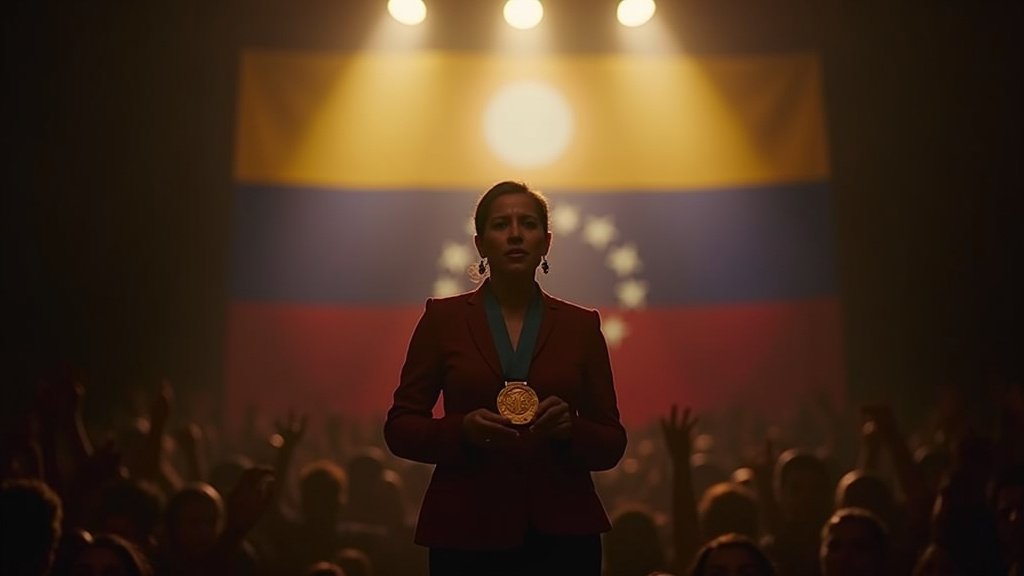
OSLO – In a significant recognition of her unwavering struggle for democratic rights, Venezuelan opposition leader Maria Corina Machado has been awarded the 2025 Nobel Peace Prize. The Norwegian Nobel Committee announced the decision on Friday, October 10, 2025, citing her courageous efforts to “keep the flame of democracy burning amidst a growing darkness in Venezuela.”
Machado, a prominent figure in Venezuela’s pro-democracy movement and the National Coordinator of the Vente Venezuela party, has become a powerful symbol of civilian courage in Latin America. An industrial engineer by training, she entered politics in 2002 and has since been a consistent voice against the authoritarian rule of President Nicolás Maduro. Her activism has included co-founding the vote-monitoring organization Súmate and serving as a member of the National Assembly from 2011 to 2014. Despite facing disqualifications, politically motivated charges, and threats, Machado has remained a central figure in rallying the opposition, often working from behind the scenes and inspiring millions through her persistent calls for peaceful resistance and free elections. The Committee specifically recognized her “tireless work promoting democratic rights” and her “struggle for a just and peaceful transition from dictatorship to democracy”.
The Nobel Committee received a total of 338 nominations for the 2025 prize, comprising 244 individuals and 94 organizations, a number reflecting the global urgency of peace and human rights issues [Context, 6, 26]. The announcement has dominated international news feeds, highlighting the ongoing political crisis in Venezuela, which has seen widespread abuses, arbitrary detentions, and a severe humanitarian emergency characterized by millions of citizens fleeing the country.
Machado’s victory was met with widespread acclaim from international bodies, with the United Nations welcoming the decision as a reflection of Venezuela’s “democratic aspirations”. However, the award also stirred political controversy. The White House issued a critical statement, asserting that the Nobel Committee had “proved they place politics over peace.” This sentiment was amplified by former US President Donald Trump, who had repeatedly claimed he deserved the prize for his efforts in mediating global conflicts, including a recent Gaza ceasefire [Context, 9, 11, 14, 19]. Experts and historians, however, have contested many of Trump’s claims, noting that his nominations for the 2025 prize arrived after the deadline and that his foreign policy approach often deviates from the ideals of sustained, multilateral peace efforts that the Nobel Committee typically favors. The committee itself maintains that its decisions are based solely on Alfred Nobel’s will and the merits of the work presented, independent of political lobbying.
The Nobel Peace Prize, established in 1901, has a history marked by controversy, with past awards to figures like Henry Kissinger, Yasser Arafat, and Abiy Ahmed drawing significant debate. Critics often point to the political nature of the Norwegian Nobel Committee, appointed by the Norwegian Parliament, as a factor influencing its selections. The American administration’s reaction underscores the complex geopolitical currents that often intersect with the prize’s perceived mission.
Machado’s award is seen as a powerful endorsement of non-violent resistance and the pursuit of democracy against entrenched authoritarianism. It injects renewed hope into the Venezuelan struggle and serves as a significant moment in global culture, underscoring the enduring value placed on democratic rights and peace. The prize includes an award of 11 million Swedish kronor (approximately $1.2 million), a diploma, and a gold medal, to be presented on December 10th [Context]. Machado’s recognition by the Nobel Committee provides a global platform for the ongoing fight for freedom and dignity in Venezuela.
More Stories
Lowriding’s Rise: SF Celebrates Cruising Culture
U.S. Repatriates 64 Cultural Relics and Fossils to China
Betting on Viral Fame: Novig’s Strategic Use of Sydney Sweeney