











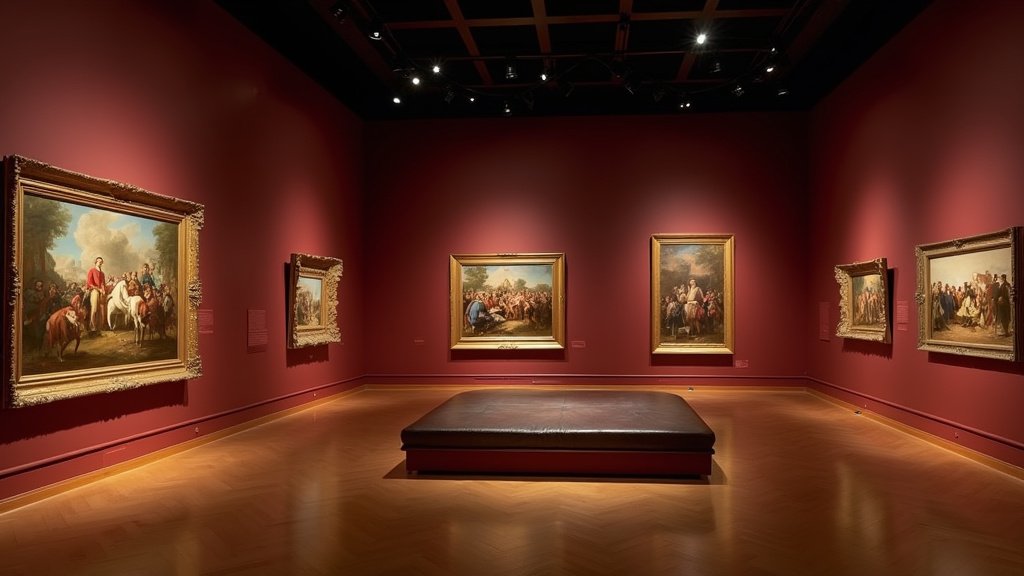
Princeton University’s newly expanded Wilmerding American Art Pavilion is not merely a repository of historical artifacts; it is a dynamic arena designed to spark critical conversations about the nation’s complex past and its evolving future. Through thoughtful juxtapositions and the inclusion of diverse perspectives, the American Art Pavilion offers visitors a unique opportunity to engage with American history and culture in nuanced and challenging ways. This approach underscores a commitment to presenting a multifaceted narrative that moves beyond traditional interpretations, fostering a deeper understanding of Princeton art history.
An American Art Pavilion Curatorial Approach Fostering Dialogue
The core strategy of the Wilmerding Pavilion lies in its deliberate arrangement of artworks. Senior curator Karl Kusserow highlights that the installation “mixes up works of art from different places and different periods of time to suggest different ways of understanding.” This method encourages viewers to forge their own connections between pieces, prompting contemplation on themes such as protest movements, gender, and environmental justice. By placing seemingly disparate works in dialogue, the American Art Pavilion challenges visitors to piece together the intricate tapestry of American identity and history, making it a significant source of cultural news and insight and a key site for dialogue through art.
Anchors of the Past: Revolutionary Roots and Evolving Narratives in the American Art Pavilion
Serving as a historical anchor within the American Art Pavilion is Charles Willson Peale’s seminal painting, “George Washington at the Battle of Princeton.” This artwork holds a special place in Princeton’s history, being the very first painting acquired by the university and an early cornerstone of its art collection. Rendered with a powerful depiction of victory, the painting reflects a pivotal moment in the American Revolution, symbolizing the nation’s nascent confidence and its fight for independence. Peale’s work, intended to replace a portrait of King George II, carries profound symbolic weight, marking a definitive shift in the visual representation of American leadership and power. The American Art Pavilion showcases this and other historical pieces not just as relics, but as starting points for understanding the foundational narratives of the United States and engaging with historical art interpretation.
Reimagining Foundational Moments at the American Art Pavilion
Further challenging traditional historical portrayals, the American Art Pavilion features Renee Cox’s provocative photograph, “The Signing.” This work revisits Howard Chandler Christy’s iconic “The Signing of the Constitution” but crucially replaces the white Founding Fathers with a diverse cast of people of color. Cox’s piece is a powerful reinterpretation, aiming to create a more inclusive vision of America’s founding document and its subsequent history, directly confronting the exclusionary aspects of the original. It serves as a critical commentary on contemporary issues and the ongoing struggle for equality, highlighting diverse perspectives art. Adjacent to this impactful photograph hangs a painting of Mrs. Reverdy Johnson, wife of the lawyer involved in the Dred Scott decision, further linking artistic displays to pivotal legal and social justice moments in American history.
A Space for Contemporary Reflection within the American Art Pavilion
The Wilmerding American Art Pavilion, significantly expanded through generous donations, now allows for nearly five times the number of American art works to be displayed simultaneously, embracing a broader definition of American art to include Spanish Colonial and Native American works. This expansion is crucial for presenting a more comprehensive and dynamic view of the nation’s artistic heritage. The American Art Pavilion’s curatorial vision explicitly aims to provoke thought and discussion, encouraging visitors to confront the nation’s legacy, including its historical associations with slavery and the ongoing pursuit of justice. By juxtaposing historical and contemporary pieces, the American Art Pavilion transforms into a vital space where visitors can critically engage with and reimagine the overarching narrative of the American experience, solidifying its role as a hub for important cultural discourse Princeton.
In conclusion, the Wilmerding American Art Pavilion at Princeton University stands as a testament to the power of art to illuminate history and foster dialogue. Its innovative approach to display and its commitment to diverse voices ensure that the American Art Pavilion remains a vital platform for exploring the complexities of the American story and its continuous evolution, offering a space for art and social justice discussions.
More Stories
The Women of Flower Drum Song Returns to Democracy Center
Freedom Plane Tour Brings History to Atlanta
PEN America’s 2026 Festival: Literature’s Defiant Return