










Introduction
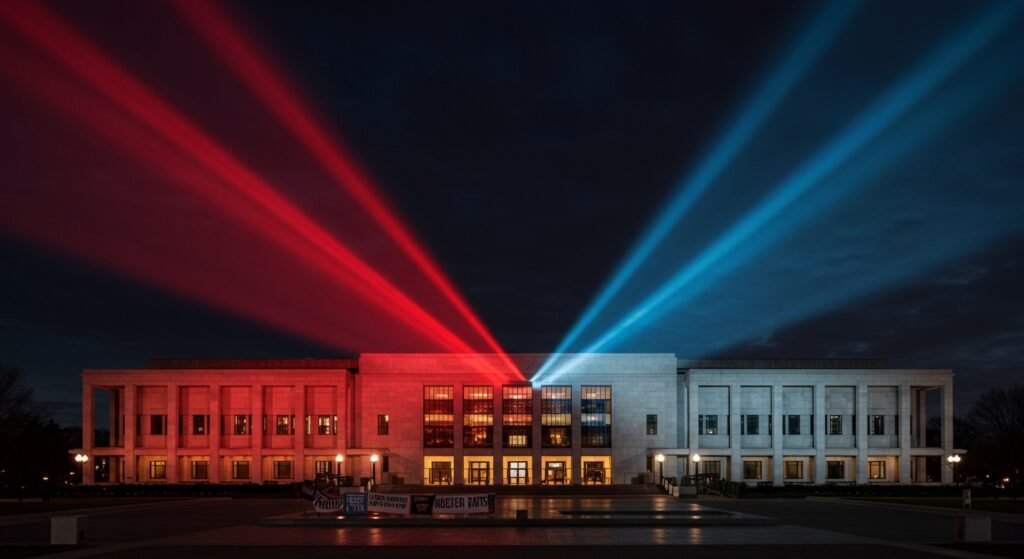
A significant cultural and political confrontation is unfolding in Washington, D.C., centered on the John F. Kennedy Center for the Performing Arts. Changes initiated by U.S. President Donald Trump at the prestigious national cultural institution have drawn sharp criticism and protest from artists and human rights advocates across both Canada and the United States.
President Trump’s actions, which include installing himself at the helm of the Kennedy Center’s governance and vowing to eliminate what he terms ‘woke’ performances, have ignited concerns about the intersection of politics and artistic expression. The resulting backlash has seen prominent figures and productions cancel planned appearances, highlighting the deep divisions and the perceived stakes for the future of American culture.
Trump Assumes Control and Declares New Direction
The controversy escalated following President Trump’s announcement in early February, made on his Truth Social platform. In a series of posts, he outlined his intent to assert direct control over the Kennedy Center.
“At my direction, we are going to make the Kennedy Center in Washington D.C., GREAT AGAIN,” Trump stated, signaling his ambition to reshape the institution’s programming and leadership. He announced plans to “immediately terminate multiple individuals from the Board of Trustees, including the Chairman,” citing their failure to align with his self-described “Vision for a Golden Age in Arts and Culture.”
A particularly notable aspect of his announcement was his decision to install himself as chairman of the board. This step was widely observed and reported as an unusual move, consolidating executive political power directly within the governance of a major national cultural institution typically operating with a degree of artistic autonomy.
President Trump explicitly declared his intention to target specific types of performances, vowing to remove those he labeled as ‘woke’. This directive has been interpreted by many as a political litmus test for artistic content presented at the center.
Artistic Community Responds with Protests and Cancellations
The President’s actions and stated intentions have prompted a swift and robust response from the arts community and human rights advocates. Protests have emerged on both sides of the border, with Canadian and American artists voicing strong opposition.
The tangible manifestation of this dissent has been the cancellation of scheduled events by notable figures and productions. Among those who have withdrawn their participation are the acclaimed musical Hamilton, which has garnered significant critical and commercial success, actress and writer Issa Rae, and the internationally renowned Canadian author Louise Penny.
Lin Manuel Miranda, the co-creator and original star of Hamilton, articulated the production’s stance in comments made to The New York Times. He stated unequivocally that “the Kennedy Center was not created in this spirit, and we’re not going to be a part of it while it is the Trump Kennedy Center.”
Commentary and Counter-Criticism
The implications of the government’s intervention in cultural institutions have also drawn commentary from legal and human rights perspectives. A human rights lawyer, speaking on the situation, cautioned that attempts to “capture culture” and dictate artistic output are characteristic tactics often employed by authoritarian governments.
In response to the cancellations and criticism, figures aligned with President Trump have offered counterarguments. Following Hamilton‘s decision to withdraw, Grenell posted on social media on Wednesday, publicly addressing the move.
Grenell characterized the Hamilton cancellation as a “publicity stunt that will backfire.” He argued against the idea that the arts should be exclusive to those who share particular political viewpoints, stating that “The arts are for everyone — not just for the people who Lin likes and agrees with.” Furthermore, Grenell asserted that “The American public needs to know that Lin Manuel is intolerant of people who don’t agree with him politically,” framing Miranda’s decision as an act of political intolerance rather than a defense of artistic freedom.
What is at Stake for American Culture?
The confrontation at the Kennedy Center raises fundamental questions about the role of national cultural institutions, the relationship between government and the arts, and the definition of artistic freedom in a politically charged environment. For Canadian and American artists and human rights advocates, the changes represent an attempt to impose a political ideology onto artistic programming, potentially stifling diverse voices and perspectives.
Critics argue that the President’s stated aim to remove ‘woke’ performances and align programming with his specific “Vision for a Golden Age in Arts and Culture” risks transforming the Kennedy Center from a broad platform for artistic expression into an arena for political endorsement or censorship. The unusual step of the President installing himself as chairman is seen by many as consolidating political power in a way that could undermine the institution’s independence and artistic integrity.
The protests and cancellations, while causing disruption, are intended by participating artists and advocates to draw international attention to the situation and underscore the perceived threat to the cultural landscape. They view their actions as a defense of the principles of artistic freedom and institutional autonomy.
Conversely, supporters of President Trump’s actions argue that the changes are necessary to address what they see as a cultural shift towards partisan or ideologically driven content within the arts, seeking to realign institutions like the Kennedy Center with a different set of values or a broader audience they feel has been alienated.
Conclusion
The dispute at the John F. Kennedy Center for the Performing Arts remains a focal point in the ongoing debate about the intersection of politics, culture, and free expression in the United States. With prominent figures and productions continuing to protest through cancellation and vocal criticism, the future direction and the nature of the art presented at this key Washington, D.C. institution remain subjects of intense scrutiny and disagreement, highlighting the significant cultural stakes involved.
More Stories
PEN America’s 2026 Festival: Literature’s Defiant Return
Dive Deep into American Culture: Quiz Explores Baseball Legends and Quirky Snacks
Original Penguin Sues Pudgy Penguins for Trademark Infringement Over Penguin Branding