











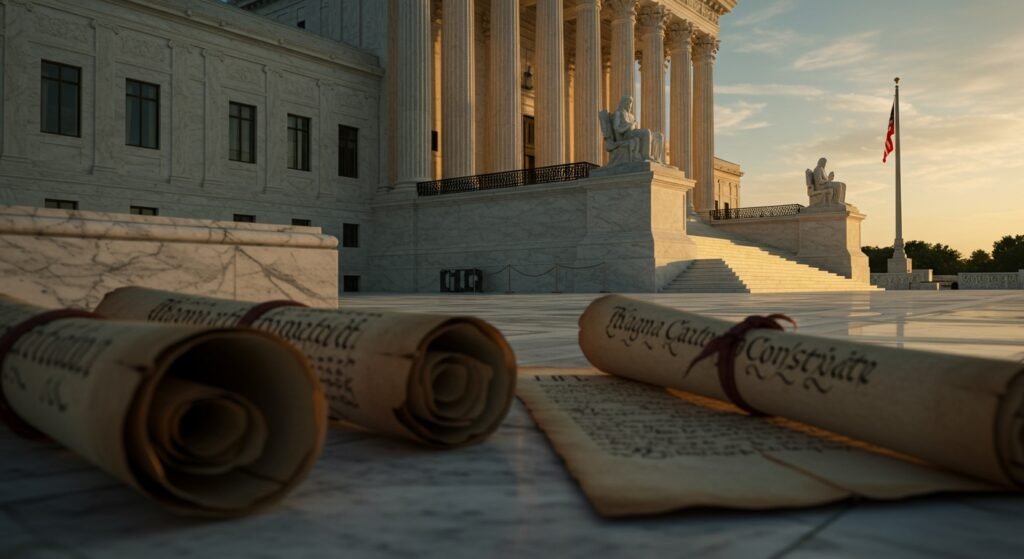
On May 6, 2025, a detailed analysis rooted in a Christian worldview provided insight into the escalating national conversation surrounding due process rights in the context of illegal immigration. The discussion gained renewed prominence following recent comments made by President Trump, which underscored the complexities and constitutional questions inherent in addressing individuals residing in the United States without legal authorization.
The analysis highlighted the fundamental principle of due process, a cornerstone of legal systems designed to ensure fairness and prevent arbitrary deprivation of life, liberty, or property. Its historical roots trace back to monumental legal documents, notably Clause 39 of the Magna Carta, enacted in 1215, which stated that no free man should be imprisoned, exiled, or destroyed “except by the lawful judgment of his peers or by the law of the land.”
Foundations of Due Process in the United States
In the United States, the concept of due process is explicitly enshrined in the Constitution. The 5th Amendment, ratified as part of the Bill of Rights, mandates that no person shall “be deprived of life, liberty, or property, without due process of law.” Following the Civil War and Reconstruction, the 14th Amendment, ratified after 1866, extended this protection, stating that no state shall “deprive any person of life, liberty, or property, without due process of law; nor deny to any person within its jurisdiction the equal protection of the laws.”
Crucially, these amendments are generally understood within U.S. jurisprudence to apply to individuals within the U.S. legal jurisdiction. However, the precise scope of due process rights for non-citizens, particularly those who have entered the country unlawfully, remains a subject of significant legal and political debate. This ambiguity is central to the current discourse surrounding immigration enforcement and the rights afforded to individuals facing deportation or other legal actions.
The Immigration Context and President Trump’s Comments
The recent comments from President Trump have brought the application of due process in immigration cases into sharper focus. While the specifics of his remarks were not detailed in the analysis, they evidently reignited debate over whether the U.S. legal system adequately, or excessively, extends procedural rights to individuals present illegally.
Proponents of a more stringent approach argue that individuals who violate immigration laws forfeit certain protections, while advocates for broader rights contend that basic human dignity and the principle of due process require fair treatment and access to legal processes regardless of immigration status. This tension between national sovereignty, border security, and individual rights forms the crux of the legal challenge.
The Anticipated Role of the Supreme Court
The analysis underscored the expectation that the Supreme Court of the United States will eventually be tasked with resolving many of these complex constitutional questions. Given the differing interpretations of statutory and constitutional law regarding immigration and due process, high court review appears all but inevitable. A Supreme Court ruling would carry significant weight, potentially reshaping immigration policy and enforcement procedures nationwide by clarifying the extent of due process rights applicable to non-citizens in various circumstances.
Past rulings by the Court have offered some guidance, distinguishing between different categories of non-citizens and the rights afforded to them. However, evolving challenges at the border and shifting political dynamics necessitate further legal clarity, which only the nation’s highest court can ultimately provide.
A Comparative Legal Perspective
The discussion also drew a distinction between the U.S. legal framework and that of other nations, specifically referencing Britain’s parliamentary supremacy. In contrast to the U.S. system, where constitutional due process provides a robust check on legislative and executive power, parliamentary supremacy in Britain historically places less emphasis on judicial review based on entrenched constitutional rights. This comparison highlights the unique constitutional safeguards embedded within the U.S. system, even as their application is debated.
Broader Political Landscape: ‘Dark Woke’ Messaging
Beyond the legal and constitutional debate, the analysis touched upon the broader political environment influencing these discussions. It noted an announcement from the Democratic party regarding the introduction of new political messaging, described as ‘Dark Woke’. While the specifics or implications of this messaging strategy were not elaborated upon, its mention indicates the diverse political forces and communication tactics at play in the national discourse, likely impacting how complex issues like immigration and constitutional rights are framed and debated publicly.
In summary, the issues of upholding the Constitution, the scope of due process, and the challenges posed by illegal immigration remain central to the national conversation on May 6, 2025. Fueled by political commentary, grounded in deep historical legal tradition, and facing prospective clarification from the Supreme Court, these topics continue to highlight fundamental questions about law, rights, and national identity in the United States.
More Stories
PEN America’s 2026 Festival: Literature’s Defiant Return
Dive Deep into American Culture: Quiz Explores Baseball Legends and Quirky Snacks
Original Penguin Sues Pudgy Penguins for Trademark Infringement Over Penguin Branding