











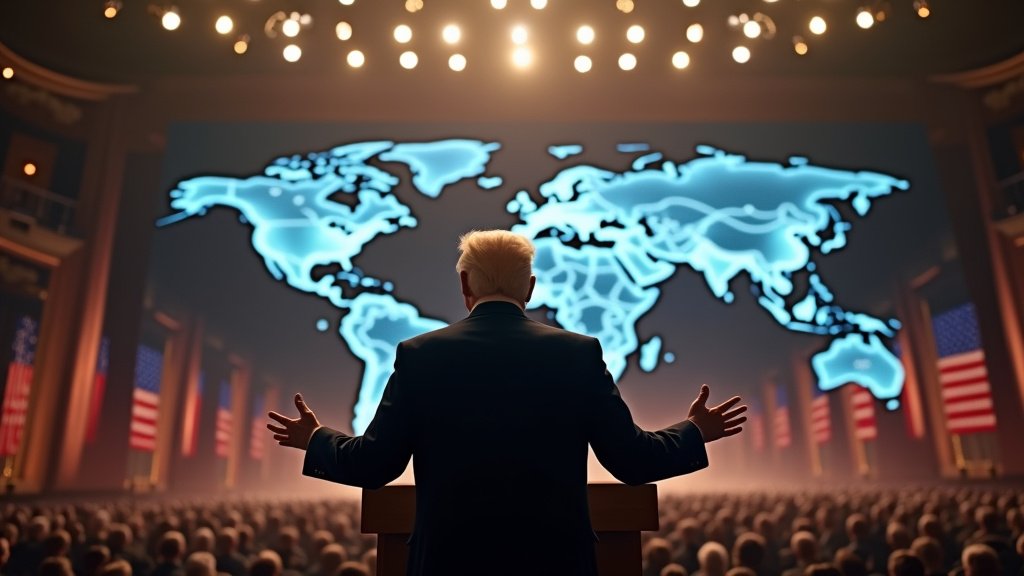
The stark reality is that globalization failed the West, a message powerfully conveyed by President Donald Trump at the 2026 World Economic Forum. Championing an “America First” agenda, Trump set a stark new tone in Davos, with his delegation prioritizing trade protectionism and dominance in artificial intelligence. This marked a clear departure from traditional WEF consensus, signaling a significant shift in global economic and political discourse. The news from Davos undeniably confirmed that globalization failed.
Globalization Failed the West: A New American Stance
Commerce Secretary Howard Lutnick delivered a blunt message, stating globalization has failed the West. He spoke on a panel at the forum, unequivocally declaring, “Globalization has failed the West and the United States of America,” labeling it a “failed policy.” Lutnick argued that it moved production offshore, leaving American workers behind. The administration pushed a new model centered on national interest, economic resilience, and national sovereignty, directly addressing how globalization failed.
Aggressive Stance on Trade Protectionism US
The US Trade Representative defended the use of tariffs, calling them legitimate geopolitical tools. He warned European allies against retaliation, stating the US market is not permanently available to everyone. This rejected decades of trade policy, with tariffs now viewed as strategic currency, not just economic instruments. The US warned that retaliation would be “unwise.”
Trump claimed he slashed the trade deficit by “a staggering 77 percent,” defending his trade protectionism US policies as supportive of national growth and industry. He reiterated that globalization failed to deliver for the average American.
The AI Dominance Competition Heats Up
Dominance in artificial intelligence was a key theme, with the US delegation highlighting the AI dominance competition. Deregulation was presented as vital for winning this race. Discussions at Davos noted AI’s rapid advancement, with Edge AI a major focus. New technologies enable AI on devices, reducing cloud energy demands and unlocking real-time experiences. Leaders discussed AI’s impact on transforming professional services, emphasizing the need for firms to embrace AI for new outcomes and rethink business models. AI governance will shape future economies, impacting work, society, and governance, a crucial area where the failure of globalization necessitates a new approach.
Greenland: A Strategic Geopolitical Chess Piece
President Trump also addressed Greenland, pursuing sovereign control over the island as a key part of his address. Trump stated he “won’t use force” for Greenland but linked US support for Ukraine and NATO to European acquiescence. The US sees Greenland as a vital national sovereignty asset for defense, controlling a key Arctic location. Tensions rose with Denmark and allies, with EU lawmakers even suspending trade deal talks, highlighting the strategic importance often overlooked when globalization failed to prioritize such assets.
Globalization’s Failure and a New American Vision
Secretary Lutnick framed the US stance on economic security, arguing globalization left Western workers behind. The “America First” approach prioritizes national interests, focusing on workers and industries. This addresses the core critique that globalization failed.
President Trump highlighted economic achievements, claiming “phenomenal news from America.” He stated the economy is booming, growth is exploding, and inflation has been defeated. Trump asserted the US is the “economic engine on the planet,” promoting a vision of national sovereignty and cultural preservation. The administration aims for mutual prosperity and to fortify alliances, a stark contrast to the perceived failures of globalist thinking. He explicitly stated that the era of globalization failed and a new era has begun.
The US delegation presented a clear message: aggressive trade policies are a priority, economic security guides US actions, and the pursuit of AI leadership is paramount. These themes dominated the news from Davos, reshaping the global economic and political landscape, underscoring the widely held belief that globalization failed.
More Stories
PEN America’s 2026 Festival: Literature’s Defiant Return
Dive Deep into American Culture: Quiz Explores Baseball Legends and Quirky Snacks
Original Penguin Sues Pudgy Penguins for Trademark Infringement Over Penguin Branding