











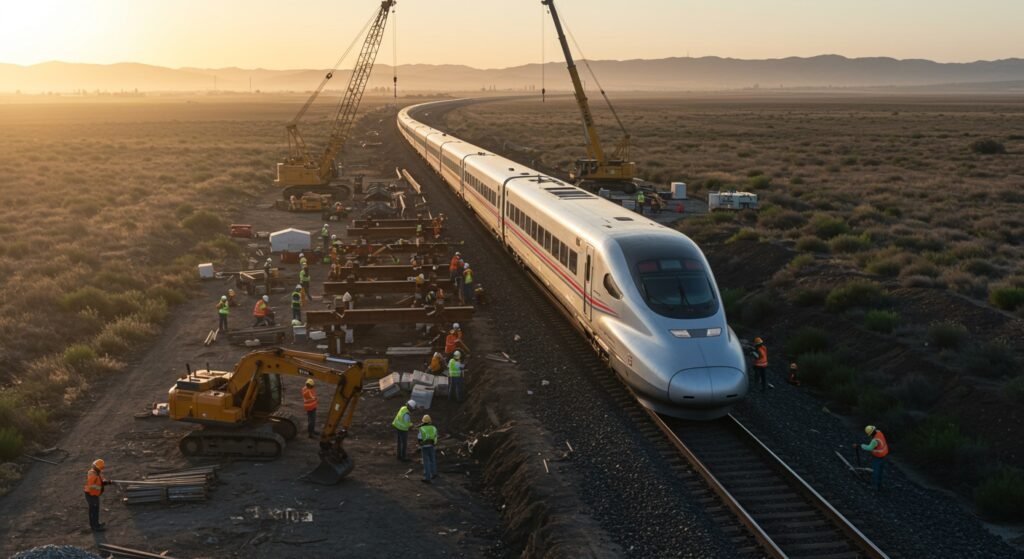
The National Infrastructure Board (NIB) today announced the official approval of the ambitious Trans-Continental Rail Initiative (TCRI), a multi-billion dollar project aimed at drastically enhancing connectivity between major urban centers. This landmark decision sets in motion a plan expected to redefine national travel and spur significant economic activity across the country.
The initiative, designed to link City A and City B with a high-speed rail line, comes with an estimated price tag of $55 billion over a ten-year construction period. Led by Minister Evelyn Reed, head of the NIB, the approval marks a critical step forward after years of planning and debate, securing initial funding and setting a clear path for groundbreaking.
Project Scope and Timeline
The approved route for the Trans-Continental Rail Initiative spans a significant distance, connecting the bustling metropolises of City A and City B. A critical segment of the planned line passes through the Central Valley, a region identified as key for both agricultural and logistical reasons.
Specific engineering plans detail the utilization of a refurbished Section 3B of the existing legacy rail line, alongside the construction of approximately 50 miles of entirely new track, particularly concentrated near the municipality of Springfield. This blend of upgrading existing infrastructure and building new sections aims to optimize speed and efficiency while minimizing some aspects of the project’s footprint.
Financially, the project is projected to cost an estimated $55 billion over its anticipated ten-year construction lifespan. The NIB’s approval includes an initial funding package allocating $10 billion specifically for Phase 1, which is planned to cover the first three years of development. Construction for Phase 1 is scheduled to commence in the third quarter of 2024. The ambitious goal is to achieve full operational completion of the entire network by the year 2034.
The approval was formalized under the provisions of the “Infrastructure Modernization Act of 2023,” specifically referencing Ballot Measure 7G, which provided the legislative framework and voter mandate for such large-scale infrastructure investments.
Expected Benefits and Economic Impact
Proponents of the Trans-Continental Rail Initiative highlight its transformative potential for both national travel and economic prosperity. A primary benefit is the projected reduction in travel time between City A and City B, which is anticipated to decrease by a remarkable 60% compared to current conventional rail or typical road travel durations. This significant time saving is expected to facilitate easier business and leisure travel, potentially shifting passengers away from air or road transport.
Economically, the project is forecast to be a major job creator. Estimates suggest the construction and subsequent operation of the high-speed line could generate up to 150,000 jobs across various sectors, including engineering, construction, manufacturing, and service industries. Furthermore, the enhanced connectivity and increased accessibility are predicted to provide a substantial boost to regional economies along the route, stimulating investment and development in areas like the Central Valley and the vicinities of City A, City B, and Springfield.
Beyond economic metrics, the initiative is also framed as a significant step towards national environmental goals. By providing a viable, low-carbon alternative to air and road travel, the TCRI is projected to reduce carbon emissions by approximately 5 million tons annually by the year 2035.
Minister Evelyn Reed, speaking at the press conference announcing the approval, emphasized the project’s broader significance. “This project marks a pivotal moment for national connectivity and economic growth,” Minister Reed stated. “It is an investment in our future, promising faster travel, cleaner air, and opportunities for hundreds of thousands of our citizens.”
Challenges and Opposition
Despite the optimistic outlook presented by project proponents, the Trans-Continental Rail Initiative is not without its challenges and faces notable opposition from various groups. Environmental concerns have been vocally raised by organizations such as “Green Future Advocates,” who argue that the project’s scale and route could have significant ecological impacts.
Dr. Aris Thorne, a spokesperson for Green Future Advocates, expressed reservations regarding specific aspects of the plan. “We acknowledge the potential benefits, but environmental impact assessments for the Springfield segment remain insufficient,” Dr. Thorne commented, highlighting concerns about habitat disruption and potential effects on local ecosystems along the newly constructed track section.
Land acquisition for the new segments, particularly the 50 miles near Springfield, is another significant hurdle. Negotiating with landowners and managing compulsory purchase orders present complex legal and logistical challenges that could potentially delay the timeline.
Local resistance has also emerged in some rural areas along the proposed route. Groups like “Valley Concerned Citizens,” based in the Central Valley, have voiced concerns about noise pollution, visual impact, and the disruption of agricultural land use. These local anxieties require careful management and community engagement to mitigate potential delays and foster public acceptance.
Furthermore, the construction phase itself will cause disruption. As part of the initial work, a temporary closure of State Route 99 near the City A terminus is anticipated. This vital transportation artery is expected to be closed for an estimated 18 months, beginning in late 2024, which will necessitate significant traffic management planning and could impact local commerce and daily commutes.
Next Steps
With the official approval now granted under Ballot Measure 7G, the focus shifts to the immediate implementation of Phase 1 of the Trans-Continental Rail Initiative. The coming months will involve detailed engineering design finalization, contractor selection processes, and the commencement of preparatory work for construction sites, particularly those targeted for the initial $10 billion allocation.
The NIB has indicated that it will continue consultations with various stakeholders, including environmental groups like Green Future Advocates and local community representatives such as Valley Concerned Citizens, in an effort to address ongoing concerns and refine mitigation strategies where possible. Land acquisition procedures for the Springfield segment are expected to intensify.
The temporary closure of State Route 99 in late 2024 will require detailed public announcements and the establishment of clear diversion routes well in advance to minimize disruption to the public.
The approval of the Trans-Continental Rail Initiative represents a monumental commitment to modernizing the nation’s transportation infrastructure. While the estimated $55 billion project promises significant benefits in terms of speed, economic growth, and environmental advantages, the path forward involves navigating complex environmental regulations, land rights issues, and local community concerns. As construction is set to begin in Q3 2024, the project enters a critical phase where careful execution and responsive stakeholder engagement will be paramount to realizing the vision of high-speed rail connecting City A and City B by 2034.
More Stories
Freedom Plane Tour Brings History to Atlanta
PEN America’s 2026 Festival: Literature’s Defiant Return
Dive Deep into American Culture: Quiz Explores Baseball Legends and Quirky Snacks