











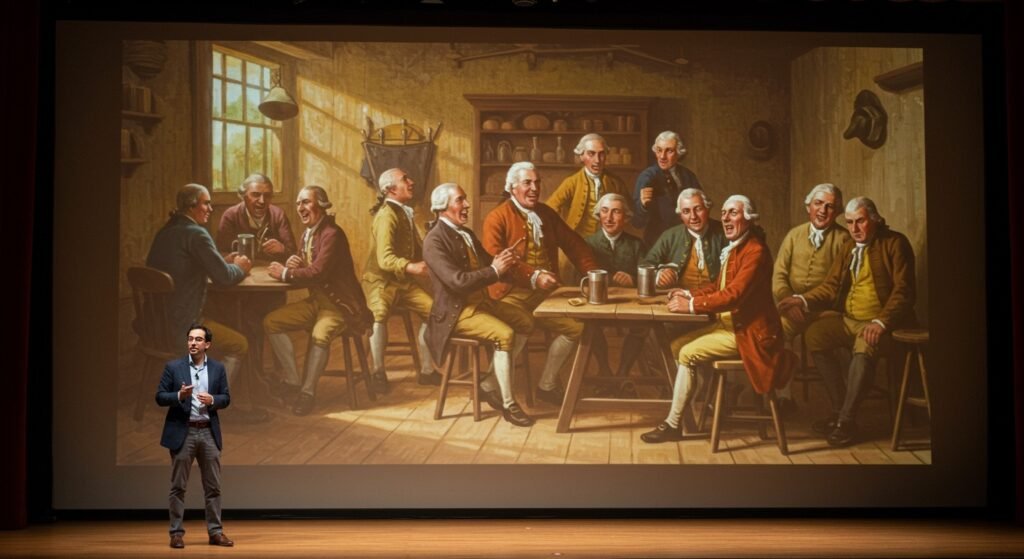
CHICO, CA – A forthcoming event at California State University, Chico, promises to shed light on a surprisingly overlooked facet of early American history: the political and social power of humor among white men during the nation’s formative decades. Dr. Eran A. Zelnik, a distinguished lecturer in the History Department at Chico State, is set to discuss his groundbreaking new book, “American Laughter, American Fury: Humor and the Making of a White Man’s Democracy, 1750-1850.”
The public discussion is scheduled to take place on Thursday, February 6, 2025, at 5:30 p.m., offering a unique opportunity to delve into the complex ways humor shaped American identity and governance in the century leading up to the Civil War.
Unpacking “American Laughter, American Fury”
Dr. Zelnik’s work challenges conventional understandings of early American political culture by centering the role of humor. The book, covering the pivotal period between 1750 and 1850, argues that laughter, jokes, and comedic performance were not merely forms of entertainment but potent social tools wielded primarily by white men. These forms of humor, often crude and aggressive by modern standards, served to define group boundaries, reinforce hierarchies, and articulate shared values and anxieties during a period of immense political and social transformation.
The era from 1750 to 1850 encompassed the American Revolution, the establishment of the republic, and the early decades of westward expansion and burgeoning industrialization. It was a time when the concept of American identity was fluid and contested, and the norms of a “white man’s democracy” were actively being constructed. Zelnik’s research suggests that humor played a critical, albeit often hidden, role in this process, operating as a form of social glue and a means of asserting dominance and belonging among white males.
Humor as a Political and Social Force
The central thesis of “American Laughter, American Fury” posits that the shared experience of certain types of humor among white men helped forge a collective sense of whiteness and masculinity that became foundational to American political culture. Humor could be used to belittle or exclude those outside the dominant group – including women, people of color, Native Americans, and immigrants – thereby solidifying the insider status of white men.
Furthermore, the book explores how humor intersected with political discourse and action. From tavern jokes and satirical prints to public speeches and popular literature, comedic elements were embedded in the ways Americans understood power, critiqued authority, and navigated social relations. Dr. Zelnik investigates how different styles of humor reflected and reinforced prevailing notions of what it meant to be a white man in a rapidly changing society and how these norms influenced the very structure and practice of American democracy during this period.
The Significance of the Study
By focusing on humor, Dr. Zelnik opens new avenues for understanding the informal, cultural mechanisms that underpinned formal political structures. His work provides valuable insights into the historical construction of race and gender in America, demonstrating how seemingly innocuous cultural practices can have profound and lasting political consequences. “American Laughter, American Fury” contributes significantly to the fields of American history, cultural studies, and the study of political discourse, offering a fresh perspective on the origins of American identity and its inherent exclusions.
The book’s analysis of how humor created and maintained social boundaries remains highly relevant today, offering a historical lens through which to view contemporary debates about identity, inclusion, and the nature of political humor.
Event Details and Public Access
The upcoming discussion at Chico State offers a direct engagement opportunity with Dr. Zelnik and his research. The event will be held in the ARTS Recital Hall on the university campus. This venue is part of the College of Humanities and Fine Arts complex and is a regular host for academic lectures and performances.
Importantly, the event is free and open to the public. Community members, students, faculty, and anyone interested in American history, political science, or the sociology of humor are encouraged to attend. The session is expected to include a presentation by Dr. Zelnik followed by a question-and-answer segment, allowing attendees to delve deeper into specific aspects of the book and its arguments.
This event represents a notable opportunity for the Chico State community and the wider public to engage with cutting-edge historical scholarship that examines the complex and sometimes uncomfortable truths about the foundations of American democracy. Dr. Zelnik’s talk promises to be both intellectually stimulating and highly relevant, prompting attendees to reconsider familiar aspects of American history through an entirely new lens.
More Stories
PEN America’s 2026 Festival: Literature’s Defiant Return
Dive Deep into American Culture: Quiz Explores Baseball Legends and Quirky Snacks
Original Penguin Sues Pudgy Penguins for Trademark Infringement Over Penguin Branding