











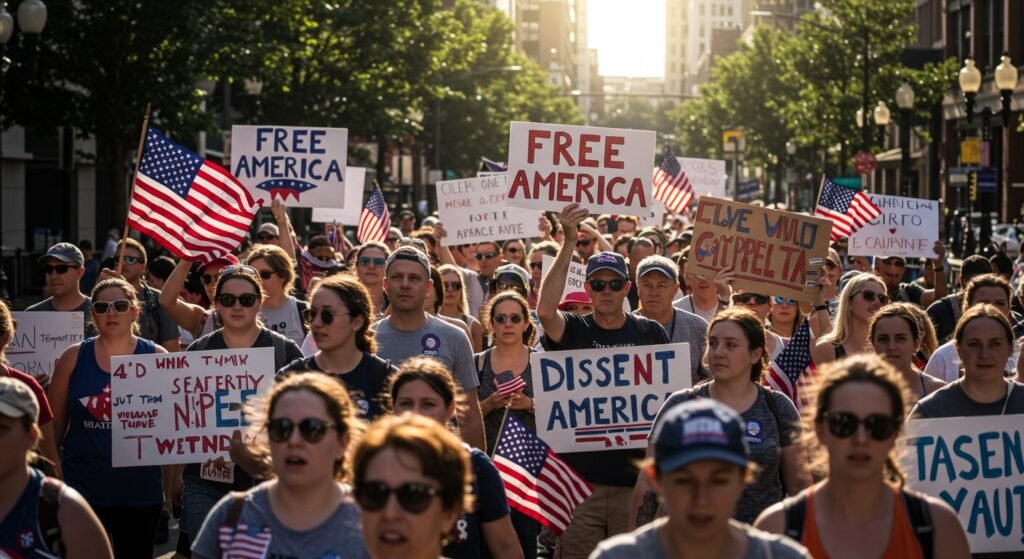
Across the United States, organizers are preparing for hundreds of planned “Free America” demonstrations scheduled for July 4th. These nationwide protests, spearheaded by the same group that orchestrated the Women’s March, are explicitly aimed at registering opposition to President Donald Trump and the policies of his administration.
The stated objective of these diverse gatherings is to “Free America from the grip of hate and the politics of fear.” The demonstrations are planned to take varied forms, moving beyond traditional marches to include community gatherings, block parties, banner drops, barbecues, and dance events, reflecting an effort to engage a broad spectrum of participants and communities across the country.
Scale and Scope of the Protests
The sheer number and variety of planned events underscore the breadth of the movement. From small, local barbecues intended to foster community discussion to more public banner drops designed to catch attention, the approach is multifaceted. Organizers hope this decentralized strategy will allow for widespread participation, adapting to local contexts while contributing to a unified national message on Independence Day.
The decision to utilize a national holiday traditionally associated with unity and patriotic celebration is deliberate. By branding the movement “Free America,” organizers explicitly connect their actions to the symbolism of July 4th, which commemorates the signing of the Declaration of Independence. They frame their protests as a contemporary assertion of fundamental liberties and a call for a government they believe is more responsive and accountable to its citizens.
Underlying Motivations and Concerns
Driving the motivation behind these protests is a perceived erosion of fundamental rights and government accountability under the current administration. Nichole Geibel, an organizer for ‘Free America’ protests in Ohio and Co-Chair of the North Ridgeville Democrats, indicated that the demonstrations stem from growing frustration.
According to Geibel, this frustration is directed at federal and state policies perceived as infringing on fundamental rights, personal autonomy, and government accountability. Organizers are specifically highlighting issues such as growing wealth disparity and what they describe as mass layoffs across the federal government as key concerns fueling the movement.
Context and Precedents
The planned ‘Free America’ protests follow a series of recent nationwide demonstrations that have expressed dissent against the administration. Notably, these include the recent “No Kings” demonstrations, which articulated similar themes of opposition to perceived autocratic tendencies.
The timing also places these protests in the immediate aftermath of significant legislative action, specifically the passage of President Trump’s measure, referred to by the administration as the “Big Beautiful Bill,” by the House of Representatives. Organizers view these events as part of a continuing pattern of policies and actions that necessitate public opposition and calls for change.
Looking Ahead on Independence Day
As the United States prepares to celebrate its independence, the planned ‘Free America’ demonstrations are poised to add a significant layer of political expression to the day. The variety of events planned across the nation suggests a widespread effort to mobilize and voice dissent.
The organizers’ decision to use the symbolic language of freedom and independence on July 4th underscores their central message: that the fight for American ideals is ongoing and requires active participation from its citizens. How widely these protests are attended and their ultimate impact on the national political discourse remain to be seen as the holiday unfolds.
More Stories
PEN America’s 2026 Festival: Literature’s Defiant Return
Dive Deep into American Culture: Quiz Explores Baseball Legends and Quirky Snacks
Original Penguin Sues Pudgy Penguins for Trademark Infringement Over Penguin Branding