











Unschooling’s Revival: A Deep Dive into a Growing American Education Trend
Washington, D.C. – As of Thursday, June 5, 2025, a significant shift is reportedly underway in the American educational landscape: the resurgence of “unschooling.” This non-traditional approach to education, where learning is driven by the child’s interests and natural curiosity rather than a fixed curriculum, is gaining renewed traction across the United States, according to recent reporting by USA Today.
Unschooling is not a new phenomenon. Its roots can be traced back to the 1960s, an era marked by cultural upheaval and questioning of established norms. At its inception, the concept was largely associated with the cultural left, driven by parents who held concerns about the content and structure of state-run schools. A notable motivation during this period was the desire to shield children from what some perceived as Cold War propaganda embedded within the standard curriculum.
For decades, unschooling remained a fringe movement, a choice made by a relatively small number of families deeply committed to alternative pedagogies. However, the past few years have witnessed a dramatic increase in interest and adoption. This recent surge is largely attributed to the widespread disruption caused by the COVID-19 pandemic.
The Pandemic’s Impact on Learning Paradigms
The pandemic forced an unprecedented closure of school systems nationwide, compelling millions of students into remote or hybrid learning models. This abrupt shift exposed many parents to the day-to-day realities of their children’s education in a way they hadn’t experienced before. For some, the observation led to the belief that their children were not learning effectively in the emergency remote settings. The structured online classes, often implemented rapidly and with varying degrees of success, highlighted perceived inefficiencies and a lack of engagement.
Simultaneously, the experience of facilitating learning at home, even under stressful circumstances, proved surprisingly rewarding for other parents. Discovering a sense of satisfaction in teaching their children directly, witnessing their individual learning pace and methods firsthand, cultivated an appetite for more personalized and parent-directed educational paths.
This combination of factors – dissatisfaction with perceived ineffective conventional schooling during disruption and a newfound confidence and satisfaction in home-based learning – provided fertile ground for the unschooling philosophy to take root with a new generation of families. It offered an appealing alternative to returning to traditional schooling, particularly for those who felt the established system was either failing their children or simply not the best fit.
Beyond Isolation: Community and Collaboration in Unschooling
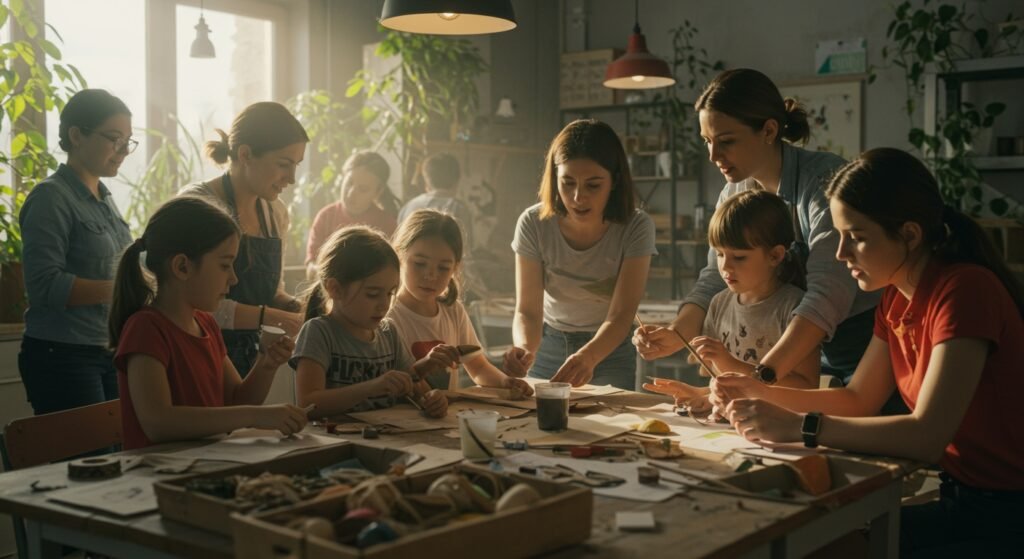
Contrary to the stereotype of the isolated unschooling family, the trend is also fostering new forms of community and collaboration. Recognizing the need for social interaction, shared resources, and collective learning experiences, some families have begun forming formal or informal consortia.
These groups can take many shapes, ranging from small, informal meetups for shared activities and field trips to more structured cooperatives where parents pool resources and expertise to offer classes, workshops, or group projects. These consortia provide not only social opportunities for children but also crucial support networks for parents navigating the complexities of educating outside traditional institutions. They allow families to share the responsibility, leverage diverse skills among parents, and create a richer, more varied learning environment than a single family might achieve alone.
Unschooling Defined: A Philosophy of Interest-Led Learning
While often grouped under the broader umbrella of homeschooling, unschooling is distinct. It is a philosophy that views the child’s natural curiosity as the primary driver of learning. Instead of following a predetermined curriculum, unschooling encourages children to explore their interests deeply. Learning happens organically through real-life experiences, play, reading, conversations, travel, mentorship, and engaging with the world.
Proponents argue that this approach fosters a lifelong love of learning, encourages intrinsic motivation, and allows children to develop skills and knowledge relevant to their passions. They believe it provides a more authentic and less stressful learning environment than traditional schooling, which they contend can stifle creativity and curiosity through rigid structure and standardized testing.
Challenges and Perspectives
Like any educational model, unschooling faces challenges and draws scrutiny. Critics often raise concerns about academic rigor, ensuring comprehensive knowledge across various subjects, and perhaps most frequently, the crucial aspect of socialization. Ensuring children have adequate opportunities for diverse social interaction outside the family unit is a common point of discussion and a primary reason families seek out the aforementioned consortia.
Regulatory environments for homeschooling and unschooling vary significantly by state, adding another layer of complexity for families considering this path. While some states have minimal requirements, others mandate testing or portfolio reviews, creating a diverse and sometimes confusing legal landscape.
The renewed trend reported by USA Today highlights a growing segment of the American population actively seeking alternatives to traditional schooling. Driven by historical roots, amplified by recent global events, and facilitated by community building, unschooling is re-emerging not just as an alternative, but as a significant, evolving component of the nation’s diverse educational ecosystem. Its continued growth and adaptation will undoubtedly shape future discussions about how children learn best in a rapidly changing world.
More Stories
PEN America’s 2026 Festival: Literature’s Defiant Return
Dive Deep into American Culture: Quiz Explores Baseball Legends and Quirky Snacks
Original Penguin Sues Pudgy Penguins for Trademark Infringement Over Penguin Branding