











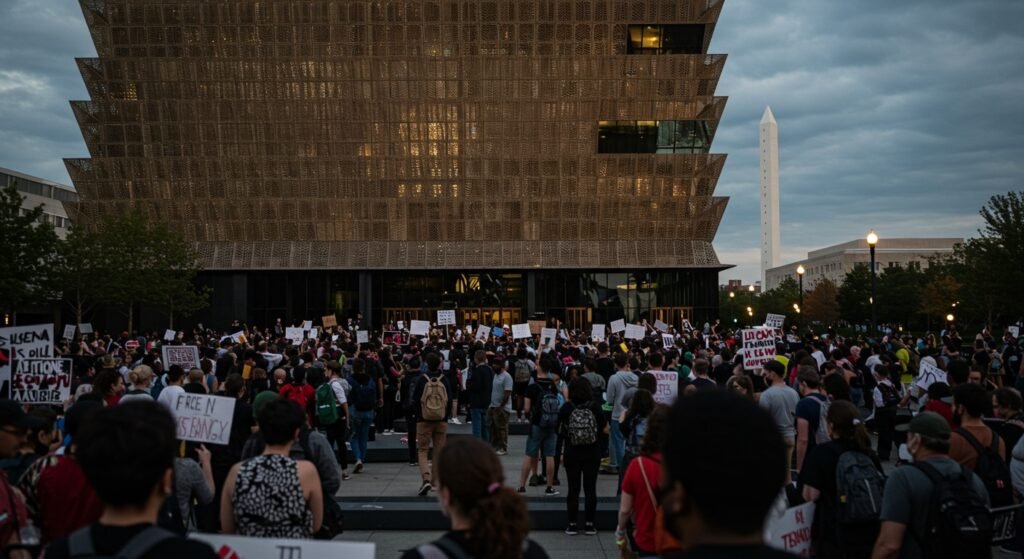
A recent executive order from the Trump administration, perceived by many as an attempt to reshape the narrative of American history, has ignited significant opposition, particularly among supporters of the Smithsonian’s National Museum of African American History and Culture (NMAAHC). This directive has become a focal point for activists and community members in Washington D.C. and beyond, who view it as a direct challenge to the accurate and comprehensive representation of Black culture and history in national institutions. The order has spurred rallies and educational efforts aimed at preserving the integrity and funding of such vital cultural landmarks.
Understanding the Executive Order
The executive order at the center of the controversy was issued by President Trump, according to reporting by The Guardian. The order ostensibly seeks to combat what the administration has characterized as “improper ideology” within historical and cultural narratives. Its stated goal is to “restore truth and sanity to American history.” However, specific sections of the order, as reported, have drawn sharp criticism for their content and implications. These sections reportedly described the NMAAHC’s portrayal of white culture as “harmful and oppressive.” Furthermore, the order reportedly included language suggesting the reinstatement of Confederate-era monuments, memorials, statues, and historical markers. This perceived attempt to re-contextualize or promote symbols associated with the Confederacy, coupled with the reported critique of a national museum dedicated to African American history, has fueled widespread alarm among civil rights advocates, historians, and museum supporters. Critics argue that such directives risk promoting a sanitized or biased view of the past, particularly concerning the nation’s history of slavery and racial inequality.
Community Mobilization and Protest
In response to these developments, a vigorous protest movement has emerged, rooted in Washington D.C., the home of the NMAAHC. On May 3, the #HandsOffOurHistory movement spearheaded a rally to voice collective dissent against the executive order and its perceived threats. A determined crowd, comprising local residents and supporters from various backgrounds, gathered near the museum to demonstrate their commitment to protecting African American history and culture. The demonstration included a symbolic march of three blocks, a deliberate choice to emphasize the proximity of their concerns to the centers of national power. Participants carried signs and chanted slogans, reflecting their deep commitment to protecting the integrity of institutions like the NMAAHC and opposing what they see as governmental interference in historical interpretation and cultural preservation. The rally served as a public declaration that efforts to “dismantle” or alter the presentation of African American history would face significant resistance and advocacy.
Advocacy Group Actions
Beyond spontaneous street protests, established civil rights and policy organizations have also mobilized their resources and networks. Groups such as the NAACP’s Legal Defense Fund and the African American Policy Forum (AAPF) have been prominent in organizing both public demonstrations and educational initiatives designed to inform and activate the public. These organizations have planned additional rallies and hosted a series of seminars aimed at explaining the potential implications of the executive order and other related policy changes enacted by the administration. Their focus extends to the broader context of what they describe as the Trump administration’s dismantling of Diversity, Equity, and Inclusion (DEI) practices across various sectors and perceived systemic attacks on Black culture and history. Through legal analysis, policy advocacy, and community education, these groups seek to build broader awareness and galvanize continued opposition to policies they believe are detrimental to the preservation and accurate representation of African American contributions and struggles.
Broader Context of Cultural Funding
The controversy surrounding the executive order coincides with broader concerns about the financial health and independence of cultural institutions under the current administration. In recent months, significant funding cuts have reportedly been implemented or proposed for various national cultural bodies. Among those affected are the National Endowment for the Arts (NEA), which supports artistic excellence and accessibility, and the Corporation for Public Broadcasting (CPB), which funds public television and radio. While the NMAAHC operates under the Smithsonian Institution’s umbrella, and its funding structure might differ somewhat from independent bodies like the NEA or CPB, these cuts to related institutions are seen by many as part of a pattern that potentially undermines the arts, humanities, and public broadcasting – all of which play a vital role in documenting, interpreting, and disseminating diverse historical and cultural narratives. This broader context of reduced support for cultural and educational programming amplifies the anxieties surrounding any perceived threat to the NMAAHC’s operational capacity or curatorial independence.
Addressing Specific Rumors
Amidst the heightened political tensions and public outcry, initial speculation arose regarding the physical removal of specific, iconic artifacts from the NMAAHC collection. One particular rumor that gained traction concerned the potential removal of the historic lunch counter from Greensboro, North Carolina, an artifact that serves as a powerful symbol of the Civil Rights Movement and the fight against segregation. However, officials at the Smithsonian institution publicly debunked these specific rumors. They clarified that there were no plans to remove such artifacts. While this particular concern was alleviated by the Smithsonian’s response, the incident highlighted the level of anxiety and misinformation that can circulate during periods of intense political focus on cultural institutions and historical narratives. The Smithsonian’s clarification underscored the distinction between policy directives originating from the executive branch and the museum’s direct, independent curatorial practices, though the broader concerns raised by the executive order and the environment of cultural funding changes persisted.
Ongoing Advocacy and Future
As organizations like the NAACP Legal Defense Fund and the African American Policy Forum continue their advocacy efforts, the future of institutions preserving crucial historical narratives remains a subject of public debate and activism. The #HandsOffOurHistory movement and its supporters remain vigilant, committed to safeguarding the National Museum of African American History and Culture and other cultural institutions from perceived political interference and funding challenges. The controversy surrounding the executive order serves as a potent reminder of the ongoing societal discourse surrounding the interpretation of American history, the role of cultural institutions in that process, and the enduring fight for equitable representation and historical truth. The efforts to protect the NMAAHC and push back against policies seen as detrimental to Black culture underscore a fundamental struggle over national identity and historical memory in contemporary America, emphasizing the continued importance of public engagement in preserving historical integrity.
More Stories
PEN America’s 2026 Festival: Literature’s Defiant Return
Dive Deep into American Culture: Quiz Explores Baseball Legends and Quirky Snacks
Original Penguin Sues Pudgy Penguins for Trademark Infringement Over Penguin Branding