











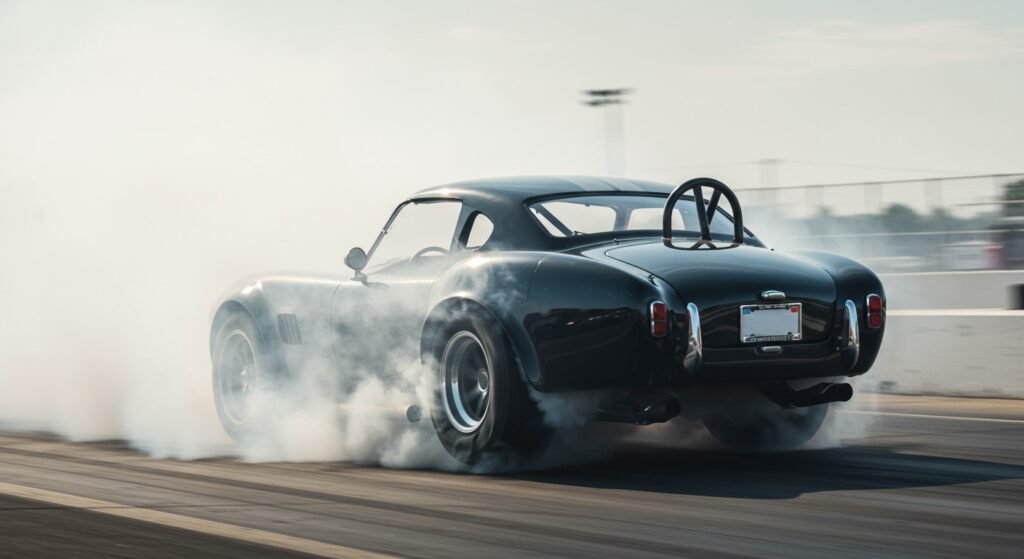
The 1960s were a transformative decade for the automotive world, a period marked by audacious design, burgeoning horsepower, and an escalating arms race for performance. Amidst this vibrant era, one machine carved out a singular reputation for its raw power and blistering acceleration: the Shelby 427 Cobra.
A recent exploration published by HotCars on January 15, 2025, revisits this iconic American sports car, delving into the attributes that cemented its status, particularly its legendary prowess over the quarter-mile.
Genesis of an American Icon
The story of the Shelby Cobra begins with the ambitious vision of Carroll Shelby, the legendary American racer and entrepreneur. Shelby sought to challenge the dominance of sophisticated European sports cars on race tracks and roads alike. His concept was elegantly simple yet revolutionary: mate a potent, lightweight American V8 engine with a nimble, proven British chassis.
The early iterations of the Cobra utilized 260 and then 289 cubic-inch Ford V8 engines, proving the concept and establishing the car’s sporting credentials. However, Carroll Shelby craved more power, a desire that would lead to the creation of the ultimate Cobra – the 427 version.
The Heart of the Beast: The 427 Big-Block
The transition to the 427 cubic-inch big-block Ford engine marked a significant leap in the Cobra’s evolution. This formidable powerplant, known for its robust construction and immense torque, transformed the already potent Cobra into a veritable brute.
In its competition guise, the 427 engine was officially rated at a staggering 485 horsepower and an equally impressive 480 lb-ft of torque. This output was astronomical for the time, placing the Cobra in an exclusive club of high-performance vehicles capable of truly breathtaking acceleration.
Power was channeled to the rear wheels via a robust four-speed manual transmission, offering drivers direct and visceral control over the engine’s massive output – a necessity given the car’s power-to-weight ratio.
Benchmark Performance: Dominating the Drag Strip
The raw numbers translate into performance figures that were simply astonishing for the 1960s. The 1965 model of the 427 Cobra showcased capabilities that few road cars could match.
One widely cited metric of its performance includes its ability to accelerate from 0 to 100 mph and then brake back to a complete stop in a mere 14.5 seconds. This demonstrates not only its acceleration but also the significant engineering required to manage its speed.
However, it was the quarter-mile sprint where the 427 Cobra truly etched its name into the history books. With a recorded time of 12.2 seconds at a trap speed of 118 mph, this figure solidified its reputation. At a time when 13 or 14-second quarter-mile times were the benchmark for fast cars, the 12.2-second run placed the 427 Cobra among the absolute quickest production or limited-production cars of the decade, earning it the moniker of the “World’s Fastest Car Over The Quarter Mile In The ’60s,” a claim strongly supported by such performance data.
Beyond acceleration, the 427 Cobra boasted a top speed reaching 165 mph, a velocity challenging the capabilities of even the most sophisticated European sports cars and GTs of the era.
Engineering for Power: Evolving the Chassis
To cope with the immense power of the 427 big-block, the Cobra underwent significant structural enhancements. The chassis was substantially revised, featuring a thicker frame to improve rigidity and handle the increased stresses of acceleration and cornering. Furthermore, the suspension system was upgraded, moving from the earlier cars’ leaf springs to a more modern and performance-oriented coil spring suspension setup, enhancing both ride quality and handling dynamics at high speeds.
These engineering improvements were crucial. Simply dropping a massive engine into an existing chassis would have resulted in a car that was powerful but potentially uncontrollable. The chassis modifications ensured that the 427 Cobra could harness its power effectively, making it a formidable competitor on both the street and the track.
An Enduring Legacy
The Shelby 427 Cobra is more than just a collection of impressive statistics; it is a cultural phenomenon. It represents a bold, unapologetic expression of American performance ideals – raw power, minimal weight, and a focus on speed above all else. Its aggressive stance, thunderous exhaust note, and legendary performance figures have made it one of the most desirable and recognizable sports cars ever created.
Today, original 427 Cobras are highly sought after by collectors, fetching astronomical prices at auction. Numerous continuation cars and replicas exist, testament to the enduring appeal of Carroll Shelby’s masterpiece. The Cobra’s influence can be seen in countless sports cars that followed, proving that Shelby’s formula of big American power in a lightweight package remains eternally relevant.
In revisiting the 1960s, the Shelby 427 Cobra stands as a monument to a time when performance cars were visceral, challenging, and utterly thrilling. Its quarter-mile dominance wasn’t just about a number; it was about a statement – a statement of intent from Carroll Shelby and a declaration of American muscle on the global stage.
More Stories
PEN America’s 2026 Festival: Literature’s Defiant Return
Dive Deep into American Culture: Quiz Explores Baseball Legends and Quirky Snacks
Original Penguin Sues Pudgy Penguins for Trademark Infringement Over Penguin Branding