











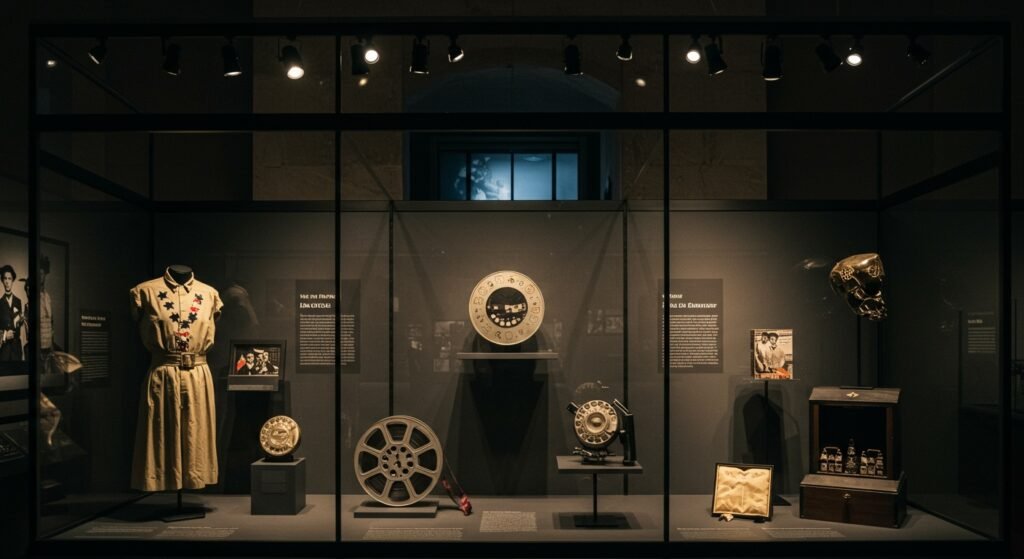
Washington, D.C. — The Smithsonian Institution, the world’s largest museum, education, and research complex, is facing sharp criticism from the Trump administration regarding the content of one of its prominent exhibits. Accusations center on the alleged use of federal funding to promote what officials describe as “one-sided, divisive political narratives” that do not adequately reflect the nation’s positive attributes or “greatness.”
The specific target of this criticism is the Entertainment Nation exhibit housed within the National Museum of American History. According to an exclusive email from White House official Lindsey Halligan to Fox News Digital, the administration contends that certain displays within the exhibit present an overly negative view of American culture.
Allegations Detailed
The email from Ms. Halligan outlined several specific examples deemed problematic. The criticism alleges that the exhibit broadly frames American culture as inherently “violent, imperialist, or racist.” This overarching characterization is viewed by the Trump administration as presenting a skewed and critical perspective rather than a balanced portrayal of the nation’s cultural landscape.
Beyond the general thematic concerns, the email pointed to particular displays and panels within the exhibit. One cited example is a section exploring modern gender roles, which features prominent figures such as Mae West, Judy Garland, and Gertrude Ederle. While not detailing the specific content found objectionable in this display, the inclusion alongside other criticisms suggests a disagreement with how gender evolution and representation are interpreted and presented.
Specific Exhibits Under Scrutiny
Several other individual components of the Entertainment Nation exhibit were singled out. A panel dedicated to the popular 1980s television series Magnum, P.I. came under fire. Similarly, a section focusing on Jon Stewart’s Daily Show, a satirical news program known for its political commentary, was listed as an example of the alleged problematic content.
Another display mentioned was a panel dedicated to the late Tejano music superstar Selena Quintanilla-Pérez. The criticism noted that this particular panel focused heavily on identity politics, suggesting that the exhibit prioritized this interpretive lens over other aspects of her cultural impact or artistic legacy.
Perhaps one of the most historically sensitive criticisms involved a display centered on the iconic character Mickey Mouse. The objection here referenced the exhibit’s discussion of the character’s origins and its perceived connections to blackface minstrelsy. This critique highlights a sensitivity to how the institution portrays historical elements that have uncomfortable racial undertones.
Political Dimensions and Funding Concerns
The criticism from the Trump administration is underscored by concerns regarding the Smithsonian’s funding structure. The institution operates on an annual budget of approximately $1 billion, with a significant portion – roughly two-thirds – derived directly from federal appropriations. The implication is that taxpayer money should not be used to disseminate what officials consider biased or divisive narratives.
This pressure appears to have political backing from figures associated with the administration’s political sphere. Vice President J.D. Vance and Congressman Carlos Giménez have reportedly advocated for an expedited review process of the content displayed throughout the Smithsonian’s various museums and exhibits. Their push for a swift examination suggests a desire for prompt changes to address the perceived issues.
Tensions surrounding the content review process were reportedly evident at a June board meeting of the Smithsonian Institution. Disagreements or frustrations were noted regarding the pace at which this review was being conducted, indicating internal as well as external pressure on the institution to address the concerns raised by its critics.
Institutional Context and Future Outlook
The Entertainment Nation exhibit, which opened to the public in December 2022, is intended to explore the profound influence of entertainment on American culture and identity. Museum curators and officials typically develop exhibit narratives based on scholarly research and diverse interpretations of historical and cultural phenomena.
The Smithsonian Institution has not yet issued a detailed public response to the specific criticisms outlined in the email from Ms. Halligan, though it operates under a congressional charter and a mandate to increase and diffuse knowledge. The allegations from the Trump administration, however, place the institution at the center of a broader cultural and political debate regarding how national history and culture should be presented and interpreted in public institutions, particularly those reliant on federal funding.
The push for an expedited content review, backed by prominent political figures, suggests that the Smithsonian may face continued scrutiny and pressure to potentially alter or recontextualize aspects of its exhibits to align with the perspectives favored by its critics within the political establishment.
More Stories
PEN America’s 2026 Festival: Literature’s Defiant Return
Dive Deep into American Culture: Quiz Explores Baseball Legends and Quirky Snacks
Original Penguin Sues Pudgy Penguins for Trademark Infringement Over Penguin Branding