











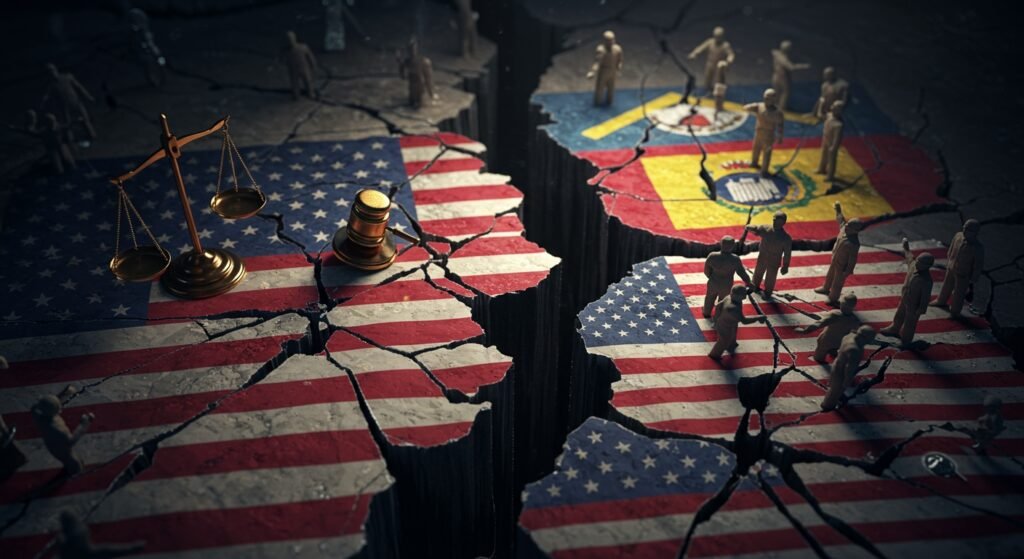
Across the United States on May 14, 2025, significant legal and political conflicts intensified, highlighting deepening divisions over federal authority, immigration enforcement, and the role of civil society organizations. Key developments included a federal grand jury indictment against a Wisconsin judge, a pivotal federal court ruling in Pennsylvania concerning presidential powers and deportation, multi-state legal challenges to federal funding threats, and a proposed legislative measure targeting non-profit organizations.
Judicial Action and Immigration Enforcement
In Wisconsin, a federal grand jury handed down an indictment against a Milwaukee County Circuit Judge. The specific charges center on allegations that the judge obstructed the work of Immigration and Customs Enforcement (ICE). This development underscores the friction between federal immigration mandates and local judicial discretion, raising questions about the boundaries of judicial authority when interacting with federal law enforcement agencies. The indictment initiates a complex legal process that will scrutinize the interactions between the judge’s chambers and ICE operations within Milwaukee County.
Simultaneously, a critical decision emerged from the U.S. District Court in Pennsylvania. U.S. District Judge Stephanie Liu Haynes, an appointee of President Trump, issued a ruling that upheld President Trump’s controversial use of the 1798 wartime law, the Alien Enemies Act. The ruling specifically concerns the deportation of Venezuelan immigrants without due process. This decision marks a significant turning point, representing the first such ruling to support President Trump’s application of this rarely invoked act after judges in three other federal jurisdictions had previously ruled against its use in similar contexts. The Alien Enemies Act, passed during a period of heightened international tension, permits the President to apprehend and deport citizens of hostile nations during declared war or invasion, and its application to modern immigration enforcement against individuals from countries with which the U.S. is not formally at war, particularly without typical immigration due process protections, has drawn considerable legal and humanitarian scrutiny. Judge Haynes’s ruling sets up a potential circuit split, likely paving the way for higher court review.
States Challenge Federal Funding Threats
Adding another layer to the escalating legal conflicts, a coalition of 20 U.S. states filed lawsuits against the Trump administration on this date. The states are challenging the administration’s threat to withhold billions of dollars in federal funds. This threat is explicitly tied to a condition requiring states to cooperate with President Trump’s mass deportation efforts. The lawsuits argue that the president has exceeded his constitutional authority by leveraging federal funding streams to coerce state participation in federal immigration enforcement activities. Governors and state attorneys general involved in the litigation contend that such actions infringe upon state sovereignty and violate constitutional principles governing the separation of powers and the allocation of federal funds. The outcome of these multi-state challenges could significantly impact the balance of power between the federal government and the states, particularly concerning immigration policy implementation.
Proposed Measure Targets Non-Profit Sector
Further contributing to the landscape of potential legal and political shifts, a proposed measure by House Republicans was also highlighted. If enacted, this measure could grant President Trump broad powers to significantly impact or, as some critics describe, “crush” various non-profit organizations. The proposal targets groups involved in a wide array of advocacy and social justice work. Specifically mentioned are organizations focused on environmental justice, racial justice, LGBTQ+ rights, gender justice, immigration justice, and anti-genocide efforts. Proponents argue the measure is necessary for oversight or accountability, while opponents warn it represents an unprecedented attempt to suppress dissent and curtail the activities of groups critical of or working on issues distinct from administration policy. The potential passage of this measure raises concerns about freedom of association, speech, and the future operational capacity of a vital segment of civil society in the United States.
Taken together, the events of May 14, 2025, paint a picture of a nation navigating intense legal and political friction points. From individual judicial accountability to the interpretation of centuries-old laws, from the federal-state balance of power to the rights and roles of non-governmental organizations, the day’s headlines underscore the profound and ongoing contests shaping the future direction of the United States.
More Stories
Freedom Plane Tour Brings History to Atlanta
PEN America’s 2026 Festival: Literature’s Defiant Return
Dive Deep into American Culture: Quiz Explores Baseball Legends and Quirky Snacks