











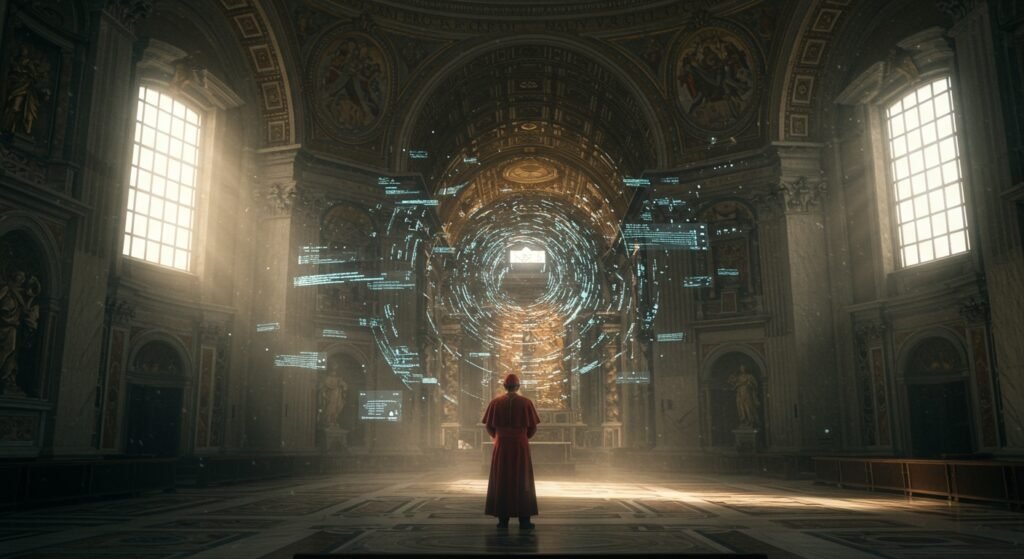
The profound influence of digital media and rapidly advancing technology, including the ascent of artificial intelligence, is reshaping human society and culture on an unprecedented scale. This transformation necessitates a critical re-examination of the long-held idea that technology inherently holds a determinative role in shaping cultural structures and human interaction.
This global shift is occurring within a complex landscape where digital power converges with political forces. US participants attending a recent conference in Rome were particularly attuned to the dynamics of what has been characterized as the “new Trump ‘broligarchy’.” This term describes a blend of populist, nationalist governance intertwined with the immense influence wielded by prominent figures from Silicon Valley, including Elon Musk, Mark Zuckerberg, Sundar Pichai, and Jeff Bezos. The conference attendees were acutely aware of how this potent combination impacts cultural, social, and political landscapes, both domestically and internationally.
The Evolving Digital Landscape
The current digital environment is marked by the maturation of major online platforms. Facebook, a dominant force in social networking, has reached 21 years of age, while Twitter, now known as X, is 19. Instagram is 15 years old, and TikTok, the relatively newer but immensely influential video platform, is nearly 9. These platforms, through their algorithms, significantly shape the information users consume and interact with, often contributing to the formation of online echo chambers that can potentially limit open dialogue and exposure to diverse perspectives.
Alongside the pervasive influence of social media, the world is witnessing a rapid acceleration in artificial intelligence development. While the current AI boom might seem sudden, its roots can be traced back approximately 15 years, building upon decades of research and innovation. The integration of AI across various sectors, from communication to economics and governance, presents both immense opportunities and significant ethical challenges that demand careful consideration from all segments of society, including religious institutions.
The Church’s Response to the Digital Challenge
The Roman Catholic Church, with its global reach and ancient traditions, finds itself at a critical juncture, navigating this rapidly evolving digital frontier. Recognizing the need for guidance in the age of advanced technology, the Vatican has taken concrete steps.
In January 2025, the Vatican City State released its own comprehensive Guidelines on Artificial Intelligence. This document serves as a significant statement on the Church’s perspective regarding the ethical development and deployment of AI technologies. A central tenet emphasized within these guidelines is the principle that AI technology should fundamentally respect, rather than replace or dominate, human decision-making processes and human dignity. This perspective underscores a foundational belief in the intrinsic value and agency of the human person.
Resisting Technological Determinism
A key intellectual and spiritual challenge facing the Church, and society at large, is the imperative to resist the concept of “technological determinism.” This idea suggests that technology’s development follows an inevitable, predetermined path that dictates societal structure and human behavior, leaving little room for human choice or ethical direction. The Vatican’s guidelines and the broader engagement by Church leaders with digital issues signal a deliberate effort to push back against this notion.
Instead, the Church is urged to champion a vision where technology serves humanity and its values, guided by ethical frameworks rooted in faith and reason. This requires fostering critical engagement with digital tools, understanding their potential impacts – both positive and negative – and advocating for their development and use in ways that promote the common good, human flourishing, and genuine connection rather than isolation or manipulation facilitated by algorithmic echo chambers.
From the early days of papal tweets, signalling the Church’s cautious entry into social media, to the recent comprehensive guidelines on artificial intelligence, the journey reflects a gradual but determined digital awakening within the institution. It acknowledges the irreversible impact of technology while seeking to provide a moral compass for navigating its complexities. As digital landscapes continue to shift and AI capabilities expand, the Church’s role in fostering ethical dialogue and advocating for a human-centric technological future remains increasingly vital.
More Stories
PEN America’s 2026 Festival: Literature’s Defiant Return
Dive Deep into American Culture: Quiz Explores Baseball Legends and Quirky Snacks
Original Penguin Sues Pudgy Penguins for Trademark Infringement Over Penguin Branding