











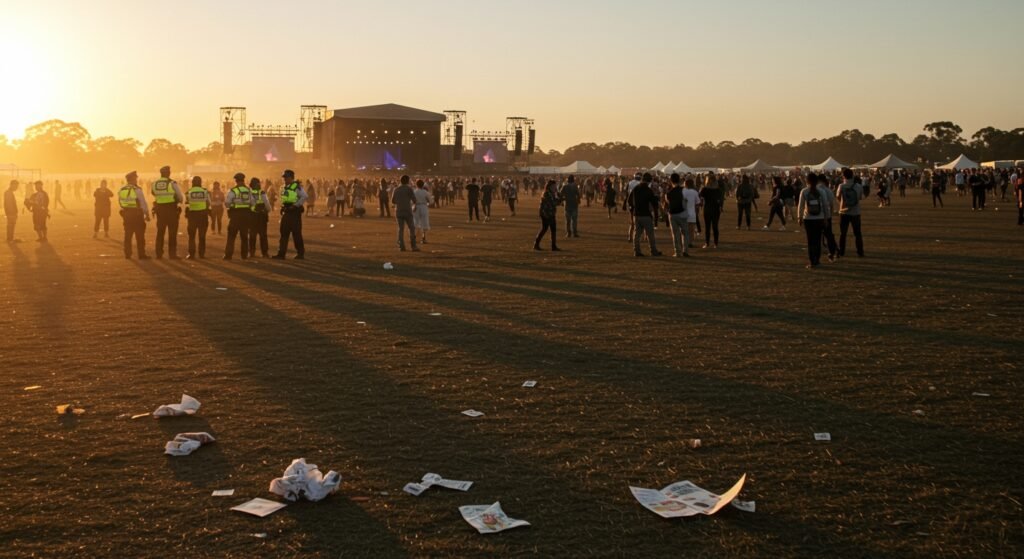
Australia’s vibrant music festival scene is facing an unprecedented crisis, with at least 25 events cancelled since 2022. Organizers across the country are citing a perfect storm of challenges, primarily driven by poor ticket sales post-pandemic and, critically, a dramatic escalation in rising costs, particularly those related to essential public safety provisions.
At the heart of the financial strain for many lies the contentious User Charges policy, which imposes significant fees for police and medical services required at events. This policy, aimed at ensuring public safety, has become a major barrier to viability for many operators.
The Impact of Escalating Costs
The financial burden imposed by these user charges can be staggering. Organizers of the popular electronic music event, Return to Rio, held in New South Wales (NSW), provided a stark example of the policy’s impact. They were forced to cancel their planned 2024 festival after facing a colossal 529 percent increase in combined police and medical costs compared to previous years.
According to Return to Rio’s organizers, this exponential rise would have necessitated a minimum of a $100 increase per ticket just to cover the additional safety expenses. Such a price hike, they concluded, would render the event commercially unviable in the current market climate, making cancellation the only feasible option.
Understanding User Charges in NSW
In NSW, the state where Return to Rio operates, event organizers are now commonly budgeting figures as high as $50,000 for police presence, a cost incurred in addition to their own privately contracted security personnel. Similarly, medical presence can cost upwards of $45,000. These figures are not fixed ceilings; charges can be significantly higher depending on the specific operational requirements and, crucially, the number of police officers deemed necessary for the event.
The scale of these costs is further highlighted by Return to Rio’s specific situation. Their organizers revealed that their police fees alone for the cancelled 2024 event were projected to be an astonishing $110,000, underscoring the magnitude of the financial hurdle.
The Origins: The Music Festivals Act 2019
These increased safety requirements and subsequent costs largely stem from the implementation of the Music Festivals Act 2019 in NSW. This legislation was a direct response to a series of tragic incidents, specifically six drug and alcohol-related deaths that occurred during the 2017-18 summer festival season. The Act aimed to enhance safety protocols and regulatory oversight for music festivals in the state.
While the intent of the Act was to improve safety, its practical implementation, particularly concerning the User Charges, has drawn heavy criticism from the industry. Organizers argue that while they support robust safety measures, the current charging model is unsustainable.
Recent Amendments and Ongoing Criticism
Recent amendments have been made to the Act, aiming to provide some relief. These changes now allow organizers a formal process to appeal costs. Furthermore, they stipulate that NSW Health agreement for health plans is now only required for a select list of designated high-risk festivals, rather than a blanket requirement for all.
Despite these revisions, many critics within the festival industry contend that the amendments have not adequately addressed the fundamental issue of the cost of police presence. They argue that requiring festivals to bear the full cost of potentially large police deployments, often mandated by authorities, places an undue burden on event viability.
Seeking Solutions and Exemptions
There are instances where organizers have managed to mitigate some of the User Charges. The original summary notes that some organizers, such as Mode, have received reductions on User Charges by meeting specific exemption criteria. A key criterion for such exemptions can be government sponsorship, suggesting that official backing can provide a financial lifeline in navigating these costs.
The industry has proactively suggested alternative models to ensure safety without crippling event economics. A frequently proposed solution is for governments to fund the required police presence at festivals. Proponents of this approach argue that such funding should be viewed not as an expense, but as an essential investment in the local economy, recognizing the significant tourism, employment, and cultural benefits that music festivals provide.
As festival cancellations continue to mount, the future of Australia’s music festival landscape remains uncertain. The debate over who should bear the cost of public safety – the event organizers, the attendees, or the government – is far from settled, leaving many beloved cultural events on the brink of collapse.
More Stories
Keanu Reeves’ Dogstar Announces ‘All In Now’ Album and Extensive 2026 World Tour
Pattaya Music Festival 2026 Ignites Beaches with Month-Long Free Concert Series
WAK Festival 2026 Invites Creatives to ‘Shoots’ Theme Call for Proposals