










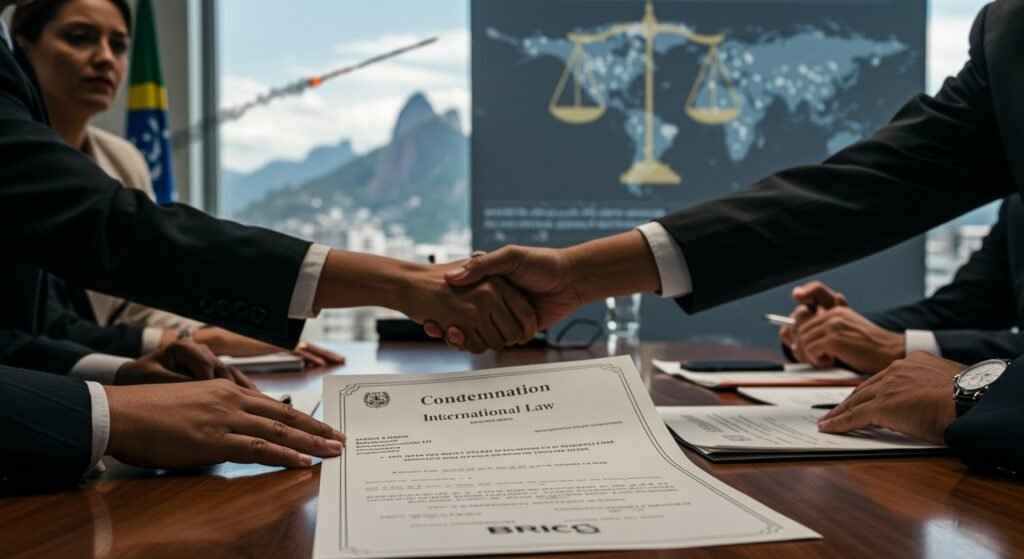
Rio de Janeiro, Brazil — The BRICS group of nations on Sunday, July 6, 2025, issued a strong condemnation of recent military strikes against Iran attributed to Israeli and United States forces. In a joint declaration released from their summit proceedings in Rio de Janeiro, Brazil, the influential bloc asserted that these actions constituted a clear violation of international law and the fundamental principles enshrined in the United Nations Charter.
The condemnation from BRICS – an acronym for Brazil, Russia, India, China, and South Africa – underscores growing international concern over escalating tensions in the Middle East. The group’s statement reflects a shared perspective among member states regarding the importance of adhering to established international norms and legal frameworks in addressing regional security challenges.
Joint Declaration Highlights Grave Concerns
The joint declaration from the BRICS summit expressed grave concern regarding the subsequent escalation of the security situation across the wider Middle East region following the strikes. This phrasing highlights the bloc’s apprehension that the military actions could trigger a dangerous cycle of retaliation and instability, potentially impacting global security and economic interests.
The statement was particularly pointed in its emphasis on the necessity of upholding nuclear safeguards and security protocols. While the specific context linking this emphasis directly to the strikes was not detailed in the summary, it implies a concern that military actions could jeopardize the integrity of existing nuclear monitoring and safety frameworks in the region.
Furthermore, the BRICS nations raised significant concerns about attacks targeting civilian infrastructure. The declaration specifically referenced peaceful nuclear facilities that are under the full safeguards of the International Atomic Energy Agency (IAEA). Attacking such facilities, even if not intended to cause a nuclear incident, poses risks and undermines the international verification regime designed to ensure the peaceful use of nuclear energy.
This concern about civilian infrastructure and IAEA-safeguarded sites aligns with broader international conventions protecting civilians and non-military installations during conflict. The BRICS position signals a collective stance against actions that could endanger civilian populations or undermine the credibility and functionality of international monitoring bodies like the IAEA.
Russia Echoes Condemnation on Sidelines
Adding further weight to the BRICS position, Russian Foreign Minister Sergey Lavrov separately condemned the Israeli-US strikes against Iran. Minister Lavrov conveyed Russia’s strong disapproval during a bilateral meeting held on the sidelines of the summit in Rio de Janeiro with his Iranian counterpart, Abbas Araghchi.
The meeting between Lavrov and Araghchi provides further insight into the diplomatic alignment between Russia and Iran on this issue, which appears to be shared, at least in principle on the condemnation of the strikes as violations of international law, by the broader BRICS group. Russia’s individual condemnation reinforces the collective statement and highlights the depth of concern from a key BRICS member state.
International Law and the UN Charter
The core of the BRICS condemnation rests on the assertion that the strikes violated international law and the UN Charter. The UN Charter is the foundational treaty of the United Nations, outlining the principles of international relations, including the prohibition on the use of force against the territorial integrity or political independence of any state, except in self-defense or when authorized by the UN Security Council.
By referencing these fundamental legal instruments, the BRICS countries are positioning themselves as proponents of a rule-based international order. Their statement implies that military actions not explicitly sanctioned by international law or the UN Charter are illegitimate and contribute to global instability.
The invocation of international law and the UN Charter in the joint declaration serves as a normative challenge to the actions taken by Israel and the United States. It frames the issue not merely as a political disagreement but as a breach of the established legal framework governing interstate conduct.
Implications for Regional Stability and Global Dynamics
The BRICS condemnation of the strikes is significant within the context of evolving global dynamics. The group represents a substantial portion of the world’s population and economic output, and its collective voice carries weight in international forums.
The stance taken in Rio de Janeiro could influence the diplomatic landscape surrounding the Iran issue and the broader Middle East conflict. It signals to the international community, including the United States and Israel, that a significant bloc of nations views the recent military actions as unacceptable and detrimental to regional stability.
While the BRICS declaration is a political statement and does not carry the force of a UN Security Council resolution, it contributes to the international discourse and pressure on the involved parties. It reinforces calls for de-escalation and adherence to diplomatic solutions and international legal norms.
Conclusion
The BRICS summit on Sunday, July 6, 2025, in Rio de Janeiro delivered a unified message regarding the recent Israeli and US military strikes on Iran. Through their joint declaration, the member states unequivocally condemned the actions as violations of international law and the UN Charter, voiced grave concerns over regional escalation, and emphasized the importance of nuclear safeguards and the protection of civilian infrastructure and IAEA-monitored facilities. The separate, but aligned, condemnation by Russian Foreign Minister Sergey Lavrov during his meeting with Iranian counterpart Abbas Araghchi further underscored the shared perspective within the bloc and among key partners on the necessity of upholding international legal frameworks in the face of rising Middle East tensions.
More Stories
Iran Military Scoffs as US Pushes Ceasefire Plan Amid Escalating Tensions
AI Smuggling Ring Busted: 3 Charged in $2.5B Tech Heist
Middle East Tensions Explode: Iran Launches Missile Barrage After US-Israel Strikes