










A catastrophic midair collision occurred over the Potomac River near Ronald Reagan National Airport in Washington, D.C., on Wednesday night, involving a commercial passenger jet operated by American Airlines and a U.S. military helicopter. The devastating incident resulted in the loss of all 67 individuals aboard the two aircraft.
President Donald Trump confirmed the somber news that there were no survivors among the 60 passengers and four crew members on the American Airlines jet, identified later as a Bombardier CRJ700, and the three soldiers aboard the military helicopter. The crash prompted an immediate and extensive search-and-rescue operation in the icy waters of the Potomac.
Immediate Aftermath and Rescue Efforts
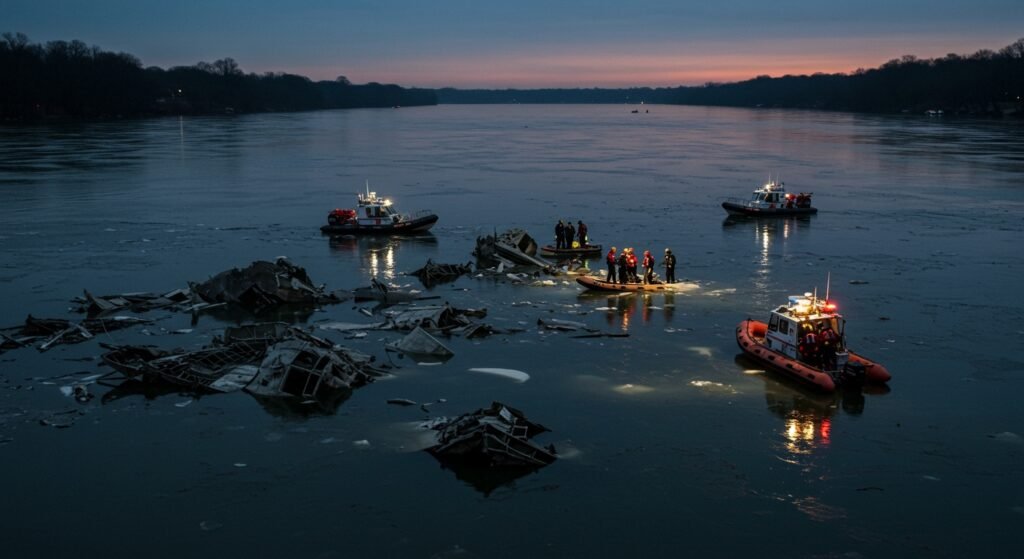
The collision, occurring in the vicinity of a major international airport and over a significant waterway, triggered a swift, albeit challenging, response. Emergency services, including multiple local and federal agencies, rapidly mobilized for a large-scale search-and-rescue effort concentrated on the Potomac River. Rescuers faced difficult conditions, navigating the cold, dark, and icy waters during the overnight hours as they scoured the crash site.
Despite the confirmation of no survivors, search efforts were critical for recovery and investigation purposes. Throughout the night, recovery teams worked tirelessly, managing to retrieve at least 28 bodies from the frigid river. The grim task underscored the severity of the tragedy and the challenging environment in which responders operated.
Wreckage Discovery and Initial Assessment
As dawn approached, the scope of the destruction became clearer with the location of significant sections of both aircraft. The fuselage of the American Airlines jet was found upside down and broken into three distinct sections. Wreckage lay partially submerged in waist-deep water, indicating the force of the impact and the subsequent crash into the river. The fragmented state of the aircraft posed significant challenges for recovery teams and investigators seeking to piece together the events.
Separate wreckage from the military helicopter was also located in the vicinity. The discovery of debris from both aircraft in relatively close proximity confirmed the midair nature of the collision and provided initial clues about the crash sequence and impact point. The location and condition of the wreckage would become crucial evidence for the subsequent investigation.
The Investigation Begins
The National Transportation Safety Board (NTSB) swiftly dispatched a team of investigators to the scene. The NTSB is the independent U.S. government agency responsible for investigating civil transportation accidents, and their expertise is vital in determining the cause of such complex incidents. A key priority for the investigators was the recovery of the aircraft’s flight recorders, commonly known as “black boxes.”
NTSB investigators successfully recovered both the cockpit voice recorder (CVR) and the flight data recorder (FDR) from the Bombardier CRJ700 aircraft. These devices are designed to withstand significant impact and submersion, containing vital information about the aircraft’s performance, control inputs, and cockpit audio in the moments leading up to the crash. Analyzing the data from these recorders will be paramount in understanding the flight paths of both aircraft, communications, and any potential mechanical issues or human factors involved in the collision.
Investigating a midair collision presents unique challenges, requiring investigators to reconstruct the events from potentially scattered debris and limited witness accounts, in addition to the recorder data. The NTSB’s work will involve mapping the wreckage field, interviewing potential witnesses, reviewing air traffic control communications, and analyzing radar data to piece together the precise sequence of events that led to the collision over one of the nation’s busiest airspaces.
Victims and Historical Context
The tragedy claimed the lives of all 67 individuals on board the two aircraft. Among the confirmed victims were two Chinese nationals, highlighting the international scope of the disaster aboard the commercial flight. The loss of life represents a profound tragedy for the families and communities of all those affected.
The scale of the casualties in this incident, if the current numbers hold following complete recovery and identification, positions it as potentially the deadliest U.S. air crash in nearly 24 years. This places the event in a grim historical context, underscoring the rare but devastating potential of such aviation accidents. The investigation is expected to be thorough and potentially lengthy, as authorities work to provide answers and prevent future tragedies.
More Stories
AI Smuggling Ring Busted: 3 Charged in $2.5B Tech Heist
Middle East Tensions Explode: Iran Launches Missile Barrage After US-Israel Strikes
Russia Shares Intel with Iran to Target US Forces Amid Escalating War