











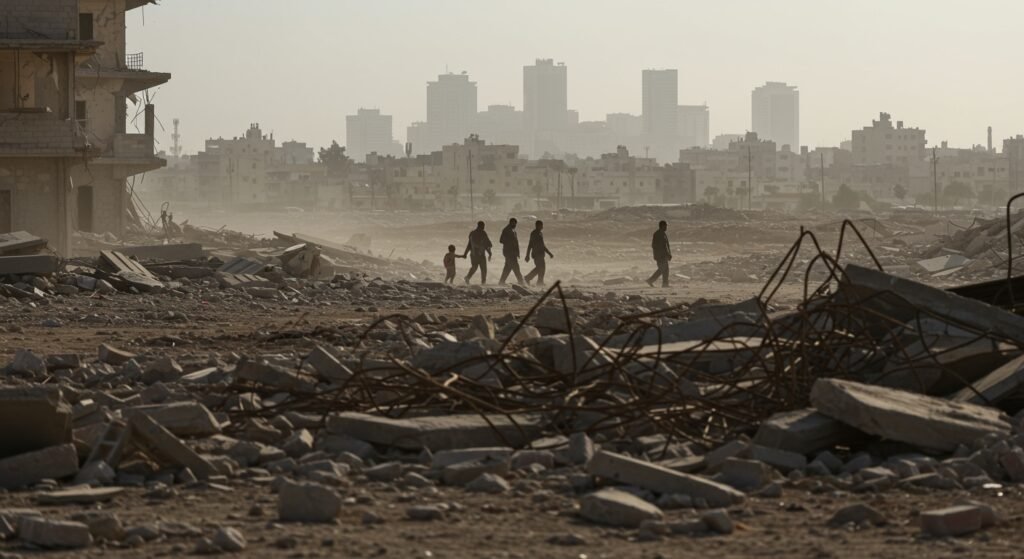
Escalation of Conflict in Gaza
Intense fighting continues to grip the Gaza Strip, with Israeli forces escalating military operations as U.S. President Donald Trump undertakes a diplomatic tour of the Gulf region. Recent Israeli strikes have resulted in significant casualties among Palestinians, targeting both residential areas and medical facilities.
On Tuesday, May 14, 2025, Israeli actions in Jabaliya city and its associated refugee camp led to the deaths of at least 70 Palestinians, according to local reports. The casualties included numerous children. The fatalities occurred when Israeli forces struck five distinct residential buildings within these densely populated areas.
This follows a devastating strike the previous day, Tuesday, May 13, 2025, when Israeli warplanes reportedly dropped nine bunker buster bombs on the European Hospital complex. That attack resulted in the deaths of at least 28 Palestinians and wounded dozens more. Israeli officials have stated that the intended target of this strike was Mohammed Sinwar, identified as a top leader within the Hamas organization. However, Hamas has publicly denied this claim.
Humanitarian Crisis and Toll on Civilians
The escalating violence has exacerbated an already dire humanitarian situation. The impact on civilian infrastructure, including hospitals, has drawn international condemnation.
The conflict has also claimed the lives of media professionals working to document the events. On Tuesday, May 13, 2025, mourners gathered in Khan Younis for the funeral of Palestinian journalist Hassan Islayeh. Mr. Islayeh was reportedly killed in a targeted strike while receiving medical treatment at Nasser Hospital. His death marks a grim milestone, making him the 215th media worker killed by Israel during the conflict.
Concerns about a potential humanitarian catastrophe continue to mount. At the United Nations, Emergency Relief Coordinator Tom Fletcher issued a stark warning to world leaders, urging them to take action to “prevent genocide” in Gaza. Fletcher specifically criticized Israel’s 10-week blockade of the territory, stating that it has resulted in over half a million Palestinians now facing starvation.
Parallel Diplomacy: President Trump’s Gulf Tour
Concurrent with the intensified military operations in Gaza, U.S. President Donald Trump is conducting a high-profile visit to the Gulf region. The President arrived in Qatar after spending two days in Saudi Arabia, engaging with regional leaders on a range of diplomatic and strategic issues.
During his time in Saudi Arabia, President Trump met with Syria’s new president, Ahmed al-Sharaa. Discussions reportedly focused on regional integration and security. President Trump urged President al-Sharaa to normalize relations with Israel and to join the Abraham Accords, the normalization agreements brokered between Israel and several Arab nations. The U.S. President also reportedly pressed Syria to deport Palestinians described by the U.S. as terrorists.
As part of the diplomatic engagement with Syria, President Trump pledged the lifting of U.S. sanctions on the country.
Strengthening Strategic Partnerships
The visit to Saudi Arabia also underscored the enduring strategic partnership between Washington and Riyadh. A significant outcome of President Trump’s discussions was the signing of a new $142 billion arms deal with Saudi Arabia. This agreement was hailed by the White House as the “largest defense cooperation agreement” in U.S. history, signaling a major commitment to bolstering Saudi Arabia’s military capabilities and cementing defense ties between the two nations.
The juxtaposition of escalating conflict in Gaza and intense diplomatic activity across the wider Middle East highlights the complex and volatile dynamics currently shaping the region.
More Stories
AI Smuggling Ring Busted: 3 Charged in $2.5B Tech Heist
Middle East Tensions Explode: Iran Launches Missile Barrage After US-Israel Strikes
Russia Shares Intel with Iran to Target US Forces Amid Escalating War