










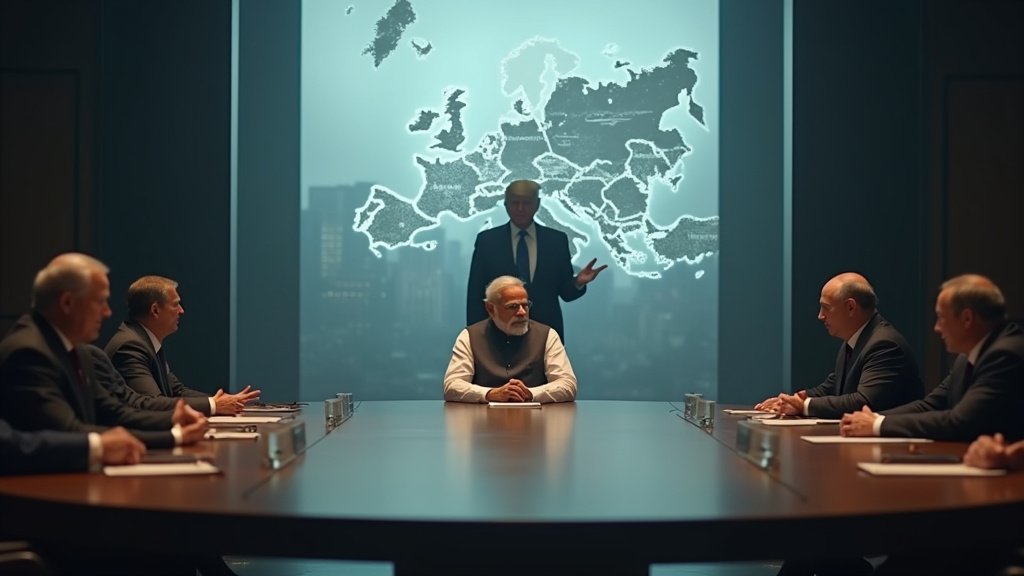
In a flurry of high-level international consultations, Prime Minister Narendra Modi has intensified India’s diplomatic outreach concerning the protracted Ukraine-Russia conflict, engaging directly with both warring nations in a bid to foster a peaceful settlement. This significant diplomatic push unfolded concurrently with a notable assertion from former U.S. President Donald Trump, who declared that all parties involved in the Ukraine war would ultimately need to cede territory as part of any resolution.
Prime Minister Modi’s recent engagements underscore a determined effort to navigate the complex geopolitical landscape surrounding the conflict. On August 11, 2025, the Indian Prime Minister held a crucial conversation with Ukrainian President Volodymyr Zelenskyy, during which he reiterated India’s steadfast commitment to peace and advocated vigorously for a peaceful settlement to the devastating conflict. This vital dialogue with Kyiv came just two days after Prime Minister Modi had similarly engaged with Russian President Vladimir Putin, signaling a balanced and comprehensive approach to mediation from New Delhi.
India’s Proactive Diplomatic Stance
The proactive stance adopted by Prime Minister Narendra Modi highlights India’s evolving role on the global stage, positioning it as a potential bridge-builder in one of the world’s most intractable conflicts. The consistent engagement with both Moscow and Kyiv demonstrates a nuanced understanding of the multifaceted nature of the Ukraine-Russia conflict, emphasizing dialogue as the only viable path to de-escalation and long-term stability. The conversation with Ukrainian President Volodymyr Zelenskyy on August 11, 2025, was specifically aimed at reinforcing the imperative of a peaceful settlement, reflecting a global desire to end the hostilities that have caused immense human suffering and widespread geopolitical instability. This diplomatic headline truly captures the essence of India’s commitment to global peace. Modi’s earlier call with Russian President Vladimir Putin, just two days prior, established the foundational groundwork for these recent exchanges, showcasing a sustained diplomatic initiative.
Trump’s Call for Territorial Concessions
Adding another layer to the intricate international discourse surrounding the conflict, Donald Trump has asserted a definitive stance on the terms for an eventual peace. The former U.S. President declared that both sides involved in the Ukraine war will need to cede territory. This statement from a prominent global political figure carries significant weight, especially given the ongoing debate about the future of territories contested since the full-scale invasion. Trump’s comments introduce a contentious element into the broader discussions about sovereignty and territorial integrity, principles that have been at the core of the conflict. Such pronouncements invariably shape the ongoing global news cycle and contribute to the often-polarized opinions on how the conflict might eventually conclude. The idea of territorial concessions, while often a component of peace negotiations, remains deeply sensitive, particularly for nations defending their internationally recognized borders.
The Road Ahead for Ukraine-Russia Peace
The convergence of India’s diplomatic offensive and Trump’s outspoken call for territorial concessions underscores the multifaceted approaches being proposed to resolve the Ukraine-Russia conflict. While Prime Minister Modi’s efforts focus on facilitating dialogue and a peaceful settlement through direct engagement with the leadership of both nations—Ukrainian President Volodymyr Zelenskyy and Russian President Vladimir Putin—Donald Trump’s statement offers a potential framework, albeit a controversial one, for the terms of such a peace. The immediate challenge remains the stark divergence in positions held by Kyiv and Moscow. Achieving a peaceful settlement will necessitate overcoming deeply entrenched national interests and security concerns, a process that promises to be arduous and protracted. The global community continues to watch these developments closely, hopeful that sustained diplomatic pressure and realistic proposals, like those hinted at in the latest news, can eventually pave the way for an end to the hostilities that have gripped the region and reverberated across the world. The calls involving Prime Minister Narendra Modi, Ukrainian President Volodymyr Zelenskyy on August 11, 2025, and Russian President Vladimir Putin two days prior, alongside the strong statements from Donald Trump, mark a pivotal period in the ongoing efforts to find a resolution to the devastating Ukraine war.
More Stories
Prosecutors Push for Life Sentence in Trump Golf Course Assassination Attempt
EU-Singapore Digital Trade Agreement Officially Enters Force, Boosting Global E-Commerce
Trump Lawsuit: $10 Billion Claim Against IRS & Treasury Over Tax Data Leak