










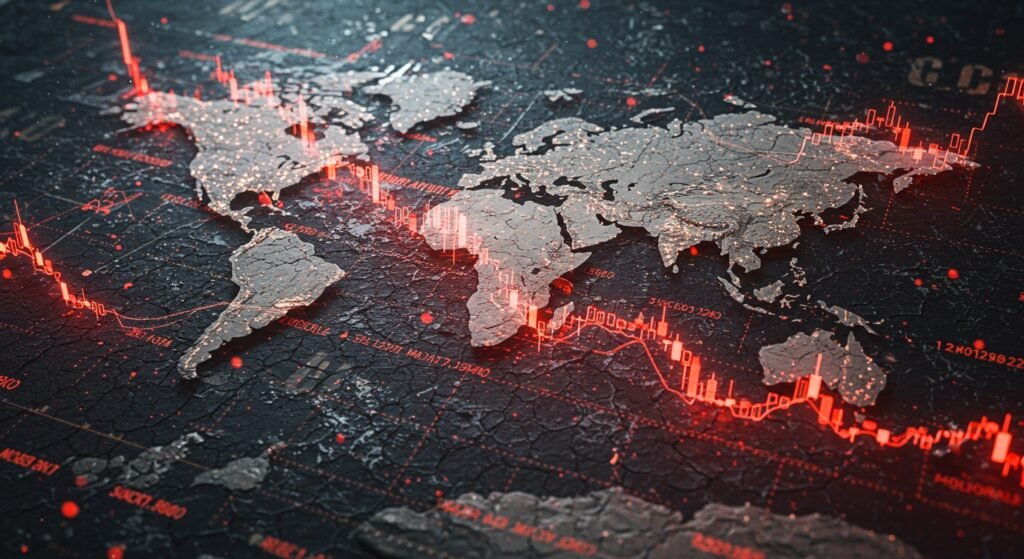
Global financial markets experienced a sharp decline on April 9, 2025, following the implementation of significant new tariffs by the United States under President Trump. The economic upheaval coincided with deepening humanitarian concerns in the Middle East and Africa, shifts in U.S. immigration policy, and escalating geopolitical tensions.
Economic Shockwaves as Tariffs Take Effect
Stock markets around the globe plummeted after President Trump’s unprecedented tariffs on imports to the United States officially took effect at midnight on April 9. These measures included a substantial 104% levy on Chinese goods, prompting swift retaliation from Beijing, which imposed 84% tariffs on U.S. imports. The immediate impact was evident across major Asian indices. Hong Kong’s Hang Seng Index registered a dramatic fall of over 13%, marking its biggest one-day drop since 1997. Japan’s Nikkei index also saw a significant decline, falling nearly 8%.
The introduction of these high tariffs signals a significant escalation in global trade tensions, raising concerns among investors and economists about potential disruptions to supply chains and prospects for international economic growth. The reciprocal nature of the tariffs imposed by both the U.S. and China suggests the potential for a protracted trade dispute with far-reaching consequences.
Humanitarian Crises and U.S. Policy Shifts
Amidst the economic turmoil, humanitarian organizations voiced urgent pleas regarding funding cuts and policy changes affecting vulnerable populations. The World Food Programme (WFP) issued a critical call to the Trump administration, urging a reversal of $1.3 billion in cuts to emergency food assistance programs designated for 14 nations facing famine. The WFP warned that these cuts could amount to a “death sentence” for millions of people dependent on this aid for survival.
Simultaneously, the Trump administration implemented significant changes to U.s. immigration policy. It revoked deportation relief for over 900,000 immigrants who had entered the U.S. through a parole process established under President Biden’s administration. Those who had received temporary protections via the CBP One app were explicitly ordered to leave the country or face arrest and deportation, a move that could have profound implications for hundreds of thousands of individuals and families.
Further administrative shifts were reported at the Internal Revenue Service (IRS). The acting head of the IRS, Melanie Krause, is resigning following the agency’s agreement to share personal tax data on undocumented immigrants with federal agents. This decision has raised concerns among privacy advocates and immigrant rights groups.
Allegations of Rights Violations and Calls for Investigation
The date also brought renewed focus on human rights concerns in the Middle East. An autopsy report provided disturbing details regarding the death of Palestinian teen Walid Khaled Abdullah Ahmed. Ahmed, who had been held without trial for six months in Israel’s Megiddo prison for allegedly throwing stones, likely starved to death. The autopsy revealed he suffered severe muscle and fat loss, scabies, and showed signs consistent with torture. This case has drawn international scrutiny regarding the conditions of detention for Palestinians in Israeli prisons.
Separately, the family of 14-year-old Palestinian American Omar Muhammad Rab is demanding a U.S. investigation into his death. Rab was reportedly shot dead by Israeli forces, allegedly 11 times, during an Israeli raid on Sunday near Turmus Aya in the occupied West Bank. The incident has sparked outrage and calls for accountability from his family and human rights advocates, highlighting the ongoing violence and tensions in the region.
Geopolitical Manoeuvring and Diplomatic Tensions
Geopolitical tensions also flared, particularly concerning strategic global assets. China accused the Trump administration of attempting to blackmail Panama. Beijing alleged that the U.S. made threats to seize the Panama Canal in an effort to diminish Chinese influence in the vital waterway. This accusation followed a visit by U.S. Defense Secretary Pete Hegseth to Panama, during which he reportedly stated that the U.S. would “take back” the Panama Canal from Chinese influence, underscoring Washington’s strategic concerns about Beijing’s growing presence in the region.
Other Global Incidents
In unrelated news, a tragic incident occurred in the Dominican Republic’s capital, Santo Domingo. Nearly 100 people were killed and about 155 injured after the roof of a nightclub collapsed, leading to a complex rescue and recovery operation.
Taken together, the events of April 9, 2025, paint a picture of a world grappling with significant economic headwinds, urgent humanitarian challenges, complex human rights situations, and assertive geopolitical strategies playing out on multiple fronts.
More Stories
AI Smuggling Ring Busted: 3 Charged in $2.5B Tech Heist
Middle East Tensions Explode: Iran Launches Missile Barrage After US-Israel Strikes
Russia Shares Intel with Iran to Target US Forces Amid Escalating War