











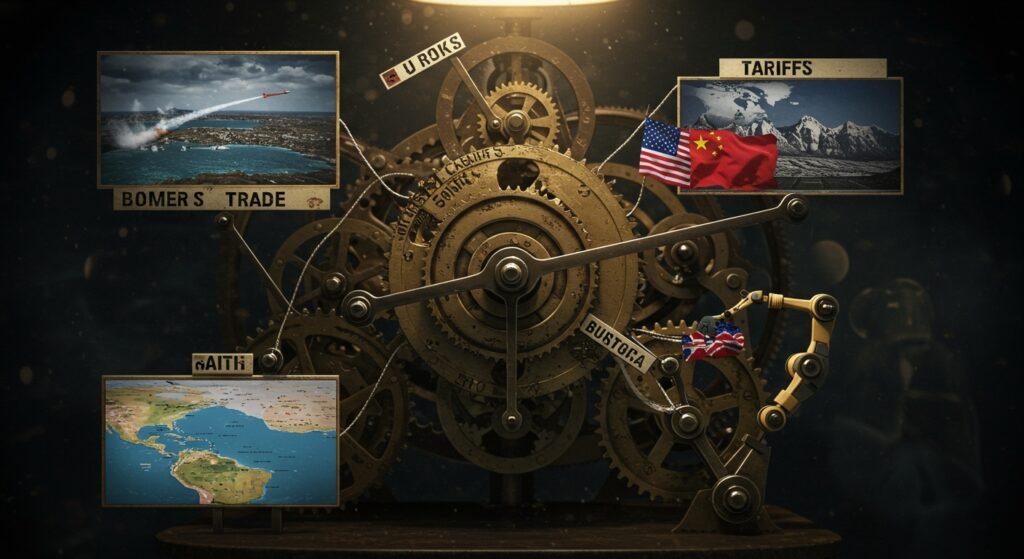
Global financial markets remain on edge following comments from the United States Federal Reserve, which signaled a continued pause in interest rate adjustments, citing persistent inflationary pressures and the potential economic fallout from escalating trade tensions. Simultaneously, geopolitical flashpoints flared across Asia on Thursday, May 8, 2025, with North Korea conducting missile tests and deadly border skirmishes intensifying between India and Pakistan. Amidst this complex backdrop, the US and China are preparing for crucial trade negotiations.
Federal Reserve Maintains Rate Stance Amid Tariff Concerns
US Federal Reserve Chair Jerome Powell delivered a clear message regarding the central bank’s monetary policy direction, firmly ruling out “preemptive rate cuts” at this time. According to analysis by The Business Times’ Lens on Daily, Powell underscored that inflation remains “still running above target,” justifying the Fed’s cautious stance. The central bank has held its policy rate steady since its “last cut in December,” primarily to allow time to “evaluate the tariff impact” on the US economy.
Powell highlighted the potential economic risks associated with trade protectionism. He stated that if “large increases in tariffs are sustained,” they are “likely to generate a rise in inflation, a slowdown in economic growth, and an increase in unemployment.” These remarks reinforce the market’s expectation that the Fed will not ease monetary policy until there is clearer evidence of inflation moving sustainably towards the target and the economic effects of trade policies become more predictable.
Escalating Tensions Across Asia
Geopolitical stability in Asia faced significant challenges on Thursday, May 8.
North Korea Conducts Missile Launch
South Korea’s military reported that North Korea fired “what appeared to be multiple short-range missiles” off its “east coast” on “May 8.” The projectiles were reportedly launched from the vicinity of Wansen. Seoul is maintaining close coordination with its key allies, stating that “South Korea is closely communicating with the US and Japan to share information” regarding the launch event, which marks the latest in a series of tests by Pyongyang.
India-Pakistan Border Conflict Intensifies
Further south, the volatile border region between India and Pakistan witnessed a dangerous escalation. Pakistan issued a stern warning, vowing to “avenge those killed by Indian air strikes.” New Delhi maintained that its strikes were conducted “in response to an attack in Kashmir.” This exchange signals an “imminent escalation in violence” between the nuclear-armed neighbors.
The human cost of the conflict is mounting rapidly, with “at least 43 deaths reported so far.” Islamabad has reported that “31 civilians killed by Indian strikes and firing along the border,” while New Delhi has countered with a report of “at least 12 dead from Pakistani shelling.” The rising casualty count on both sides underscores the severity of the current confrontation.
US-China Trade Talks Move Forward Tentatively
Amidst the global uncertainty, efforts to de-escalate the trade dispute between the United States and China are tentatively moving forward. Speaking “on Wednesday,” US President Donald Trump suggested that “China initiated upcoming senior level trade talks” between the two economic superpowers. However, President Trump also reiterated his firm stance, stating he was “not willing to cut US tariffs on Chinese goods” simply to bring Beijing back to the negotiating table.
Details regarding the meeting were announced “on Tuesday.” US “Treasury Secretary Scott Bessant” and “US Trade Representative Jameson Greer” are scheduled to meet with “China’s top economic official” “on Saturday” in “Switzerland.” This high-level engagement represents an “initial step in potential negotiations over a trade war” that has significantly impacted global supply chains and economic growth.
Singapore Aviation Sector Soars Past Pre-Pandemic Levels
In contrast to the prevailing economic caution and geopolitical tensions, Singapore’s aviation sector continues to demonstrate robust recovery and growth. The island nation’s “aviation industry,” which currently employs “about 36,000 workers,” remains highlighted as “a bright spot” in the global landscape. Notably, the sector has successfully crossed employment levels recorded “before the CO9 pandemic,” when it employed “35,000 workers.”
According to transport minister Chi Hong Tat, the sector’s recovery has been strong and consistent. Employment figures reached “90% of pre-pandemic levels in May 2023” and further climbed to “95% in August 2023.” This strong performance underscores Singapore’s position as a key aviation hub and its ability to rebuild a vital industry post-pandemic.
Thursday, May 8, 2025, presented a complex global picture, characterized by central bank caution driven by inflation and trade risks, heightening geopolitical tensions in sensitive regions, tentative steps towards resolving major trade disputes, and pockets of strong economic recovery in specific sectors like Singapore’s aviation industry.
More Stories
Iran Military Scoffs as US Pushes Ceasefire Plan Amid Escalating Tensions
AI Smuggling Ring Busted: 3 Charged in $2.5B Tech Heist
Middle East Tensions Explode: Iran Launches Missile Barrage After US-Israel Strikes