











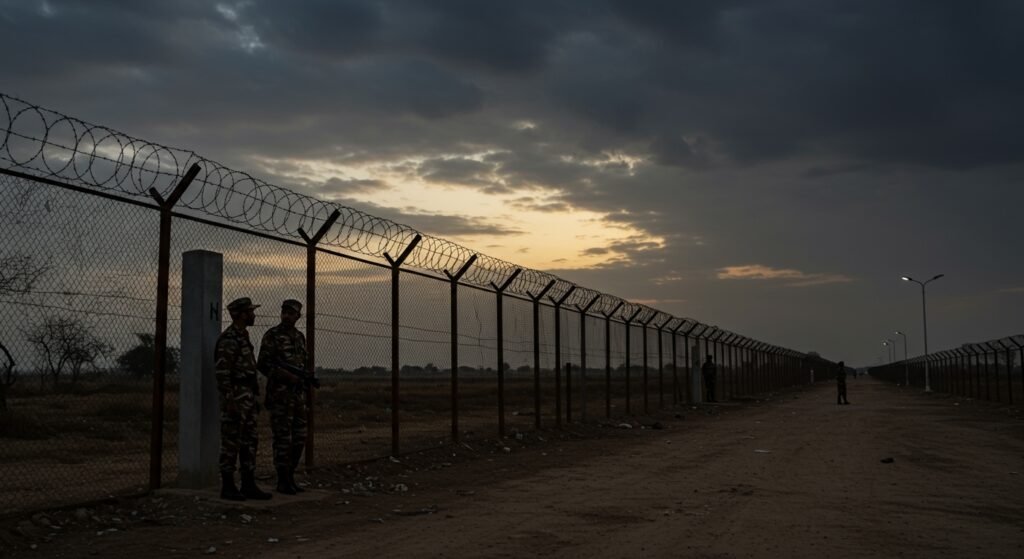
ISLAMABAD/NEW DELHI – India and Pakistan have reached an agreement to cease all military actions along their shared border and in adjoining operational areas, marking a significant de-escalation step following a period of heightened tension and recent counter-terrorism operations.
The breakthrough was announced on Saturday, May 10, 2025. According to India’s Foreign Secretary, Vikram Misri, speaking during a Ministry of External Affairs press briefing on Operation Sindoor, the Director General of Military Operations (DGMO) of Pakistan initiated contact with his Indian counterpart at 1535 hours on May 10. During this communication, both sides concurred to halt all firing and military activity across land, air, and sea domains.
Terms of the Agreement
The ceasefire understanding, crucial for potentially lowering temperatures along the volatile border, was agreed to become effective from 1700 hours IST on the same day, May 10, 2025. Both the Indian and Pakistani authorities have reportedly issued instructions to their respective forces and personnel to implement this agreement fully.
The scope of the ceasefire is comprehensive, covering all forms of military engagement and firing. This broad agreement is seen as an effort to restore a degree of stability and predictability along a frontier that has frequently witnessed exchanges of fire and other military confrontations.
Pakistan Reopens Airspace
Adding to the positive developments following the ceasefire announcement, Pakistan declared the reopening of its airspace for all air traffic. The Pakistan Airports Authority (PAA) confirmed this decision, stating that all airports within the country are now available for normal flight operations. The closure or restriction of airspace is a common measure during periods of military tension between the two nations, and its reopening is a tangible sign of reduced immediate risk.
Context: Operation Sindoor and Recent Actions
The ceasefire agreement comes amidst a complex backdrop of recent events, including India’s ongoing Operation Sindoor. Indian security officials confirmed that precision strikes conducted on May 7, 2025, as part of the launch of Operation Sindoor, resulted in the elimination of five high-profile terrorist leaders. These individuals were identified as belonging to the proscribed groups Jaish-e-Mohammed (JeM) and Lashkar-e-Taiba (LeT).
These strikes were stated to be in direct retaliation for a brutal terror attack that occurred on April 22, 2025, in Pahalgam, Jammu and Kashmir. That attack resulted in the deaths of 25 Indian citizens and one Nepali citizen, sparking widespread condemnation and calls for a strong response.
Immediate Preceding Incident
Only hours before the ceasefire agreement was reached on May 10, tensions remained high. Several Byker YIHA III kamikaze drones launched by Pakistan were detected heading towards the city of Amritsar in Punjab. These unmanned aerial vehicles were intercepted and successfully shot down by India’s Army Air Defence (AAD) units, preventing potential damage or casualties.
The incident involving the drones earlier on May 10 underscores the volatile situation that prevailed immediately before the DGMOs’ communication and agreement, highlighting the urgency and necessity of reaching a de-escalation understanding.
Path Forward Uncertain
The agreement on May 10, 2025, represents a critical moment in the relationship between the two nuclear-armed neighbors. While the immediate cessation of hostilities on the border is a welcome development, the underlying issues and tensions, particularly concerning cross-border terrorism and the disputed territory of Kashmir, remain unresolved.
The success and longevity of this ceasefire will depend on strict adherence by both sides and a commitment to maintaining the communication channels that facilitated this recent agreement. International observers are closely watching to see if this step leads to a more sustained period of peace and stability or if it merely represents a temporary pause in the long-standing cycle of tension and conflict.
More Stories
Senate Advances DHS Funding Without ICE/CBP Provisions
Iran Military Scoffs as US Pushes Ceasefire Plan Amid Escalating Tensions
AI Smuggling Ring Busted: 3 Charged in $2.5B Tech Heist