











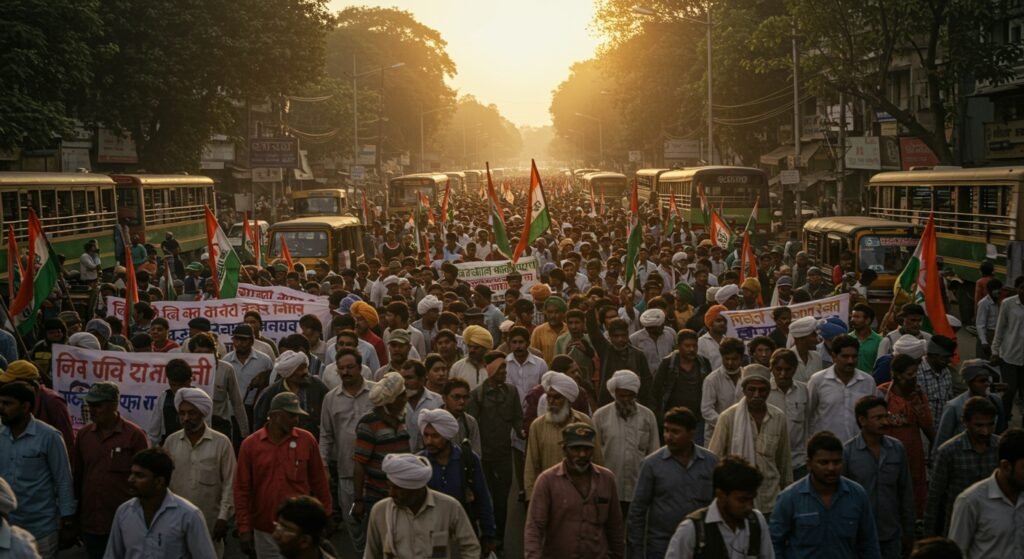
India’s Labor and Farmers Unite in Massive Nationwide Strike
NEW DELHI – Hundreds of thousands of workers and farmers across India participated in a massive nationwide strike on Wednesday, July 9, 2025, bringing significant portions of the country’s economy and public life to a standstill. The daylong action, organized by a coalition of ten Central Trade Unions (CTUs) and supported by various farmer bodies, was a vocal protest against the Indian government’s controversial new labor codes and ongoing privatization policies.
The strike represents a significant escalation of dissent from organized labor and agricultural groups, expressing deep concerns over the potential impact of the Narendra Modi administration’s economic reform agenda on workers’ rights, job security, and social welfare provisions.
Key Demands Driving the Industrial Action
The striking workers and their supporting organizations articulated a clear set of demands aimed at reversing or mitigating the effects of the government’s policies. Among the most prominent calls were the urgent implementation of a nationwide minimum wage set at ₹26,000 per month and the reinstatement of the old pension scheme, which provided guaranteed retirement benefits, in place of newer, market-linked systems.
Union leaders argue that the existing minimum wage provisions are insufficient to meet the cost of living, while the new labor codes, consolidated from earlier laws, are seen as weakening workers’ bargaining power and making it easier for employers to hire and fire. The pushback against privatization stems from fears that divesting state-owned enterprises will lead to job losses and reduced worker protections.
Broad Participation Across Key Sectors
The scale of the strike was significant, with organizers having anticipated participation from an estimated 25 crore (250 million) workers across a vast array of sectors. This included crucial areas such as banking, insurance, postal services, and vital industries like coal mining, highway construction, and general building and construction. The explicit support from farmer bodies also mobilized large numbers of farmers and agricultural laborers, broadening the strike’s base beyond traditional industrial workers.
The widespread participation underscores the depth of discontent among various segments of the Indian workforce and agricultural community regarding the current economic trajectory and government policies.
Conflicting Claims on Strike Participation
While the CTUs claimed massive support and adherence to the strike call, the Union Labour Ministry presented a different perspective. According to the Ministry, approximately 213 unions had indicated in advance that they would not be joining the strike. This figure notably included the Bharatiya Mazdoor Sangh (BMS), a prominent labor union affiliated with the Rashtriya Swayamsevak Sangh (RSS), the ideological parent of the ruling Bharatiya Janata Party (BJP).
The CTUs, however, vehemently refuted the government’s claim, accusing the administration of attempting to undermine the strike’s legitimacy and of exerting pressure on unions and individual workers to dissuade them from participating. This divergence highlights the contentious nature of industrial relations and the challenges in accurately assessing the scale of such nationwide actions.
Disruptions to Daily Life
The effects of the strike were palpable in major urban centers across the country. Reports from cities like Kolkata and Bengaluru confirmed significant disruptions to public life and essential services. Commuters in these areas faced considerable challenges as public transport services, including state-run buses, auto-rickshaws, traditional taxis, and even app-based cab services, were widely affected due to workers joining the protest or route blockades.
Shops and businesses in some areas remained closed, while banking and postal services faced interruptions. The impact varied by region and sector, but the overall effect was a noticeable slowdown in economic activity and daily routines in affected areas.
A Test for Government Reforms
The nationwide strike on July 9, 2025, serves as a potent reminder of the significant challenges facing the Indian government in implementing its ambitious economic reform agenda. The unified action by labor unions and farmer bodies signals a strong collective opposition to policies perceived as detrimental to workers’ rights and livelihoods.
As the government continues to push for reforms aimed at boosting economic growth and ease of doing business, the organized resistance from these powerful segments of society poses a substantial political and economic challenge. The strike’s success in garnering widespread participation is likely to fuel further debate and potential confrontation over the direction and pace of India’s economic transformation.
More Stories
Senate Advances DHS Funding Without ICE/CBP Provisions
Iran Military Scoffs as US Pushes Ceasefire Plan Amid Escalating Tensions
AI Smuggling Ring Busted: 3 Charged in $2.5B Tech Heist