











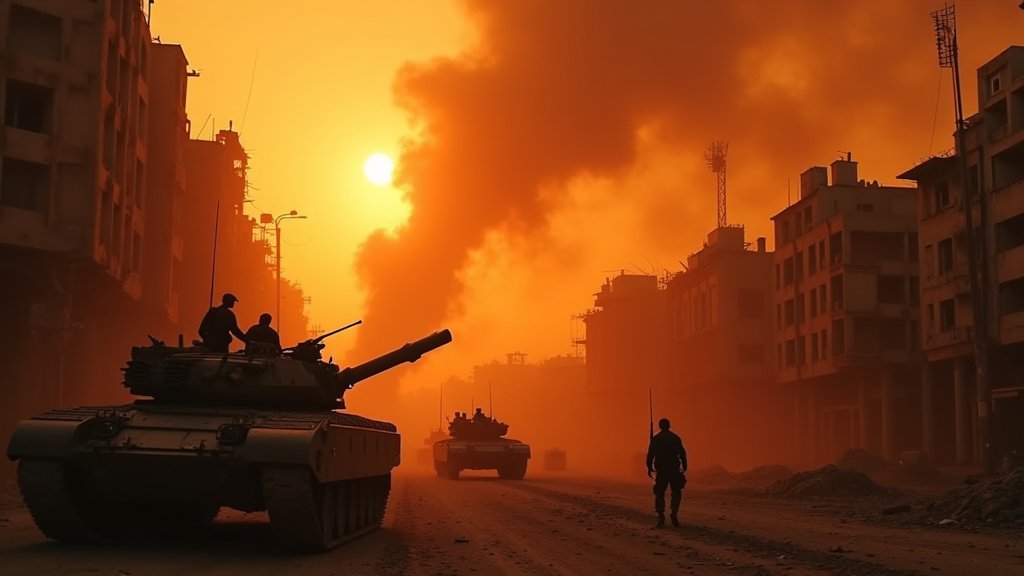
Israel has launched the main phase of its long-anticipated ground offensive into Gaza City, escalating the conflict with a declaration from Defense Minister Israel Katz stating, “Gaza is burning.” This significant military escalation, involving land, air, and sea forces, began on Tuesday.
Intensified Ground Operation in Gaza City
Israeli military officials confirmed that troops have begun moving deeper into Gaza’s largest urban center, with the operation described as a “gradual manoeuvre”. The Israel Defense Forces (IDF) has mobilized multiple divisions, estimated to involve tens of thousands of soldiers, with the stated objective of dismantling Hamas’s military infrastructure and control within the city. This offensive is expected to take several months to complete, according to Israeli military spokespersons. The IDF contends that Hamas utilizes Gaza City as a central hub for its military and governing power, accusing the group of using the city as “the largest human shield in history”.
Residents of Gaza City have described the bombardment as the most intense since the war began nearly two years ago, with reports of widespread destruction of homes and infrastructure. Thousands of Palestinians are fleeing the city, clogging coastal roads as they attempt to move south, though aid agencies report that hundreds of thousands remain trapped. Many who remain cite lack of funds or shelter as reasons for not evacuating.
International Condemnation and UN Genocide Accusations
The ground assault has drawn widespread international condemnation. The United Nations Human Rights chief, Volker Turk, called the operation “totally and utterly unacceptable” and demanded an end to the “carnage”. The European Union warned that the offensive would worsen an already “catastrophic” humanitarian situation, leading to more death, destruction, and displacement. Britain’s foreign minister condemned the assault as “utterly reckless and appalling,” stating it would only lead to more bloodshed and endanger remaining hostages. Canada’s foreign ministry also labeled the offensive “horrific”.
Adding to the global outcry, an independent United Nations commission of inquiry released a report on Tuesday accusing Israel of committing genocide in Gaza. The commission cited “explicit statements” by Israeli civilian and military authorities and the pattern of conduct of Israeli security forces as evidence of genocidal intent, detailing acts that align with the definition of genocide under international law. The report specifically points to the death toll, the “total siege” of Gaza, the blockade of humanitarian aid leading to starvation, the systematic destruction of the healthcare system, and the direct targeting of children as factors in their conclusion. Israel has vehemently rejected the report’s findings, calling it “distorted and false” and accusing the commission’s authors of bias and relying on “Hamas propaganda”.
Background and Context
The current escalation follows Hamas’s attack on Israel on October 7, 2023, which resulted in the deaths of approximately 1,200 people and the taking of 251 hostages. Israel’s subsequent military campaign in Gaza has led to a devastating humanitarian crisis, with the Gaza health ministry reporting over 64,900 Palestinians killed and more than 165,300 injured as of early September 2025. Scholars estimate that around 80% of those killed are civilians, with women and children making up a significant portion of the casualties. The ongoing conflict has resulted in mass displacement and widespread destruction across the enclave, with parts of Gaza declared to be in famine.
Diplomatic Efforts and Regional Dynamics
Despite the intensifying military operations, diplomatic efforts are ongoing. U.S. Secretary of State Marco Rubio, during a visit to the region, acknowledged that the window for a peace deal is “very short” and stressed the need for Hamas to surrender its weapons and release hostages. U.S. policy continues to support Israel while also pushing for a ceasefire and increased humanitarian aid, often in coordination with Qatari and Egyptian mediators. However, the offensive has also strained regional relations, particularly following an Israeli strike on Hamas leaders in Qatar, which has expressed significant displeasure.
The narrative surrounding the conflict remains deeply contested, with Israel determined to dismantle Hamas and achieve its war objectives, while international bodies and numerous countries call for an immediate ceasefire and accountability for actions in Gaza. The “Gaza is burning” declaration signifies a critical and highly destructive phase in the ongoing conflict.
More Stories
Iran Military Scoffs as US Pushes Ceasefire Plan Amid Escalating Tensions
AI Smuggling Ring Busted: 3 Charged in $2.5B Tech Heist
Middle East Tensions Explode: Iran Launches Missile Barrage After US-Israel Strikes