










India Takes Crucial Step Towards Human Spaceflight with Integrated Air Drop Test
The Indian Space Research Organisation (ISRO) achieved a significant milestone on August 24, 2025, successfully conducting its first Integrated Air Drop Test (IADT-01) for the ambitious Gaganyaan human spaceflight mission. This crucial test demonstrated the end-to-end functionality of the parachute-based deceleration system, a vital component for ensuring the safe return of astronauts to Earth. The successful trial marks a pivotal step in India’s quest to join an elite group of nations capable of independent human spaceflight. [4, 5, 7, 8, 9, 11, 13, 14, 15, 16, 17, 18, 19, 20, 21]
Detailing the IADT-01
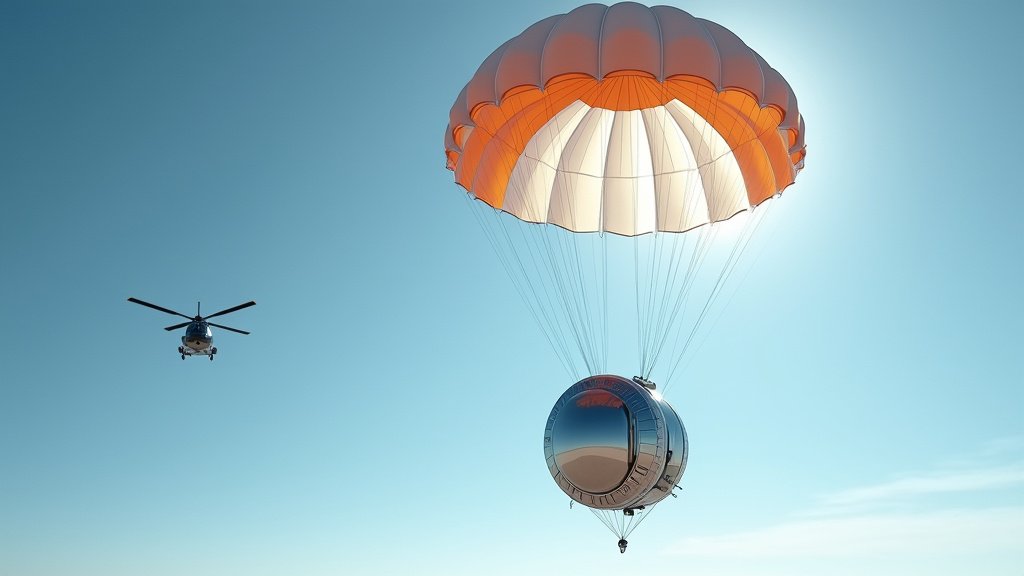
The IADT-01 was an elaborate exercise designed to simulate the final stages of a crew module’s re-entry into Earth’s atmosphere and its subsequent splashdown. For the test, a mock crew module, weighing approximately five tonnes, was airlifted by an Indian Air Force (IAF) Chinook helicopter to an altitude of around 13,000 feet. Upon release, a complex sequence of parachute deployments commenced. First, a stabilizer parachute was deployed, followed by two drogue parachutes – conical devices crucial for initial deceleration. These then extracted pilot chutes, which in turn deployed three large main parachutes, ensuring a controlled and safe descent of the module. The exercise culminated in a precise splashdown in the sea near Sriharikota. [8, 9, 12, 13, 14, 17, 18, 30]
The successful execution of IADT-01 was a collaborative effort, underscoring the inter-agency cooperation driving India’s space ambitions. The test involved close coordination between ISRO, the Indian Air Force, the Defence Research and Development Organisation (DRDO), the Indian Navy, and the Indian Coast Guard. DRDO played a significant role in providing human-centric systems, including the crucial parachutes. [4, 5, 6, 7, 8, 9, 11, 12, 13, 14, 15, 16, 19, 20, 21]
This test was particularly vital as it represented the first demonstration of the integrated parachute system in a nominal configuration, following earlier separate trials of individual components like drogue parachutes and rail-track rocket sled tests. The IADT-01 had experienced prior delays in May 2024 due to a need to address certain aspects related to the helicopter chosen for the test, issues that have since been resolved. [8, 12]
The Grand Vision: Gaganyaan Mission
Gaganyaan, meaning ‘sky vehicle’ in Sanskrit, is India’s maiden human spaceflight program, aiming to send a three-member crew into a Low Earth Orbit (LEO) at an altitude of approximately 400 km for a three-day mission, followed by a safe return to Earth with a splashdown in Indian sea waters. [1, 2, 3, 7, 14, 15, 21]
If successful, India will become the fourth nation, after the United States, Russia, and China, to independently achieve human spaceflight capability, marking a significant leap in its technological prowess and global standing. [1, 2, 6, 7, 21, 32]
Key Components and Milestones
Central to the Gaganyaan mission is the Human Rated Launch Vehicle 3 (LVM3), a specially modified version of ISRO’s reliable GSLV Mk III rocket, designed to ensure astronaut safety. It features a sophisticated Crew Escape System (CES) for emergency abort scenarios. [1, 2, 3, 13, 20]
The Orbital Module (OM), comprising the Crew Module (CM) and Service Module (SM), is the heart of the spacecraft. The Crew Module provides a habitable, Earth-like environment for the astronauts and houses the crucial deceleration systems. The Service Module offers essential support in orbit, including propulsion, power, and avionics. The CM is being manufactured by Hindustan Aeronautics Limited (HAL). [3, 17]
ISRO has systematically progressed through a series of rigorous tests:
* Space Capsule Recovery Experiment (SRE): Conducted in 2007, demonstrating re-entry and recovery technologies. [6, 10]
* Pad Abort Test (PAT): Successfully carried out in 2018, validating the Crew Escape System. [3, 6]
* Test Vehicle Abort mission-1 (TV-D1): Completed in October 2023, simulating an abort scenario during ascent and successfully recovering an unpressurised crew module from the sea. [31, 33]
* Service Module Propulsion System (SMPS) Qualification Tests: Successfully concluded in July 2025, validating the system’s performance for both nominal and emergency conditions. [32]
Road Ahead for Gaganyaan
The successful IADT-01 paves the way for the next critical phases of the Gaganyaan program. The immediate future includes the first uncrewed test flight (G1), scheduled for December 2025. This mission will carry Vyommitra, a semi-humanoid robot, to evaluate the spacecraft’s systems in a near-human flight environment. [1, 4, 7, 14, 18, 21, 23, 25]
Multiple sources indicate that India’s first crewed Gaganyaan flight is tentatively targeted for the first quarter of 2027, with some projections extending to 2028. [4, 6, 7, 14, 18, 21, 24, 30] Four Indian Air Force pilots, designated as Gaganyatris, have already completed extensive training in Russia and are undergoing advanced mission-specific training in India. One of them, Group Captain Shubhanshu Shukla, recently gained international spaceflight experience aboard the Axiom-4 mission to the International Space Station in June-July 2025, conducting experiments on behalf of ISRO. [6, 22, 24, 29, 32]
Beyond Gaganyaan, India envisions a long-term human spaceflight roadmap, including the establishment of the Bharatiya Antariksha Station (BAS), India’s own space station, by 2035, and the ambitious goal of landing an Indian astronaut on the Moon by 2040. [4, 16, 18, 20, 24]
With each successful test, ISRO reinforces its methodical approach to human spaceflight, prioritizing safety and indigenous technological development. The IADT-01 success is not just a technical achievement but a powerful declaration of India’s growing capabilities and its aspirations to become a leading spacefaring nation. [1, 16, 21]
More Stories
AI Smuggling Ring Busted: 3 Charged in $2.5B Tech Heist
Middle East Tensions Explode: Iran Launches Missile Barrage After US-Israel Strikes
Russia Shares Intel with Iran to Target US Forces Amid Escalating War