











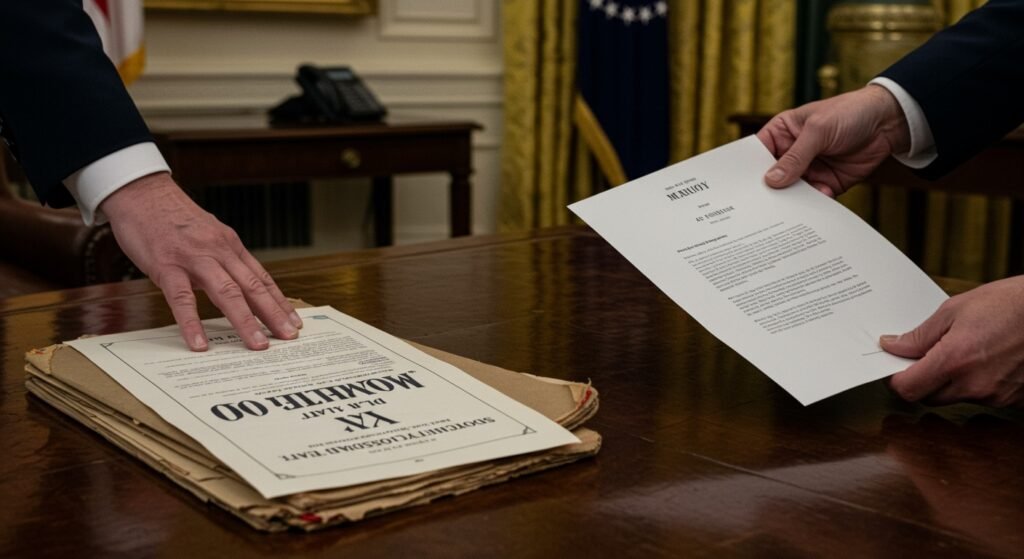
Washington D.C. – President Trump on Wednesday, January 22, 2025, escalated his administration’s efforts to dismantle diversity, equity, and inclusion (DEI) programs across the federal government and its contracted partners. The action included the significant step of revoking a 60-year-old executive order that had prohibited discrimination in hiring by federal contractors.
The original executive order, signed by then-President Lyndon B. Johnson, established foundational anti-discrimination requirements for companies receiving federal contracts. Its revocation signals a major policy shift under the Trump administration regarding the criteria and expectations for private entities doing business with the U.S. government.
Directive on Federal Worker Reporting
Accompanying the rollback of the anti-discrimination order, the Trump administration issued a directive mandating federal employees to report colleagues who do not comply with orders aimed at purging DEI initiatives. The directive explicitly warned of “adverse consequences” for those failing to report non-compliant behavior among their peers.
This move introduces a new layer of internal enforcement mechanisms within federal agencies, compelling employees to actively participate in the administration’s policy implementation regarding DEI. The threat of “adverse consequences” suggests potential disciplinary action, though the specific nature of these consequences was not immediately detailed.
Preceding Actions Against DEI Offices
The measures announced on Wednesday followed closely on actions taken the previous day, Tuesday, January 21, 2025. On that date, the Trump administration placed employees in all federal DEI offices on immediate administrative leave. This sweeping action effectively paused the operations and personnel of dedicated diversity and inclusion departments across the vast landscape of the federal bureaucracy.
The administrative leave order indicated a direct and rapid effort to halt current diversity-related work and potentially restructure or eliminate these functions entirely. The placement of staff on leave pending review or further instruction is a common procedural step when an administration intends to significantly alter or disband specific governmental units or initiatives.
Justice Department Directives
Parallel actions have also been ordered within the Justice Department (DOJ). The DOJ has reportedly been instructed to implement a freeze on all new cases within its crucial Civil Rights Division. This division is responsible for enforcing federal statutes prohibiting discrimination in areas such as voting, education, employment, housing, lending, and policing.
A freeze on new cases in the Civil Rights Division could significantly impede the federal government’s capacity to investigate and prosecute instances of discrimination and civil rights violations nationwide. Critics argue such a freeze could leave individuals and groups without recourse for rights infringements, while proponents might argue it allows for a re-evaluation of the division’s priorities and methods.
Adding to the Justice Department’s new directives, federal officials within the DOJ have also been ordered to prosecute state and local officials who resist the administration’s plans for mass deportations. This instruction signals a potential legal confrontation between the federal government and jurisdictions that have adopted “sanctuary” policies or otherwise expressed reluctance to cooperate fully with federal immigration enforcement mandates, specifically those related to large-scale deportation efforts.
Context and Implications
The series of directives issued over the two days – the revocation of the 60-year contracting anti-discrimination ban, the order for federal employees to report colleagues on DEI non-compliance, the administrative leave for DEI office staff, the freeze on new Civil Rights Division cases, and the order to prosecute officials resisting deportation plans – collectively represent a rapid and comprehensive effort by the Trump administration to reshape federal policy on diversity, civil rights, and immigration enforcement.
The revocation of the anti-discrimination order for federal contractors overturns a longstanding policy designed to use the government’s purchasing power to promote equitable employment practices in the private sector. The order originated in the Civil Rights era under President Johnson, reflecting the federal government’s commitment at the time to combatting discrimination in areas beyond direct federal employment.
The directive for federal employees to report colleagues introduces a climate of internal surveillance within the bureaucracy, potentially impacting employee morale and trust. The focus on “DEI non-compliance” suggests a broad mandate to ensure all federal staff adhere to the administration’s stance against diversity initiatives.
The actions at the Justice Department indicate a potential shift in the federal government’s approach to civil rights enforcement and its relationship with state and local governments on immigration matters. Freezing new cases in the Civil Rights Division could have wide-ranging implications for ongoing and future efforts to address discrimination across various sectors.
These coordinated actions underscore the Trump administration’s stated priority of rolling back policies and programs associated with diversity, equity, and inclusion, coupled with an intensified focus on immigration enforcement, using both executive authority and directives to federal agencies.
More Stories
Iran Military Scoffs as US Pushes Ceasefire Plan Amid Escalating Tensions
AI Smuggling Ring Busted: 3 Charged in $2.5B Tech Heist
Middle East Tensions Explode: Iran Launches Missile Barrage After US-Israel Strikes