











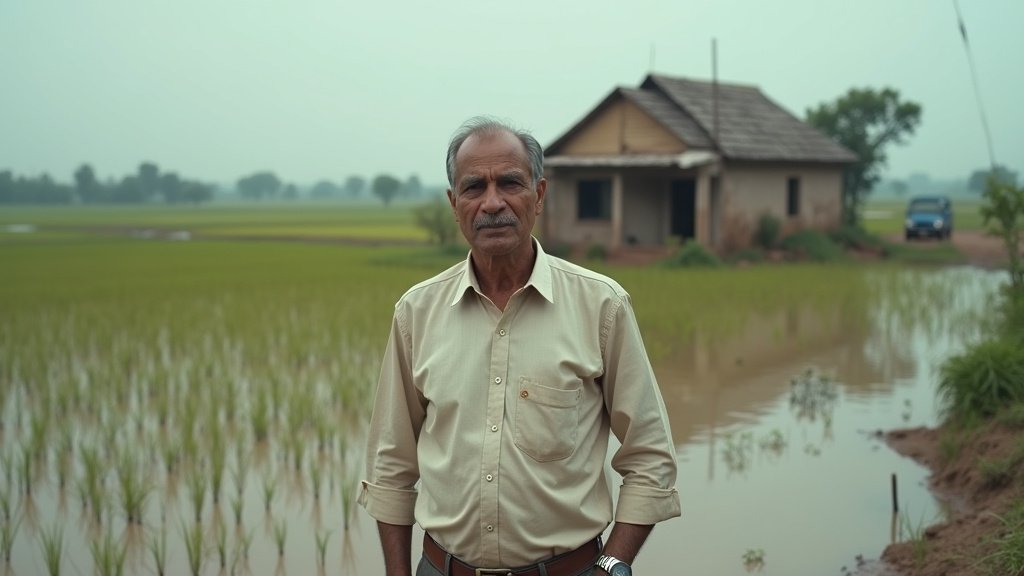
New Delhi – Union Agriculture Minister Shivraj Singh Chouhan undertook an extensive tour of the flood-affected regions in Punjab on Thursday, September 4th, 2025, assessing the scale of devastation wrought by recent torrential rains. His visit underscores the gravity of the situation, which has seen the state declare itself a disaster-affected area following its worst deluge since 1988.
Union Minister’s Ground Assessment and Assurance
Minister Chouhan began his day at Amritsar Airport, where he was briefed by Punjab Governor Gulab Chand Kataria on the extensive damage across five key districts: Amritsar, Pathankot, Gurdaspur, Tarn Taran, and Ferozepur. The Governor’s detailed report highlighted severe impacts on life, property, crops, and infrastructure. Chouhan, accompanied by Union Minister of State Ravneet Singh Bittu and Punjab BJP President Sunil Jakhar, then proceeded to visit severely impacted villages, including Ghonewal in Amritsar district and Dharamkot Randhawa in Gurdaspur district.
During his interactions with affected farmers, Chouhan expressed deep concern over the widespread destruction, particularly the submergence of crops across more than 1.75 lakh hectares of land. He was visibly moved by the plight of the farming community, assuring them of the Central Government’s unwavering support. “The central government, our Prime Minister, is standing with the people in this hour of crisis,” Chouhan stated, promising all possible assistance for relief and rehabilitation efforts. He committed to providing a detailed report to the Centre to ensure timely and comprehensive aid.
Punjab Grapples with Its Worst Floods in Decades
The state of Punjab is currently battling a catastrophic flood situation, characterized as the most severe in over three decades. All 23 districts have been impacted, with the deluge claiming 37 lives and affecting over 3.55 lakh people. Rivers like the Sutlej, Beas, and Ravi, along with seasonal rivulets, have breached their banks due to incessant rainfall in their catchment areas in Himachal Pradesh and Jammu & Kashmir, exacerbating the crisis. The damage extends to agricultural lands, with paddy crops, crucial for the state’s economy, being the worst affected. Official estimates indicate that nearly 1,75,216 hectares of standing crops have been submerged. Consequently, schools and colleges across Punjab were ordered to remain closed until September 7th to ensure the safety of students and staff.
Supreme Court Raises Concerns Over Environmental Factors
The widespread devastation has also drawn the attention of the judiciary. The Supreme Court, taking suo motu cognisance of the floods and the related environmental impact, issued notices to the Central Government and the states of Punjab, Himachal Pradesh, Uttarakhand, and Jammu & Kashmir. A bench headed by Chief Justice BR Gavai flagged the issue of unchecked illegal tree felling, noting that it might be a contributing factor to the current crisis. The court stressed the critical need to balance developmental activities with environmental protection. Media reports showing large numbers of timber logs flowing in rivers in Himachal Pradesh were cited as prima facie evidence of potentially illegal logging. The apex court has sought a response from the government within three weeks, underscoring the seriousness of environmental exploitation leading to such natural calamities.
Political Undertakings Amidst the Calamity
In a separate development linked to the ongoing crisis, former Delhi Chief Minister Arvind Kejriwal and former Deputy Chief Minister Manish Sisodia sought exemption from personal appearance before the Delhi Rouse Avenue Court. Their plea, related to an Enforcement Directorate (ED) case concerning the Delhi liquor excise policy, cited their presence in Punjab to coordinate relief measures and assist flood victims. The court granted their exemption applications, scheduling the next hearing for October. This political engagement highlights the multifaceted response to the national news unfolding.
Ongoing Relief and Future Outlook
Relief and rehabilitation operations are in full swing across Punjab, with the state government, Army, NDRF, and various NGOs working tirelessly to provide aid to those affected. The Border Security Force (BSF) has also been actively involved in rescue, medical aid, and strengthening breached embankments. As the nation focuses on managing this severe natural disaster, the Union Minister’s visit, the Supreme Court’s intervention, and the political involvement all highlight the comprehensive approach being taken to address the flood crisis and its underlying causes. The coordinated efforts aim to mitigate the immediate suffering and assess long-term strategies for recovery and resilience.
More Stories
AI Smuggling Ring Busted: 3 Charged in $2.5B Tech Heist
Middle East Tensions Explode: Iran Launches Missile Barrage After US-Israel Strikes
Russia Shares Intel with Iran to Target US Forces Amid Escalating War