











Trump Escalates Border Response with Troop Surge, Emergency Declaration, and Birthright Citizenship Challenge
President Trump has enacted a series of significant measures targeting both the operational posture at the U.S.-Mexico border and fundamental aspects of U.S. immigration law. The actions include the deployment of additional military personnel, the declaration of a national emergency, and a highly controversial challenge to the concept of birthright citizenship. These moves signal a multifaceted and intensified approach by the administration to curb illegal immigration and assert executive authority on border control.
Deployment of Additional Troops
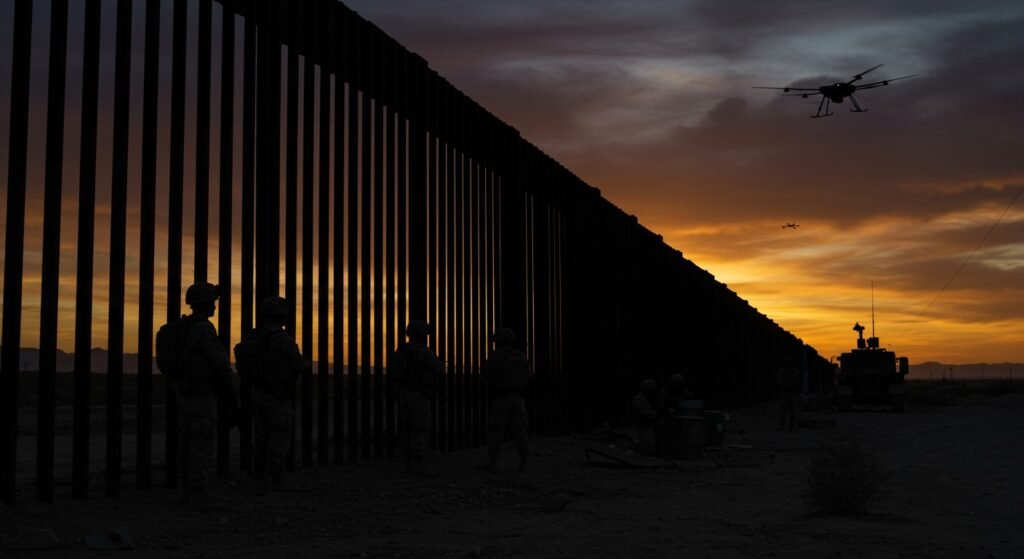
Central to the immediate operational changes is the mobilization of an additional 1,500 active duty troops. This contingent comprises personnel from both the U.S. Army and the Marine Corps. The directive for deployment was issued with notable urgency, requiring the troops to be in position within a compressed timeframe of just 24 hours. This rapid deployment underscores the administration’s perceived need for a swift and substantial increase in military presence along the southern border.
The mission assigned to these troops is carefully defined, focusing on support roles rather than direct law enforcement engagement. Their primary tasks include aiding in detection and monitoring activities along the border, providing surveillance capabilities to border patrol agents. Furthermore, the deployed personnel are directed to assist in the construction of physical barriers, contributing to the administration’s ongoing efforts to expand walls and fencing along the frontier.
A military official speaking on the deployment explicitly clarified the scope of the troops’ duties, stating unequivocally that these personnel will not participate in law enforcement functions. This distinction is critical, aiming to maintain the separation between military and civilian authorities, particularly in domestic operations. The deployment is intended to free up U.S. Customs and Border Protection personnel to focus on enforcement duties, while the military provides logistical, surveillance, and engineering support.
In addition to the ground forces and construction support, military assets are also being leveraged for air support. Military aircraft have been designated to support deport flights. This indicates an integration of military transportation capabilities into the process of removing individuals who have been ordered deported, streamlining or increasing the capacity for such operations.
National Emergency Declaration Precedes Troop Move
The deployment of these 1,500 active duty troops follows closely on the heels of President Trump’s declaration of a national emergency regarding the situation at the U.S.-Mexico border. While the specific powers or funds unlocked by this particular declaration were not detailed in the provided information, national emergency declarations are executive actions typically used to justify extraordinary measures, often related to resource allocation or specific policy objectives, under the pretense of an urgent crisis. In this context, the emergency declaration serves as the backdrop and potential justification for the expanded military presence and other associated actions at the border.
Challenge to Birthright Citizenship
Parallel to the operational surge at the border, President Trump has also undertaken a significant policy initiative impacting U.S. citizenship law. He has unilaterally declared his intention or action to end birthright citizenship. This legal concept, widely understood to be guaranteed by the 14th Amendment of the U.S. Constitution for individuals born within the country’s jurisdiction, has been a subject of intense legal and political debate. The President’s declaration represents a direct challenge to this long-standing interpretation.
This declaration has immediately triggered widespread legal opposition. A substantial coalition of governing bodies, including 22 states and two cities, have responded by filing lawsuits aimed at blocking the implementation of President Trump’s action. These lawsuits argue against the legality of ending birthright citizenship via presidential declaration, asserting that such a fundamental change would require a constitutional amendment or congressional action, rather than executive order or declaration.
The human impact of such a policy change, if it were to be successfully implemented, is projected to be considerable. Estimates provided suggest that an end to birthright citizenship could potentially affect some 150,000 children annually. This figure highlights the scale of the population that could be denied automatic U.S. citizenship based on their place of birth if the policy were to take effect, underscoring the profound personal and societal implications of the President’s declaration and the ensuing legal battles.
Implications and Legal Challenges
The multi-pronged approach taken by the Trump administration – combining a military surge justified by a national emergency with a direct legal challenge to birthright citizenship – signals an aggressive stance on immigration and border control. Both the emergency declaration and the attempt to end birthright citizenship are expected to face significant legal challenges in the courts, as evidenced by the immediate lawsuits filed by states and cities.
The deployment of troops, while carefully delineated as non-law enforcement, raises questions about the increasing militarization of border management. The separation of duties, with military personnel focused on support tasks like detection, monitoring, and construction, while leaving law enforcement to civilian agencies, is a key detail officials have stressed. The use of military aircraft for deport flights further illustrates the extent to which the military is being integrated into various facets of border operations.
The challenge to birthright citizenship, however, represents a potentially more fundamental legal and constitutional confrontation. The swift legal response from 22 states and two cities indicates the depth of opposition and sets the stage for what is likely to be a protracted legal fight that could ultimately reach the Supreme Court. The estimate of 150,000 children annually underscores the potential human cost of the policy should the legal challenges prove unsuccessful.
In conclusion, President Trump’s recent directives mark a significant escalation in the administration’s efforts to address immigration and border security, employing both operational deployments and controversial legal challenges. The coming months are likely to see these actions tested both operationally at the border and extensively in the U.S. court system.
More Stories
Iran Military Scoffs as US Pushes Ceasefire Plan Amid Escalating Tensions
AI Smuggling Ring Busted: 3 Charged in $2.5B Tech Heist
Middle East Tensions Explode: Iran Launches Missile Barrage After US-Israel Strikes